
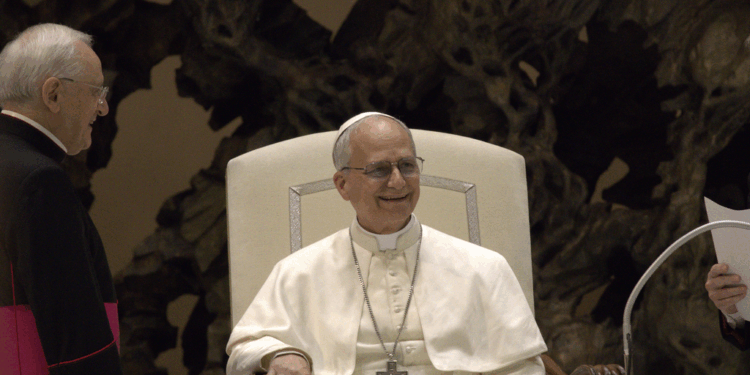
Pope Leo XIV ignited a firestorm this weekend after signaling that the Vatican views a Palestinian state as “the only solution” to the ongoing Middle East conflict — a dramatic shift that clashes directly with President Donald Trump’s strategic peace plan.
The comments, delivered aboard the papal plane while traveling from Turkey to Lebanon, leave many conservatives asking why the Vatican is pushing a policy that could undermine Israel’s security and reward extremist groups.
Vatican Doubles Down on Two-State Demand
Pope Leo reiterated the Holy See’s longstanding support for a Palestinian state, a position first formalized in 2015. He also repeated calls for a ceasefire in Gaza, echoing past Vatican statements describing the region as facing a “grave humanitarian crisis.”
Under Pope Francis — before his passing — even the popemobile was repurposed into a medical vehicle for children in Gaza.
But what stunned many observers was Pope Leo’s renewed push for a two-state solution while Israel remains under constant threat from Hamas, and while President Trump is working to stabilize Gaza under a strict, security-first framework.
Pope Praises Turkey, Signals Support for Erdoğan’s Position
While thanking Turkish officials for hosting him during the 1,700th anniversary celebration of the Council of Nicaea, the pope emphasized his mission to “promote peace throughout the region.”
When asked about discussions with Turkish President Recep Tayyip Erdoğan, the pope revealed that both men “spoke about Gaza and Ukraine,” and that Erdoğan strongly supports the creation of a Palestinian state.
“Turkey has an important role it could play in all of this,” Pope Leo claimed — a message that raised eyebrows given Turkey’s complex relationship with both the West and Israel.
Direct Clash With Trump’s Security-First Approach
The pope’s remarks land at a critical moment. Israel and Hamas are in a fragile ceasefire plagued by violations, while President Trump’s administration is implementing the first phase of a 20-point peace plan designed to stabilize Gaza and cut off Hamas’ military power.
Earlier this month, the U.N. Security Council approved a U.S.-drafted measure supporting:
- Trump’s Gaza stabilization strategy
- an International Stabilization Force
- security guarantees for Israel
- conditional steps toward Palestinian self-determination
The Trump administration has repeatedly warned that no Palestinian state can exist while Hamas or other terror groups maintain influence.
Netanyahu and Rubio Reinforce Trump’s Position
Israeli Prime Minister Benjamin Netanyahu has drawn a hard line, stating:
“I will never surrender Israel’s right to maintain complete security control. It is precisely because I’ve stood firm that a Palestinian state — one that could have threatened Israel’s very survival — has not been created.”
Secretary of State Marco Rubio echoed that sentiment on Meet the Press, noting that:
- A Palestinian state is not a “yes-or-no” question.
- It requires Hamas’ complete removal from power.
- Israel must first face zero threats from Gaza.
Rubio emphasized that Trump’s team is creating conditions for long-term peace — not rushing into a political arrangement that could embolden extremists.
Lebanon Visit Sends Mixed Messages
Archbishop George of the Melkite Greek Catholic Church said the pope’s visit “shows that Lebanon is not forgotten,” yet the timing is sensitive.
Trump’s plan is entering its second phase, focused on:
- Hamas disarmament
- establishing an armed stabilization force
- creating new international governance structures for Gaza
These steps, conservatives argue, must come before any talk of statehood.
A Growing Divide Between Global Elites and Trump’s Strategy
The pope’s endorsement of a Palestinian state now places him at odds with:
- President Donald Trump
- Israel’s leadership
- U.S. national-security officials
- millions of Americans who prioritize Israeli security
Conservatives warn that pushing premature statehood risks empowering Hamas, undermining Israel’s safety, and unraveling Trump’s peace architecture just as it begins to take hold.
Pope Leo is expected to remain in Lebanon for several days before returning to Italy on Tuesday.