
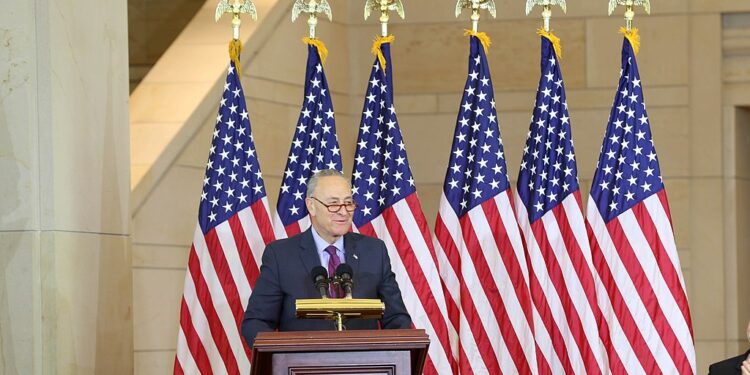
Senate Democrats are launching a high-profile challenge to President Donald Trump following a major U.S. military operation in Venezuela that resulted in the arrest of longtime strongman Nicolás Maduro.
The Senate is preparing to hold a vote next week on a bipartisan war powers measure that would limit President Trump’s ability to continue U.S. military operations in Venezuela. The planned vote follows increased international scrutiny after American forces conducted what administration officials characterized as a focused mission related to national security and anti–drug trafficking efforts.
Because the measure is classified as “privileged” under Senate rules, Majority Leader John Thune cannot prevent it from reaching the floor, guaranteeing a public and potentially divisive debate.
Democrats Push Back on Trump’s Authority
The resolution is being led by Senate Minority Leader Chuck Schumer, alongside Senators Tim Kaine, Rand Paul, and Adam Schiff. Only a simple majority of 51 votes is needed for passage.
Kaine framed the proposal as a constitutional safeguard, arguing that Congress must reclaim its authority over matters of war and peace. He warned that allowing military operations without explicit congressional approval risks eroding long-standing checks and balances.
Schiff echoed that position, asserting that unilateral military decisions could destabilize the region. He argued that Congress must reflect the will of Americans who remain cautious about expanded foreign military involvement.
Key Republican Votes Could Decide Outcome
Democrats are expected to vote unanimously in favor of the resolution, and Paul — a libertarian-leaning Republican — has indicated support. That means the measure would still require at least three additional Republican votes to pass.
Attention has turned to Sens. Susan Collins, Lisa Murkowski, and Josh Hawley, all of whom have previously expressed reservations about prolonged U.S. military engagements overseas.
GOP Leadership Backs Trump’s Move
Sen. Thune publicly praised the arrest of Maduro, calling it a critical step toward accountability for alleged drug-related crimes tied to U.S. indictments. He also commended American service members involved in the operation, describing their actions as both courageous and necessary.
Supporters of the administration argue that the operation strengthened U.S. security and sent a clear message to hostile regimes operating near America’s borders.
Similar Efforts Already Failed in the House
Democratic attempts to rein in Trump’s authority have already fallen short in the House of Representatives. A proposal sponsored by Rep. Jim McGovern was narrowly defeated last month.
Another resolution, led by Rep. Gregory Meeks, also failed. That measure sought to restrict military action against suspected drug-smuggling operations tied to terrorist organizations in the Western Hemisphere.
Trump Expected to Veto Any Restriction
Even if the Senate approves the war powers resolution, it would still need House approval and the president’s signature to become law. President Trump is widely expected to veto any legislation that limits his authority as commander in chief, and Congress currently lacks the votes needed to override a veto.
For now, the looming Senate vote appears less about changing policy and more about drawing a sharp political contrast — one that underscores deep divisions over executive power, national security, and America’s role in the Western Hemisphere.