
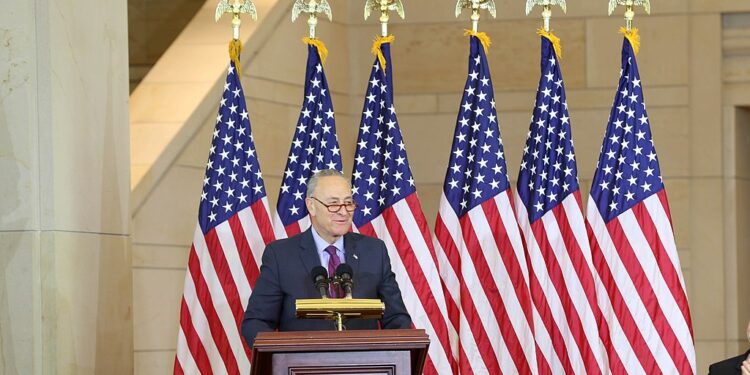
Senate Minority Leader Chuck Schumer said Monday that a renewed Republican effort to tighten federal election rules would not advance in the Senate, calling the proposal “dead on arrival.”
The legislation, known as the Safeguard American Voter Eligibility Act, or SAVE Act, is backed by Republicans who say it is designed to ensure that only U.S. citizens vote in federal elections. Democrats, however, argue the measure could create barriers for eligible voters.
In a statement, Schumer warned that attaching the SAVE Act to must-pass legislation would halt progress on government funding and could lead to another budget standoff. He described the proposal as a political obstacle that would derail broader negotiations.
Republicans strongly disagreed with that assessment, saying the bill addresses basic election security concerns shared by many voters. The legislation was reintroduced last week by Rep. Chip Roy and Sen. Mike Lee.
Under the proposal, voters would be required to present photo identification in federal elections. New registrants would also need to provide proof of U.S. citizenship, and states would be directed to remove non-citizens from voter rolls.
Supporters say these steps are necessary to restore public confidence in elections. Critics argue that existing safeguards already prevent illegal voting and warn the changes could burden some lawful voters.
The original SAVE Act passed the House of Representatives last April but was never brought up for a vote in the Senate.
Now, Rep. Brandon Gill, backed by the Republican Study Committee, is leading a renewed push in the House to force Senate action. The group is urging leadership to bring the bill forward without further delay.
Republican Study Committee Chairman August Pfluger said the House acted months ago and accused the Senate of stalling on what he called a commonsense election integrity measure.
Senate Majority Leader John Thune has said he supports the SAVE Act, including an updated version that explicitly includes a voter ID requirement. He noted, however, that the bill has not yet moved through the committee process.
The renewed debate comes as Congress works to finalize most fiscal year 2026 funding. While many agencies have long-term funding in place, the Department of Homeland Security remains under a short-term extension.
Rep. Anna Paulina Luna has urged House leaders to attach the SAVE Act to the funding package, arguing it is the only realistic path for passage. She warned that approving spending measures without the election proposal would face resistance from conservatives.
As negotiations continue, the SAVE Act has once again become a central issue in the broader debate over election laws, government funding, and congressional priorities.