
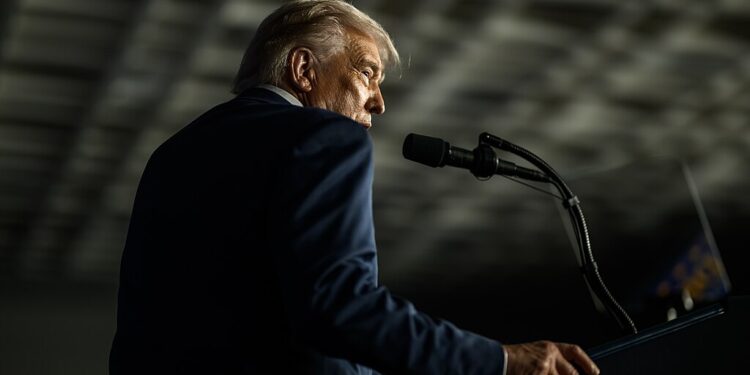
President Donald Trump once again made headlines Friday after declining to take a question from CNN during a press conference following the Supreme Court’s 6–3 decision limiting his tariff authority.
The moment quickly spread across social media, with supporters praising the president for pushing back against what he has long described as biased coverage from certain media outlets.
Trump Refuses CNN Question During Press Conference
The exchange unfolded when CNN White House correspondent Kaitlan Collins attempted to ask whether Trump regretted appointing Justices Amy Coney Barrett and Neil Gorsuch to the Supreme Court.
Before she could finish, Trump cut in.
“I don’t talk to CNN. It’s fake news,” the president said.
The room fell quiet as Trump moved on to other reporters.
For longtime observers of the president, the moment was familiar. Trump has frequently accused CNN and other major networks of unfair or misleading coverage — particularly on issues involving trade, immigration, and national security.
WATCH:
🚨 LMFAO! PRESIDENT TRUMP: "No, no. Please. I don't talk to CNN! It's FAKE NEWS. 🫵"
— Eric Daugherty (@EricLDaugh) February 20, 2026
😂😂 pic.twitter.com/lFexpMPGU1
Supreme Court Blocks Emergency Tariff Authority
The confrontation came just hours after the Supreme Court ruled that Trump could not rely on the International Emergency Economic Powers Act (IEEPA) to impose sweeping emergency-style tariffs.
In the 6–3 decision, Justices Amy Coney Barrett and Neil Gorsuch joined the Court’s three liberal justices along with Chief Justice John Roberts in limiting the administration’s use of emergency economic powers.
The ruling represents a significant development in Trump’s broader trade agenda — a signature policy area that has focused heavily on protecting American manufacturing and confronting foreign trade abuses.
Trump described the ruling as “deeply disappointing” but emphasized that his administration will explore alternative legal pathways to maintain leverage over foreign competitors.
“We need strong trade enforcement,” Trump has consistently argued, saying American workers must not be disadvantaged by unfair global practices.
A Long History of Tension Between Trump and Major Media
Friday’s exchange is part of a larger pattern that has defined Trump’s relationship with the press since his first term in office.
In late 2025, Trump publicly challenged ABC News during an Oval Office exchange, criticizing what he described as biased questioning. Weeks earlier, he declined to take questions from the same network at a White House event, citing what he called unfair coverage of Vice President JD Vance.
The friction goes back even further.
In 2018, following a contentious post-midterm press conference, the White House temporarily suspended CNN correspondent Jim Acosta’s press credentials after a tense back-and-forth that drew national attention.
And in January 2017, at Trump Tower, then-President-elect Trump famously refused to take a question from CNN, declaring the network “fake news” — a moment that set the tone for years of clashes.
Supporters Say Trump Is Holding the Media Accountable
For many Americans — particularly voters over 50 who have watched decades of shifting media landscapes — Trump’s direct confrontations with major networks reflect broader concerns about media trustworthiness and political bias.
While critics argue that presidents should answer all questions, supporters contend that Trump is under no obligation to engage outlets he believes consistently misrepresent his policies.
With the Supreme Court decision reshaping the administration’s tariff strategy and the 2028 political landscape already beginning to take form, tensions between Trump and major media outlets appear far from over.
One thing remains certain: when it comes to trade policy, Supreme Court battles, and media showdowns, President Trump continues to dominate the national conversation.