
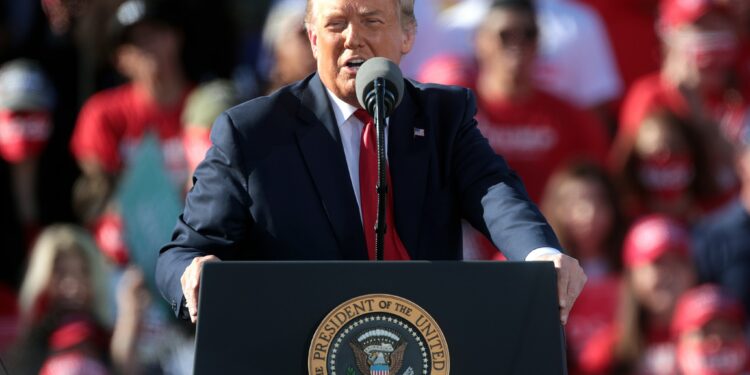
President Donald Trump is facing renewed political pressure over his tariff policy after a recent Supreme Court ruling and fresh polling data showed slipping public approval on trade issues.
As the 2026 midterm elections approach, tariffs — a central pillar of Trump’s America-First economic agenda — are once again at the center of national debate.
New Polling Shows Decline in Tariff Approval
Two recent surveys conducted by YouGov for The Economist suggest that public opinion on President Trump’s handling of tariffs has weakened in recent weeks.
A January 9–12, 2026 poll of 1,602 U.S. adults found:
- 37% approve of Trump’s handling of tariffs
- 56% disapprove
- Net approval: –19
A follow-up poll conducted February 20–23 among 1,551 U.S. adults showed further erosion:
- 33% approve
- 60% disapprove
- Net approval: –27
That marks an 8-point negative swing in just over one month.
Importantly, respondents were asked specifically about tariffs — not overall presidential approval — making the comparison between surveys direct and consistent.
Supreme Court Limits Emergency Tariff Authority
The polling shift comes after a 6–3 decision by the Supreme Court of the United States, which ruled that President Trump exceeded his authority under a 1977 emergency powers statute when imposing broad import taxes.
The decision does not eliminate tariffs entirely, but it restricts the administration’s ability to use certain emergency tools. Legal experts note the White House may still pursue alternative trade authorities to continue its tariff strategy.
President Trump criticized the ruling, calling it “deeply disappointing” and signaling that his administration will continue pursuing policies designed to protect American industries.
White House Defends America-First Trade Policy
White House officials argue that tariffs remain essential to:
- Renegotiating unfavorable trade deals
- Reducing dependence on China
- Bringing manufacturing jobs back to the United States
- Lowering prescription drug costs
A White House spokesperson said Americans strongly support efforts to correct trade imbalances and rebuild domestic production capacity.
For many working-class voters and retirees concerned about the long-term health of American industry, trade policy remains a defining issue.
Republicans Stand Behind Tariff Strategy
Ohio Senator Jon Husted stated that tariffs are “an important tool for protecting American workers and confronting unfair trade practices,” while affirming respect for the rule of law.
Republican lawmakers have signaled they intend to work with the administration to preserve core elements of the America-First trade framework despite the court setback.
Democrats Argue Tariffs Raise Consumer Prices
Massachusetts Senator Elizabeth Warren criticized the tariff program, arguing that import taxes contributed to higher prices for goods ranging from housing materials to groceries.
Democrats are expected to make inflation and consumer costs a key campaign issue heading into the midterms.
Why This Matters for the Economy
Tariffs remain one of the most debated tools in U.S. economic policy. Supporters argue they:
- Protect American manufacturing
- Counter unfair foreign subsidies
- Strengthen national security supply chains
Critics contend tariffs can increase short-term consumer prices and contribute to market uncertainty.
With legal battles ongoing and polling showing volatility, trade policy is likely to remain a major flashpoint in Washington throughout 2026.
The Political Outlook Ahead of the Midterms
For President Trump, tariffs are more than an economic tool — they are part of a broader message about sovereignty, supply chains, and economic independence.
Whether public opinion stabilizes or continues shifting could influence congressional races, trade negotiations, and broader economic messaging in the months ahead.
One thing is certain: America’s trade policy — and the debate over tariffs, inflation, and manufacturing — will remain front and center as voters prepare to head to the polls.