
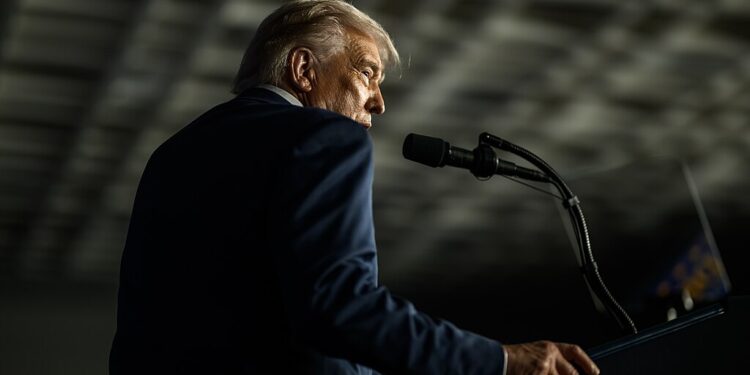
President Donald Trump is facing fresh political headwinds after a new wave of national polling showed his approval rating slipping — and some analysts say the movement may be happening where it matters most.
With the 2026 midterm elections approaching, even small shifts in voter enthusiasm could carry major consequences for Republicans across the country.
But the White House says the real verdict has already been delivered — at the ballot box.
New Polling Raises Questions About Trump’s Approval Rating
Several major national surveys released this month paint a challenging picture for President Trump’s current approval numbers.
Recent results include:
- Ipsos / Washington Post / ABC News: Net approval of -21
- CNN / SSRS poll: Net approval of -27
- American Research Group survey: Net approval of -26
When compiled into the Silver Bulletin polling average, Trump’s net approval now sits around -14.9, just slightly above its lowest point of his second term.
Political observers note that presidential approval ratings are closely watched indicators heading into midterm election cycles. Historically, they influence fundraising, messaging strategy, and turnout enthusiasm.
The Bigger Concern: Erosion Among Strong Supporters
According to Eli McKown-Dawson, a senior elections analyst writing for Nate Silver’s Silver Bulletin, the deeper issue may not be overall approval — but where the change is occurring.
The data suggests:
- Americans who strongly approve of President Trump have declined from 34% at the beginning of his second term to 24% today.
- Meanwhile, those who strongly disapprove have reportedly risen from 31% to 45%.
- Voters who only “somewhat” approve or disapprove have remained largely unchanged.
In other words, the shift appears concentrated among voters who previously expressed the strongest support.
If accurate, that dynamic could create a more fragile political environment — especially if enthusiasm among core supporters continues to soften.
White House Fires Back
The Trump administration is rejecting the narrative that polling averages reflect political weakness.
White House spokesman Davis Ingle pointed to the 2024 election as the ultimate measure of public opinion.
“The only poll that truly mattered took place on November 5, 2024, when close to 80 million voters chose President Trump to carry out his widely supported, common-sense platform.”
Ingle also emphasized that President Trump remains the dominant force in American politics and highlighted what the administration describes as historic progress at home and abroad.
President Trump himself addressed the issue during a recent White House appearance.
“It just amazes me that there’s not more support out there. We actually have silent support. I think it’s silent. I think that’s how I won.”
The concept of “silent support” mirrors themes from previous election cycles, when Trump voters were often underrepresented in public polling.
Why Approval Ratings Matter for 2026
Presidential approval ratings don’t just affect headlines — they can shape the entire political landscape.
When approval dips:
- Opposing parties ramp up fundraising.
- Media coverage intensifies.
- Competitive House and Senate races tighten.
- Independent voters become more decisive.
However, approval numbers can fluctuate based on economic conditions, border security developments, inflation trends, foreign policy events, and legislative wins.
For many conservative voters over 50, key priorities remain:
- Economic stability
- Social Security and retirement security
- Border enforcement
- National security
- Inflation control
If those issues trend positively, approval ratings can rebound just as quickly as they fall.
Is This a Temporary Dip — Or Something Bigger?
Political polling is a snapshot in time — not a final verdict.
Still, analysts across the spectrum will be watching closely to see whether this pattern continues or reverses in the coming months.
With President Trump at the center of nearly every major national debate, his approval rating will remain one of the most closely tracked metrics in American politics.
And as history has shown, underestimating Trump’s political resilience has often proven to be a risky bet.
Final Takeaway
While recent polls suggest softness among strong supporters, the White House maintains confidence that real-world results — not media narratives — will ultimately define the president’s political standing.
The next several months could determine whether this is merely a statistical fluctuation — or an early warning sign ahead of the 2026 midterms.
One thing is clear: in today’s political climate, nothing stays static for long.