
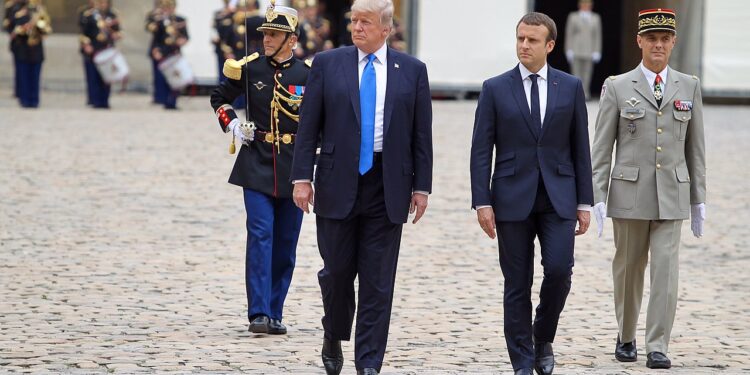
As tensions explode across the Middle East, a new divide is emerging — not just between nations at war, but between the United States and its traditional European allies.
President Donald Trump is now responding directly after French President Emmanuel Macron pushed for a halt to U.S. and Israeli military strikes, raising serious questions about whether America can still rely on its allies when it matters most.
Macron Calls for Restraint as Conflict Escalates
French President Emmanuel Macron is urging an immediate pause in strikes targeting energy and infrastructure across the region, emphasizing diplomacy over military force.
He also called for restoring safe navigation routes, particularly as global oil supply chains face growing disruption.
But critics argue this response reflects a familiar pattern — hesitation at a moment when decisive action may be required.
Trump Fires Back: “We Don’t Need Anybody”
President Trump didn’t hold back.
After speaking with Macron, Trump gave a blunt assessment:
“On a scale of zero to ten, he’s about an eight. Not perfect — but it’s France.”
While acknowledging France could assist in securing the Strait of Hormuz, Trump made one thing crystal clear:
America will not depend on foreign powers to protect its interests.
“We’re the strongest nation in the world,” Trump said. “We don’t need anybody.”
He also revealed something even more telling — the U.S. is watching its allies closely.
“I want to see how they react,” Trump added. “Because if we ever truly needed them, many wouldn’t be there.”
Why the Strait of Hormuz Crisis Matters to Americans
This isn’t just a foreign conflict — it directly impacts your wallet.
The Strait of Hormuz is one of the most critical oil routes on Earth, with nearly 20% of the world’s oil supply passing through it daily.
Iran has already begun threatening the region with drones, missiles, and naval activity — and that’s driving fears of:
- Higher gas prices
- Supply chain disruptions
- Increased inflation
For everyday Americans — especially those on fixed incomes — this could hit hard.
Europe Hesitates While Risks Grow
Despite the rising threat, France has made it clear it will not participate in military operations during active conflict.
Instead, Macron has suggested helping after the situation stabilizes — a position many see as too little, too late.
Other allies, including the United Kingdom, Germany, Italy, and Japan, have expressed conditional support, but remain cautious about immediate involvement.
This lack of urgency is fueling concerns that America may once again be left carrying the burden alone.
A Dangerous Second Front Opens
The situation is becoming even more volatile.
Iran-backed Hezbollah forces in Lebanon have launched repeated attacks against Israel, triggering a sharp military response.
Thousands of rockets and drones have been fired, dramatically escalating the conflict and raising the risk of a broader regional war.
This isn’t just a localized issue anymore — it’s rapidly becoming a global crisis.
Diplomacy vs Strength: A Growing Divide
France is now pushing for negotiations between Israel and Lebanon, calling it a “window of opportunity.”
But Israeli leaders — and many U.S. analysts — strongly disagree.
Their view is simple:
Diplomacy cannot succeed while terrorist groups remain armed and active.
Years of negotiations have failed to stop Hezbollah’s buildup, and many believe repeating the same strategy will only lead to the same results.
What This Means for America Moving Forward
This moment is about more than just foreign policy — it’s about leadership.
President Trump is signaling a clear shift:
- America will lead
- America will defend its interests
- And America will not wait for hesitant allies
At the same time, this situation is exposing a deeper reality — the growing gap between the U.S. and European nations when it comes to handling global threats.
The Bottom Line
As the Middle East conflict intensifies and global energy markets remain on edge, one thing is becoming increasingly clear:
The United States is prepared to act — whether its allies are ready or not.
And as President Trump tests those alliances in real time, the world is watching closely to see who stands with America… and who steps back when it matters most.