
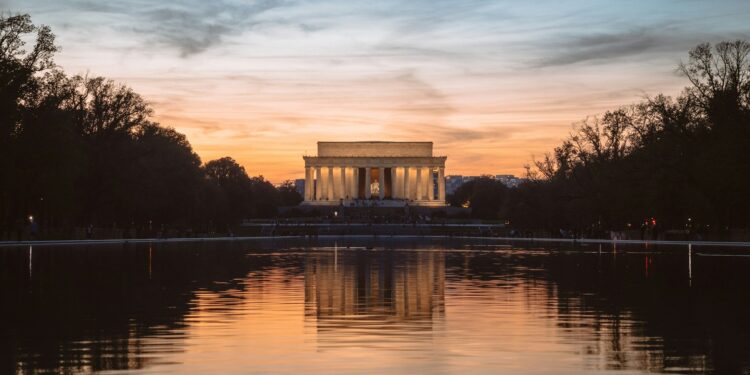
A costly renovation at the Lincoln Memorial Reflecting Pool has sparked renewed debate over how taxpayer dollars are being spent after construction problems, algae growth, and wildlife deaths raised fresh concerns about one of America’s most recognizable landmarks.
Despite the headline, the Lincoln Memorial itself has not been permanently closed. Instead, the controversy centers on the Reflecting Pool, where a multimillion-dollar restoration project has faced unexpected setbacks almost immediately after completion.
The National Park Service recently wrapped up a renovation of the historic Reflecting Pool under a federal contract worth more than $14.6 million. The project included resurfacing the bottom of the pool with a new blue coating designed to improve its appearance.
However, the work quickly ran into trouble.
Within days of the project’s completion, the new paint reportedly began peeling from the bottom of the pool. Soon afterward, the water turned green as an algae bloom spread throughout the famous Washington, D.C., landmark, prompting another round of cleanup efforts.
To restore water quality, the National Park Service deployed hydrogen peroxide treatments along with advanced nanobubble ozone technology to eliminate algae and other contaminants.
The situation became even more concerning over the weekend when visitors discovered one dead duck floating in the Reflecting Pool. Two additional ducks were later found dead in nearby Constitution Gardens.
City Wildlife, a Washington-based animal rescue organization, confirmed that it submitted two of the birds for laboratory testing. Officials said it is too early to determine what caused the deaths and that results are still pending.
As questions continue surrounding the renovation, Rep. Tim Burchett (R-Tenn.) suggested taking a completely different approach.
Rather than spending millions trying to keep the Reflecting Pool free of algae, Burchett proposed allowing nature to take over by transforming the area into a functioning ecosystem.
“I honestly think it would be neat if they just let it become an ecosystem,” Burchett told reporters on Capitol Hill. “Put fish in it and let nature do its thing.”
The Tennessee congressman acknowledged that algae naturally develops in outdoor bodies of water and argued that eliminating it entirely may not be realistic.
“It’s algae. It’s science. It’s just going to happen,” Burchett said.
He noted that stronger chemicals, including chlorine or bleach, could potentially be used but suggested that working with nature instead of constantly fighting it may deserve consideration.
Meanwhile, President Donald Trump has pointed to vandalism as another factor behind the Reflecting Pool’s problems. The Trump administration announced that six individuals have been arrested in connection with alleged vandalism at the Lincoln Memorial site.
The renovation has reignited broader questions about government spending, project oversight, and the long-term maintenance of America’s historic landmarks. Critics argue that taxpayers deserve better accountability when multimillion-dollar restoration projects experience problems almost immediately after completion.
For now, the National Park Service continues working to improve conditions at the Reflecting Pool while officials await additional test results related to the wildlife deaths. Whether Burchett’s unconventional proposal gains any support remains to be seen, but the debate has once again focused attention on how the nation’s most treasured monuments are maintained—and how taxpayer dollars are being spent.