
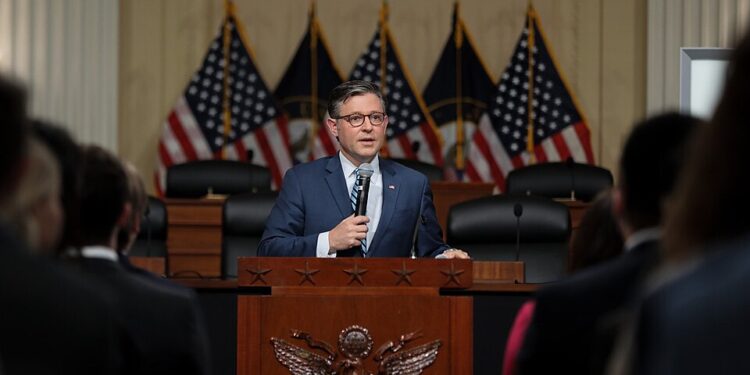
House Speaker Mike Johnson delivered a blunt message to members of his own party Monday as a growing Republican feud threatened to slow one of President Donald Trump’s top legislative priorities. The Louisiana Republican warned that House conservatives who continue blocking legislation over the SAVE America Act risk hurting the broader Republican agenda instead of advancing it.
Speaking to reporters at the Capitol, Johnson said delaying House business while demanding immediate Senate action on election integrity legislation would ultimately be a losing strategy.
“Stopping the work of House Republicans to make Americans safer and bring down the cost of living is self-defeating,” Johnson said. “It doesn’t make any sense.”
The debate is focused on the Republican-supported SAVE America Act, which would require individuals to provide proof of U.S. citizenship when registering to vote and present voter identification in federal elections. Backers say the proposal would strengthen election security and increase public trust in the voting process, while opponents argue it could make it more difficult for some eligible citizens to cast ballots.
The internal Republican disagreement intensified after several conservative House lawmakers blocked unrelated legislation from advancing last week, insisting the Senate first pass the SAVE America Act before moving forward on other priorities.
Now, the standoff is beginning to affect other major legislation, including the annual National Defense Authorization Act, one of Congress’s most significant bills each year.
Johnson revealed that he spent several hours at the White House on Monday meeting with President Trump to discuss how Republicans can keep advancing the administration’s legislative agenda despite the growing divide within the conference.
The meeting came just days after President Trump postponed signing a bipartisan housing bill, expressing frustration that the Senate had not acted on election integrity legislation. Shortly afterward, Trump called on House Republicans to stop “grandstanding,” unite behind the Republican agenda, and end procedural fights that have delayed votes on the House floor.
Rather than forcing another Senate showdown that would almost certainly face a Democratic filibuster, Johnson outlined a different strategy.
He said House Republicans intend to include key provisions of the SAVE America Act in a future budget reconciliation package. Because reconciliation bills require only a simple majority in the Senate, Republicans could potentially bypass the chamber’s 60-vote threshold and avoid unified Democratic opposition.
Johnson noted that House Republicans have already passed the SAVE America Act multiple times and remain committed to sending election integrity legislation to President Trump’s desk.
He expressed confidence that incorporating portions of the bill into a reconciliation package offers the strongest path to success.
However, not every Republican is convinced.
Rep. Anna Paulina Luna of Florida, one of the leading conservatives pushing for immediate action, publicly rejected Johnson’s proposal.
In a post on X, Luna argued that major election policy changes would likely violate the Senate’s Byrd Rule, which limits reconciliation bills to measures directly related to federal spending and revenues.
According to Luna, the proposal would not survive the Senate’s procedural review, making Johnson’s strategy unlikely to succeed without significant changes.
The disagreement highlights a broader debate within the Republican Party over how best to deliver on President Trump’s election agenda. While House leadership is focused on passing legislation that can survive the Senate, many conservative lawmakers believe stronger pressure is needed to force action on voter ID and proof-of-citizenship requirements.
Supporters of Johnson’s approach argue that passing meaningful reforms through reconciliation gives Republicans their best chance of overcoming Senate roadblocks. Others believe delaying House business is necessary to keep election integrity at the top of Congress’s agenda.
With negotiations continuing behind closed doors, Republican leaders now face mounting pressure to unify the conference before internal divisions begin slowing other key priorities involving border security, national defense, government funding, and President Trump’s broader legislative agenda.
The coming weeks could determine whether Republicans can rally behind a single strategy for advancing the SAVE America Act—or whether disagreements inside the GOP will continue delaying legislation that many conservatives view as one of the party’s most important election priorities heading into the midterm campaign.