
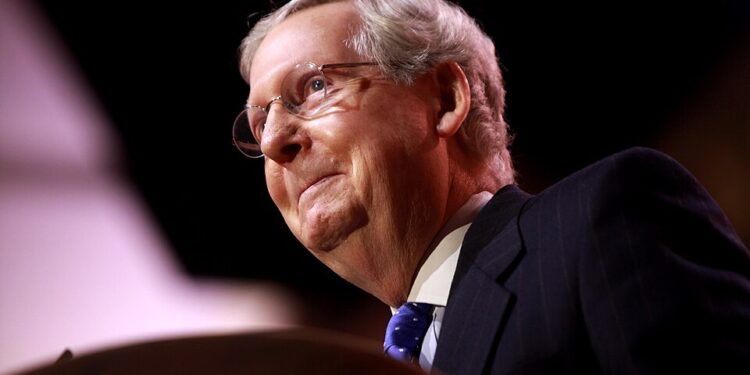
President Donald Trump’s plan to secure a record-setting $1.5 trillion defense budget is facing a major obstacle as Sen. Mitch McConnell’s continued absence from Capitol Hill slows the Senate’s ability to move critical military spending legislation forward.
McConnell, who has been hospitalized for more than three weeks, serves as chairman of the Senate Appropriations Defense Subcommittee. Without his vote, Republicans currently lack the committee support needed to advance key Pentagon funding bills without Democratic backing.
With only 24 legislative days remaining before Congress reaches its fiscal year deadline, lawmakers are running out of time to approve one of the Trump administration’s top priorities.
The delay comes as the United States continues military operations overseas, including actions involving Iran and ongoing missions in the Caribbean. Defense leaders have warned that failing to pass a funding package on time could affect military readiness and future planning.
McConnell’s Absence Creates Major Challenge
Republicans now face difficult choices as they search for a path forward.
Some policy experts believe Senate leadership may eventually have to consider replacing McConnell on the Appropriations Committee if his recovery keeps him away from Washington for an extended period.
Former congressional aide and Trump administration official Katherine Thompson said lawmakers have very little time left to act.
According to Thompson, any solution would need to be implemented quickly, and delaying action much longer could make it increasingly difficult to complete the annual defense funding process before the deadline.
Health Questions Continue
McConnell, 84, has remained hospitalized since June 14 for undisclosed medical issues.
His office has said the Kentucky Republican continues to improve and remains involved in Senate business through phone conversations with colleagues. However, staff members have not provided a timeline for when he may return to Capitol Hill.
The lack of detailed updates has fueled widespread public interest regarding when one of the Senate’s longest-serving Republicans will resume his duties.
McConnell previously announced he would retire when his current Senate term concludes in January 2027.
Defense Spending Process Remains Stalled
Even before McConnell’s hospitalization, negotiations over next year’s defense budget were becoming increasingly difficult.
Senate Appropriations Chair Susan Collins postponed a scheduled committee markup as disagreements over military spending continued.
Without McConnell present, Republicans do not have enough votes to move the legislation through committee on their own.
Analysts say attracting Democratic support appears unlikely given ongoing disagreements over defense funding levels.
Even if the legislation reaches the Senate floor, Republicans hold only a narrow 53-47 majority, leaving little room for internal disagreements.
Trump’s Defense Budget Faces Additional Hurdles
The Trump administration has proposed a defense budget totaling roughly $1.5 trillion.
That plan includes approximately $1.15 trillion in regular defense funding along with another $350 billion through the budget reconciliation process.
Before entering the hospital, McConnell publicly questioned that strategy.
He argued during Senate hearings that relying on reconciliation to finance major Pentagon priorities—including missile defense and expanded weapons production—could create unnecessary risks because the process is politically challenging and requires nearly unanimous Republican support.
Without McConnell available, Senate Republican leaders can afford to lose only two GOP votes if they attempt another reconciliation package.
Pentagon Warns About Funding Delays
Defense officials continue warning that delays could have real consequences.
If Congress fails to approve funding before the fiscal year ends on Sept. 30, the Pentagon could face additional financial pressure after already shifting money from existing accounts to support military operations involving Iran.
To replenish those resources, the Trump administration has requested an $87.6 billion supplemental funding package that would help replace depleted munitions and strengthen military readiness.
That request, however, has received mixed reactions on Capitol Hill.
Earlier this year, Chief of Naval Operations Adm. Daryl Caudle warned lawmakers that without additional funding, the Navy could eventually reduce training exercises, scale back routine operations, and postpone certain personnel initiatives.
Experts Say Military Resources Are Already Under Pressure
Defense analysts say the funding strain is already being felt across the armed forces.
Mackenzie Eaglen of the American Enterprise Institute said resources have been redirected for months to support overseas military operations, leaving fewer dollars available for maintenance, infrastructure repairs, equipment upkeep, and day-to-day operations at military bases.
Those budget pressures, analysts say, make timely congressional action even more important.
The Clock Is Ticking
With Congress approaching its fiscal year deadline, McConnell’s continued absence has become one of the biggest obstacles facing President Trump’s defense agenda.
Whether Senate Republicans can find another path to move the legislation—or must wait for McConnell’s return—could determine whether Congress delivers the military funding the administration is seeking before time runs out.
As negotiations continue, lawmakers face increasing pressure to reach an agreement that strengthens America’s military, supports service members, and avoids disruptions to national defense planning.