
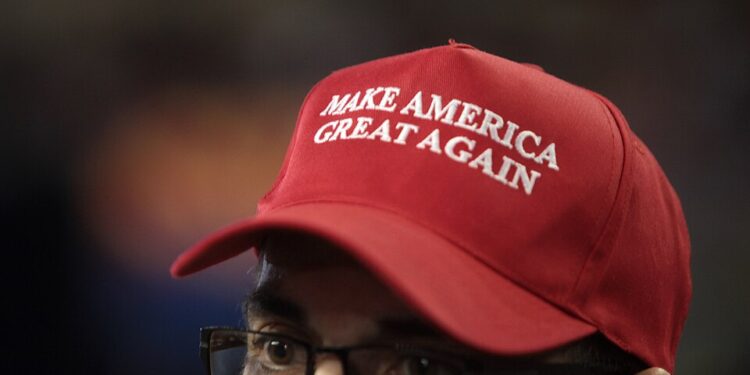
President Donald Trump has regained positive approval among rural Americans for the first time in months, according to new polling, offering Republicans an encouraging sign as the 2026 midterm election season begins to intensify.
The latest Harvard CAPS/Harris Poll found Trump with a 52% approval rating among rural voters, compared with 44% who disapprove, giving him a net positive approval rating of eight percentage points. The result marks a noticeable improvement after a difficult stretch earlier this year when several polls showed weakening support among one of the Republican Party’s most dependable voting blocs.
Because rural communities have consistently delivered some of the GOP’s largest electoral margins, even modest changes in voter enthusiasm can have an outsized impact on closely contested Senate, House and gubernatorial races.
White House spokesman Davis Ingle pointed to the administration’s record as evidence that voters are responding positively.
“No other President in history has accomplished more for the American people than President Trump, who is working tirelessly to create jobs, cool inflation, increase housing affordability, and more.”
Ingle added that the administration believes its agenda will continue producing results in the months ahead.
New Poll Shows Rural Support Rebounding
The Harvard CAPS/Harris Poll was conducted July 11-12 among 1,776 registered voters and carries a margin of error of plus or minus 2.3 percentage points.
Among rural respondents:
- 52% approve of Trump’s job performance.
- 44% disapprove.
- Net approval: +8 percentage points.
The survey marks Trump’s first positive rural approval rating from Harvard CAPS/Harris since February, when he held a narrower two-point advantage.
Nationally, however, Trump’s overall approval stood at 42%, highlighting that his support remains substantially stronger in rural America than among the electorate as a whole.
The poll was completed before the collapse of the Iran ceasefire, meaning respondents were surveyed during a period when international tensions—and concerns over their economic effects—appeared to be easing.
A Sharp Reversal From Earlier This Year
The latest numbers represent a significant turnaround from polling conducted in the spring.
A Fox News poll conducted in mid-May showed Trump’s rural approval falling into negative territory, reflecting frustration over economic issues that were affecting many farming and small-town communities.
According to that survey:
- Rural net approval had fallen to minus 14 points, compared with approximately plus 20 points in early 2025.
- Only 30% of rural voters approved of Trump’s handling of the economy.
- Inflation received his weakest ratings, with only 24% approving of his performance on rising prices.
The results suggested that economic pressures had temporarily weakened support among voters who have traditionally formed the foundation of Republican electoral success.
Inflation and Farm Costs Remain Key Issues
Economic conditions continue to play a major role in shaping political attitudes across rural America.
Farm families and rural businesses have faced higher fuel costs, increased fertilizer prices and more expensive transportation expenses throughout much of 2026.
Several economic analyses have linked those higher costs to supply-chain disruptions and geopolitical tensions that affected global energy markets.
For agricultural communities, increases in diesel fuel, fertilizer and other operating expenses directly affect both farm profitability and household budgets.
At the same time, the latest Harvard CAPS/Harris poll indicates that voter expectations may be improving. Roughly half of respondents said they believe recent price increases tied to international events are likely to be temporary, suggesting confidence may be stabilizing.
Political analysts have long noted that changing expectations about the economy can influence approval ratings almost as much as current economic conditions.
Why Rural America Matters
Although rural Americans make up roughly 18% of the U.S. population, they remain one of the most influential voting blocs in national elections.
Trump carried rural counties by wide margins during the 2024 election, helping Republicans remain competitive in numerous battleground states.
Because rural turnout is typically strong, even a small shift in enthusiasm can influence statewide races decided by narrow margins.
Political strategists from both parties closely monitor rural polling because a swing of just a few percentage points can alter the outcome of competitive elections.
Six Key Midterm Races to Watch
Several of the nation’s highest-profile contests could be influenced by changes in rural voter sentiment.
North Carolina Senate
The race for North Carolina’s open Senate seat is expected to be one of the country’s most competitive campaigns. Republicans are counting on strong rural turnout to offset Democratic strength in the state’s rapidly growing metropolitan areas.
Iowa Senate
Agriculture dominates Iowa’s economy, making farm policy, commodity prices and operating costs central campaign issues. Rural voter participation is expected to play a major role in determining the outcome.
Ohio Special Senate Election
Former Democratic Sen. Sherrod Brown is attempting to reclaim a Senate seat in a state that has shifted increasingly toward Republicans in recent election cycles. Republican strength in rural counties could prove decisive.
Maine Senate
Republican Sen. Susan Collins has historically relied on support from northern Maine’s rural communities as well as independent voters. Democrats continue to view the race as one of their best pickup opportunities.
Michigan Governor
Michigan’s open governor’s race is expected to be highly competitive. Republicans will seek strong margins outside Detroit and other urban centers while Democrats focus on suburban turnout.
Wisconsin Governor
Wisconsin remains one of America’s premier battleground states. Elections are often decided by relatively small differences between Republican rural turnout and Democratic performance in Milwaukee, Madison and surrounding suburbs.
Looking Ahead to November
While a single poll does not guarantee future election outcomes, the latest Harvard CAPS/Harris survey suggests Trump has regained momentum with one of the Republican Party’s most reliable constituencies after several challenging months.
Whether that improvement continues may depend largely on the economy. Inflation, energy prices, interest rates and farm-related expenses are expected to remain central issues as candidates campaign across the country.
With control of Congress and several governorships at stake, both Republicans and Democrats will be watching rural voter sentiment closely in the months ahead.
If Trump’s rebound among rural Americans holds, it could strengthen Republican prospects in several closely contested races. If economic concerns resurface, however, the political landscape could shift once again before voters head to the polls.
As the 2026 midterm elections approach, rural America is once again positioned to play a pivotal role in shaping the nation’s political future.