
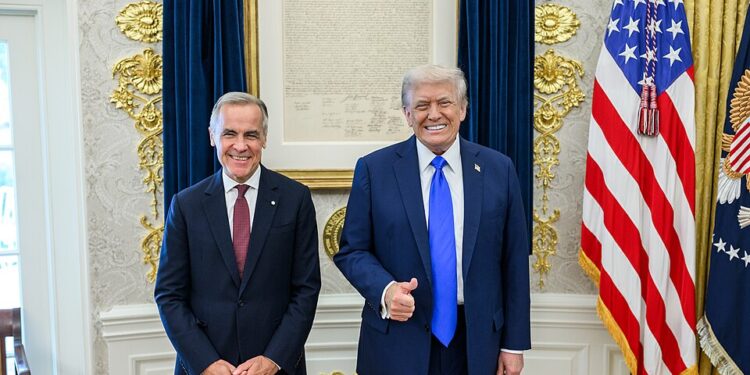
President Donald Trump is demanding stronger action from Canada after wildfire smoke once again drifted into the United States, saying Americans should not have to endure hazardous air because of fires burning north of the border. Speaking after the FIFA World Cup final on Sunday, Trump suggested Canada could eventually face financial consequences if the problem continues, including possible tariffs or compensation for the damage caused by the smoke.
The president’s latest remarks come as millions of Americans have experienced poor air quality in recent weeks, with thick smoke from Canadian wildfires triggering health alerts across multiple states.
Trump Presses Canada Over Wildfire Smoke
Speaking to reporters at Joint Base Andrews after returning from New Jersey, Trump said he personally raised the wildfire issue with Canadian Prime Minister Mark Carney during the World Cup final.
According to Trump, he told the Canadian leader that the wildfire smoke has become an unacceptable problem for Americans living south of the border.
“Our air has been poisoned,” Trump said, arguing that Canada must do more to prevent smoke from spreading into the United States.
While emphasizing that he has a good working relationship with Carney, Trump also made it clear that patience is wearing thin.
“If we can help them, we’ll help them,” Trump said. “But maybe they should pay us damages, or perhaps we should look at tariffs.”
The comments mark Trump’s strongest warning yet as wildfire smoke continues to impact millions of Americans.
Republican Lawmakers Call for Tougher Action
Trump’s comments come as several Republican lawmakers are also pushing for stronger consequences if Canada fails to better manage its wildfire crisis.
Sen. Bernie Moreno of Ohio and Rep. John James of Michigan have introduced legislation aimed at holding Canada accountable for repeated smoke events that have affected communities across the United States.
Supporters argue that American families should not be forced to deal with unhealthy air because neighboring countries fail to reduce wildfire risks or respond quickly enough once fires begin.
The legislation reflects growing frustration among lawmakers representing states that have repeatedly experienced dangerous air quality because of smoke drifting south.
Canada Continues Battling Hundreds of Wildfires
Canada remains in the middle of another intense wildfire season.
More than 900 wildfires have burned across several provinces in recent weeks, including British Columbia, Ontario, and Quebec. Officials believe many of the largest fires were ignited after roughly 1,000 lightning strikes hit parts of the country in early July.
The fires have consumed tens of thousands of acres of forest, sending massive smoke clouds across the U.S.-Canada border.
Meteorologists say weather patterns have repeatedly pushed that smoke into the Midwest, Northeast, and parts of the East Coast, where millions of Americans have been advised to limit outdoor activities because of poor air quality.
Smoke Creates Health Concerns Across America
The drifting smoke has affected communities hundreds of miles away from the fires themselves.
Air quality alerts have been issued across numerous states as smoke blanketed cities and reduced visibility. Health experts have warned that prolonged exposure to wildfire smoke can be especially dangerous for older Americans, children, and those with asthma, heart disease, or other respiratory conditions.
For many Americans, the smoky skies have become an unwelcome summer routine.
Trump said he does not remember seeing this type of recurring problem until recent years.
“I’ve never remembered this happening,” the president said. “Over the last four or five years, it really started becoming something we see.”
Trump Again Calls for Better Forest Management
The president also renewed one of his long-standing arguments—that better forest management could reduce the severity of catastrophic wildfires.
Trump has repeatedly said that clearing dead trees, removing excess brush, and reducing forest debris would help limit the spread of major fires before they grow out of control.
He made similar comments during the devastating Southern California wildfires earlier this year and has consistently argued that proactive land management should be a higher priority.
Supporters of that approach believe improved maintenance could reduce the size and intensity of many large wildfires, while critics argue that climate conditions also play a significant role.
Trump Previously Floated Tariffs Over Smoke
Trump’s latest comments follow a Truth Social post last week in which he criticized Canada’s handling of the wildfire crisis even more forcefully.
The president suggested the United States could increase tariffs because Americans were being affected by what he described as polluted air crossing the border.
He also accused Canada of failing to carry out basic forest management and debris removal, arguing that the resulting economic costs and health impacts on Americans are substantial.
The comments came as thick wildfire smoke settled over Washington, D.C., reducing visibility around several of the nation’s most recognizable landmarks.
Carney Blames Climate Change
Prime Minister Mark Carney has taken a different view of the wildfire crisis.
Rather than focusing primarily on forest management, Carney has argued that climate change is the larger driver behind increasingly severe wildfire seasons.
During a recent news conference, Carney said addressing climate change requires cooperation from every major country, including the United States.
His comments highlight one of several policy disagreements that have emerged between the two leaders.
Tensions Extend Beyond Wildfires
The wildfire dispute is just the latest issue to strain relations between Washington and Ottawa.
Trump and Carney have previously clashed over tariffs, trade policy, and broader economic issues. Trump has also periodically joked about Canada becoming America’s 51st state, remarks that have drawn criticism from Canadian officials.
Despite those differences, the two leaders met face-to-face while attending the FIFA World Cup final at MetLife Stadium in New Jersey.
Mexican President Claudia Sheinbaum also joined Trump and Carney as the leaders of the three nations hosting the international tournament.
A Growing Political Issue
Although Spain defeated Argentina 1-0 in an overtime thriller to capture the World Cup title, much of the political attention surrounding the event centered on Trump’s renewed criticism of Canada.
With wildfire season still far from over, the issue is likely to remain a major topic in Washington. If smoke continues to drift into the United States, pressure could grow for additional action aimed at protecting American communities from repeated air quality emergencies.
Trump has made it clear that he believes Canada must do more—and that if conditions fail to improve, economic measures such as tariffs or other penalties could remain on the table.