
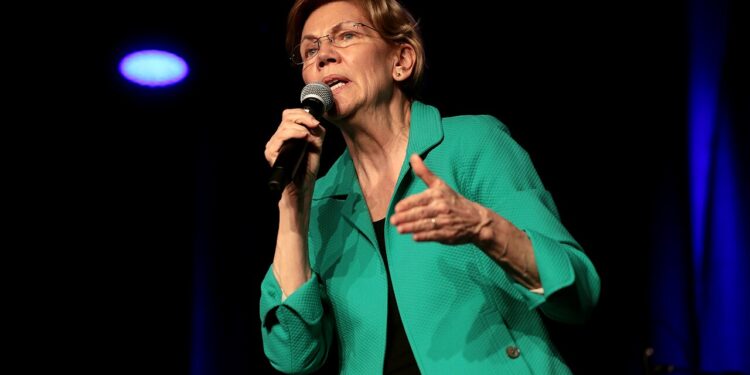
Sen. Elizabeth Warren (D-Mass.) slowed the confirmation process for several of President Donald Trump’s nominees Thursday after raising concerns about confidential FBI background investigations, creating another obstacle for the administration as it works to fill key government positions.
The unexpected move came during a Senate Banking Committee hearing scheduled to consider three Trump nominees for important federal posts.
Warren Raises Questions About FBI Background Checks
The Senate Banking Committee had planned to vote on the nominations of Christopher Phelan, Trump’s choice to lead the Council of Economic Advisers, John Crews for the National Credit Union Administration, and Jeffrey Ledbetter to serve as inspector general at the Department of Housing and Urban Development (HUD).
But Warren, the committee’s top Democrat, said a confidential FBI briefing had left her with what she described as “significant questions” about the background investigations.
Although she declined to reveal details publicly, Warren argued that lawmakers should not move forward until they had all the available information.
Warren argued that the committee should delay the vote until lawmakers are satisfied the FBI has fully addressed any outstanding issues. She added that every senator on the committee, regardless of party, deserves complete information before deciding whether to support or oppose the nominees.
Committee Moves Behind Closed Doors
Following Warren’s request, Senate Banking Committee Chairman Tim Scott (R-S.C.) agreed to move the hearing into a closed session.
Reporters, staff members, and members of the public were asked to leave while senators privately discussed the FBI background investigations.
Scott’s opening remarks only referenced the nominations of Phelan and Crews and did not address Warren’s concerns or the FBI briefing. The FBI also declined to comment, noting that it does not discuss external background investigations.
Trump Nominees Advance Despite Delay
After more than an hour of private discussions, senators returned to public session and voted on two of President Trump’s nominees.
Christopher Phelan and John Crews both advanced to the full Senate on narrow 13-11 party-line votes, keeping their confirmation process moving forward despite the earlier delay.
However, lawmakers did not vote on Jeffrey Ledbetter’s nomination, leaving his confirmation on hold for now.
HUD Inspector General Position Remains Vacant
Trump nominated Ledbetter in April to become inspector general at HUD.
According to his professional background, Ledbetter has more than 30 years of investigative experience with the U.S. Army Criminal Investigation Division and previously served as a supervisory special agent within the Defense Department’s Office of Inspector General.
HUD has operated without a Senate-confirmed inspector general since the beginning of Trump’s second term, making it one of nearly 30 federal agencies that still lack a permanent independent watchdog.
White House Calls for Faster Confirmations
Following the hearing, the White House defended the president’s nominees and urged the Senate to move quickly.
White House spokesperson Davis Ingle said the administration believes all of President Trump’s qualified nominees should move through the confirmation process without unnecessary delays.
The administration has continued pressing the Senate to confirm key nominees as quickly as possible, arguing that vacancies in senior government positions slow the implementation of the president’s agenda.
Not Warren’s First Objection
This is not the first time Warren has challenged the confirmation process over FBI background investigations.
Last year, she opposed advancing the nomination of now-HUD Secretary Scott Turner, arguing that his FBI background review had not been fully completed before the committee voted.
Thursday’s hearing highlighted the increasingly partisan battles surrounding President Trump’s nominees, with Democrats demanding additional scrutiny while Republicans continue pushing to fill critical positions across the federal government.
As confirmation fights continue in the Senate, the pace at which Trump’s nominees move through Congress is expected to remain a key political battleground in Washington.