
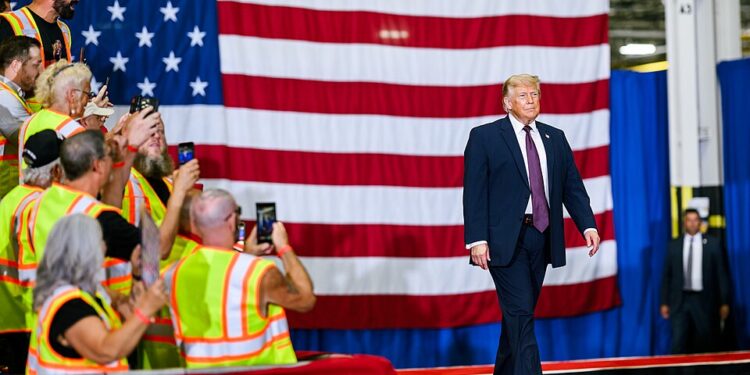
President Donald Trump’s latest tariff announcement has ignited a major political battle just months before the 2026 midterm elections. Democrats argue the new trade measures could drive up costs for American families, while Republicans insist the tariffs are necessary to protect U.S. jobs, strengthen domestic manufacturing, and push back against unfair foreign trade practices.
With inflation, energy prices, and the economy continuing to dominate voters’ concerns, the fight over Trump’s trade policy is shaping up to become one of the biggest issues of the election cycle.
Trump Expands America First Trade Agenda
The Trump administration announced a new round of double-digit tariffs on imports from approximately 60 trading partners, citing concerns over forced labor and unfair trade practices. The new duties officially took effect Friday.
The White House also unveiled a separate 50% tariff on certain Canadian imports, arguing that Canada has maintained discriminatory trade policies against the United States. Those tariffs are expected to take effect next month.
President Trump also warned that additional tariffs could soon target the European Union after EU regulators imposed a $1 billion fine against Google under the Digital Markets Act. Trump suggested the fine unfairly singled out an American company and indicated a “substantial” tariff response could follow.
The latest moves represent another step in Trump’s America First trade strategy, which focuses on encouraging domestic production while pressuring foreign governments to negotiate what the administration considers fairer trade agreements.
Economy Remains The Top Political Issue
The tariff expansion comes as economic concerns remain the number one issue for many voters heading into November.
Recent polling has presented a mixed picture for Republicans. A Fox News survey found that 33% of voters approve of Trump’s handling of the economy, while an Economist/YouGov poll reported that nearly half of Americans believe the economy is currently in poor condition.
Another YouGov survey found that many Americans believe tariffs have contributed to higher prices. Forty-six percent of respondents said Trump’s tariffs have increased prices “a lot,” while another 26% said they have increased prices “a little.” Fourteen percent reported seeing no noticeable impact.
Because affordability remains a top concern, Democrats believe the issue could become a powerful campaign message in competitive congressional races.
Democrats Make Tariffs A Campaign Issue
Democratic candidates across the country have increasingly pointed to Trump’s tariff policies as part of their broader message on inflation and the cost of living.
California Governor Gavin Newsom criticized the latest tariffs, arguing they could raise prices for consumers already struggling with everyday expenses.
Political strategists expect Democratic campaigns to continue highlighting tariffs in battleground districts where economic concerns are expected to play a major role in determining election outcomes.
Republicans Defend Trump’s Trade Strategy
Many Republicans reject the criticism, arguing that Trump’s trade policies are designed to strengthen America’s long-term economic position rather than deliver short-term political gains.
Supporters say the tariffs are intended to:
- Protect American manufacturing jobs.
- Reduce dependence on foreign supply chains.
- Encourage companies to bring production back to the United States.
- Push foreign governments toward more balanced trade agreements.
- Strengthen national security by increasing domestic production.
Many conservatives also argue previous administrations allowed countries such as China to take advantage of the United States through unfair trade practices, making stronger enforcement necessary.
Manufacturing States Could Play A Key Role
Republican strategists believe manufacturing-heavy states such as Michigan could respond differently than national polling suggests.
Many blue-collar workers have supported Trump’s tougher trade policies because they believe stronger tariffs can help preserve American manufacturing and create better-paying jobs.
Some strategists also note that portions of organized labor have supported tougher trade enforcement, creating unusual overlap between Trump’s economic agenda and some union priorities.
Supporters argue these voters are willing to accept temporary economic uncertainty if it leads to stronger domestic industries over the long run.
Farmers Continue Watching Trade Developments
Agricultural states are also paying close attention to the administration’s latest trade actions.
Farmers have previously faced retaliatory tariffs from major trading partners, particularly China. Higher prices for imported steel, aluminum, and copper have also increased equipment and production costs across the agriculture industry.
However, many rural Republicans continue supporting Trump’s broader trade agenda, believing tougher negotiations will ultimately create better export opportunities and stronger markets for American agriculture.
Several GOP strategists argue many farmers view the short-term challenges as part of a larger effort to secure more favorable trade agreements for future generations.
White House Says Tariffs Protect America
The Trump administration continues to defend the policy, arguing that tariffs are about far more than raising revenue.
Officials say the strategy is designed to:
- Protect American workers.
- Strengthen national security.
- Expand domestic manufacturing.
- Encourage investment inside the United States.
- Reduce dependence on foreign imports.
- Build stronger supply chains.
The White House maintains that these policies will help America become more competitive while encouraging companies to invest in factories and jobs at home.
Legal Challenges Continue
Trump’s latest tariff actions are already facing legal challenges.
The Liberty Justice Center filed a lawsuit on behalf of several small businesses, arguing the administration exceeded its legal authority in imposing tariffs on dozens of trading partners.
The organization previously won a significant Supreme Court ruling that struck down portions of Trump’s earlier global tariff program under the International Emergency Economic Powers Act.
Legal experts expect the newest case could shape how future administrations use tariff authority.
Could Tariffs Affect The Midterm Elections?
Political analysts remain divided over how much influence tariffs will ultimately have on voters.
Democrats believe rising consumer costs could hurt Republicans if inflation remains elevated.
Republicans counter that many voters understand Trump’s long-term strategy and are willing to support temporary trade disruptions if they lead to stronger American industries, better-paying jobs, and more balanced trade agreements.
Ultimately, the impact of Trump’s trade agenda may depend on whether voters prioritize short-term prices or long-term economic growth.
The Bottom Line
President Trump’s expanded tariff strategy has become one of the biggest economic debates heading into the 2026 midterm elections.
Supporters view the tariffs as an important step toward rebuilding American manufacturing, protecting workers, and confronting unfair foreign trade practices. Critics argue the policies risk increasing prices for consumers already dealing with inflation.
As legal battles continue and new tariffs take effect, the economy is likely to remain at the center of the national conversation. Whether voters embrace Trump’s America First trade strategy or side with Democratic criticism could play a major role in shaping control of Congress this November.
Frequently Asked Questions
Why is President Trump imposing new tariffs?
The Trump administration says the tariffs are intended to protect American workers, strengthen U.S. manufacturing, reduce dependence on foreign supply chains, and encourage fairer trade agreements with other countries.
Will tariffs increase prices?
Some economists and consumer groups argue tariffs can increase prices because import costs are often passed on to buyers. Supporters counter that tariffs encourage more domestic production, which can strengthen the economy over time.
Which countries are affected?
The latest round of tariffs targets approximately 60 trading partners. The administration has also announced new tariffs on certain Canadian imports and warned that additional tariffs on the European Union could be imposed.
Could tariffs influence the 2026 midterm elections?
Many political analysts believe trade policy and the economy will be among the most closely watched issues of the 2026 election cycle. Whether voters view Trump’s tariff strategy as beneficial or harmful could affect key House and Senate races.