
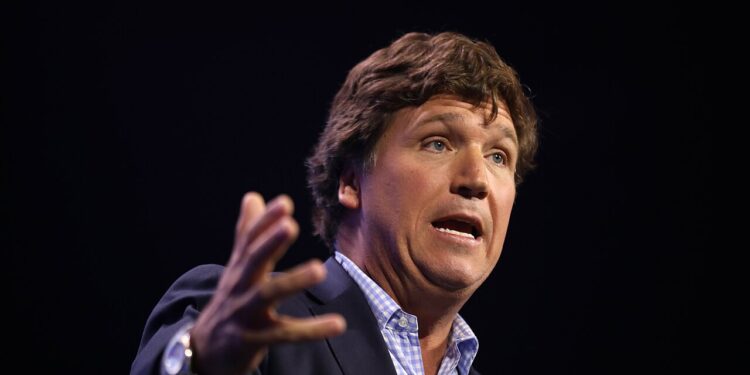
Tucker Carlson has become the subject of growing speculation about the 2028 presidential election, but a prominent former Republican lawmaker is pushing back on the idea that the conservative commentator is preparing a run for the White House.
Former Rep. Marjorie Taylor Greene of Georgia says Carlson has no plans to become a presidential candidate — either as a Republican or as the face of a potential third-party movement.
“Tucker, he’s not running for president,” Greene told Politico Playbook over the weekend.
According to Greene, Carlson has made that position clear both publicly and privately.
The comments provide a direct response to mounting speculation surrounding Carlson’s political future as conservatives begin debating what the Republican Party — and the broader America First movement — could look like after President Donald Trump leaves office.
Greene Rules Out Her Own Presidential Campaign
Greene also rejected speculation that she could become a presidential contender herself.
Instead, the former Georgia congresswoman expressed frustration with the current political system and suggested that neither major party adequately represents many Americans.
Greene said her position is that America’s two-party political system has failed completely.
She went a step further, saying she has become deeply frustrated and disillusioned with both major political parties.
Those comments are notable because Greene was once one of Trump’s most recognizable allies in Washington.
Her increasingly independent position mirrors a larger debate developing among some conservative voters and commentators over the future direction of the Republican Party.
Viral Photo Sparks Political Speculation
Much of the latest speculation began after a photo featuring Greene, Carlson and Republican Rep. Thomas Massie of Kentucky circulated online.
The image generated questions about whether the three could be involved in creating a new conservative political organization or movement outside the existing Republican establishment.
That possibility immediately attracted attention because all three figures have developed significant followings among Americans skeptical of Washington’s political establishment.
They have also each found themselves disagreeing with Trump on major issues despite previously supporting the president or significant portions of his agenda.
The disagreements have become particularly visible over foreign policy.
Carlson has emerged as a leading critic of the war with Iran, putting him in direct conflict with Trump over an issue that has divided parts of the conservative movement.
Carlson and Trump have also differed over the administration’s handling of records connected to Jeffrey Epstein.
Those disputes have fueled questions about whether Carlson is simply criticizing individual administration decisions or positioning himself as the voice of a broader political movement.
Greene’s answer, at least when it comes to a Carlson presidential campaign, is clear: he isn’t running.
Carlson’s Political Message Gets Attention
The presidential speculation intensified after Carlson recently released a video outlining his vision for what he believes America should become.
The video attracted attention because Carlson moved beyond discussing a single political controversy and instead presented a broader critique of the country’s political leadership.
Carlson argued that leaders in both parties have repeatedly benefited themselves while ordinary Americans have paid the price.
His message centered on dissatisfaction with America’s political establishment — a theme that helped propel Trump to the presidency and continues to resonate with many conservative and working-class voters.
That naturally raised another question.
Could Carlson eventually attempt to transform his massive media audience into a political movement?
Carlson has repeatedly said he does not intend to run for president, and Greene’s latest comments reinforce those denials.
But that does not mean Carlson will be irrelevant in 2028.
Far from it.
Carlson Could Still Have Major Influence in 2028
A person does not have to appear on the ballot to become an important force in a presidential election.
Carlson commands a substantial national audience and has demonstrated an ability to shape debates inside conservative politics.
His interviews, videos and commentary could therefore become influential as Republican presidential hopefuls compete for Trump’s political coalition.
Foreign policy could be especially important.
Carlson’s opposition to U.S. military intervention has increasingly separated him from Republicans who favor a more aggressive approach overseas.
That debate could become one of the defining ideological battles of the next Republican presidential primary.
Candidates seeking support from America First voters may consequently face pressure to explain where they stand on military intervention, government spending, immigration, free speech and the power of Washington’s political establishment.
Carlson could play an influential role in forcing those questions into the national conversation.
A Bigger Battle Over the Republican Party
The Carlson speculation points toward a much larger political story: What happens to the Republican Party after Trump?
Trump fundamentally reshaped the GOP by bringing millions of working-class voters into a coalition that challenged traditional Republican leadership.
Immigration, trade, foreign policy and distrust of powerful institutions became increasingly important to Republican voters during Trump’s rise.
Eventually, however, Republicans will have to choose who carries that political movement forward.
That battle could produce significant divisions.
Some Republicans will likely argue for continuing Trump’s agenda as closely as possible.
Others may attempt to combine traditional Republican policies with elements of Trump’s populist message.
And another group could argue that the existing Republican Party itself has become part of the political establishment that Trump originally promised to challenge.
Carlson’s criticism of both parties places him squarely in the middle of that debate.
Could a Third Party Actually Emerge?
Greene’s criticism of America’s two-party system also raises the possibility of something even more disruptive: a new political party.
Third-party presidential candidates have historically faced enormous obstacles in the United States, including ballot-access requirements, fundraising challenges and the dominance of the Republican and Democratic parties.
Even so, frustration with both parties has repeatedly produced independent political movements.
A nationally recognized figure with a large audience could theoretically give such an effort considerably more attention.
That is one reason Carlson’s name immediately generated interest.
But there is currently an important difference between speculation about a political movement and an actual presidential campaign.
Greene says Carlson has no intention of becoming a candidate.
Carlson himself has repeatedly pushed back on suggestions that he wants to run for office.
Until that changes, claims that he is preparing a 2028 campaign remain speculation rather than an announced political plan.
What This Means for Trump Supporters
For conservative voters, the more significant development may be the growing disagreement over what “America First” should mean after Trump.
Trump built a political coalition around border security, economic nationalism, skepticism of Washington institutions and putting American interests ahead of international priorities.
But members of that coalition do not necessarily agree on every issue.
The Iran conflict has exposed some of those differences, particularly among conservatives who believe America should avoid new overseas military commitments.
Those disagreements could become increasingly important as potential 2028 candidates begin positioning themselves for the Republican nomination.
Carlson could influence that contest without ever becoming a candidate.
An endorsement from Carlson could matter. So could his criticism of a candidate.
Perhaps even more importantly, Carlson’s ability to focus conservative attention on particular issues could force presidential contenders to address subjects they might otherwise prefer to avoid.
The 2028 Question Isn’t Going Away
Greene’s latest comments may quiet rumors of an imminent Tucker Carlson presidential campaign, but they are unlikely to end questions about his political influence.
The enormous attention surrounding the possibility demonstrates how unsettled the post-Trump political landscape remains.
For now, Carlson’s reported 2028 plan appears straightforward: he isn’t planning to run for president.
But that doesn’t mean he will sit on the sidelines.
As Republicans begin thinking about the future of the party, Carlson could emerge as an influential voice in determining which candidates, policies and ideas gain traction with conservative voters.
And with divisions already developing over foreign policy and the direction of the America First movement, the fight over the future of the Republican Party may be beginning long before the first votes of the 2028 presidential race are cast.