
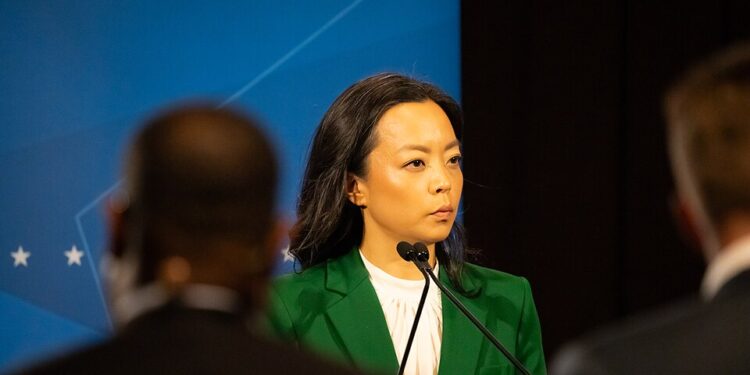
Wisconsin Democrats delivered a stunning political upset Tuesday night, rejecting democratic socialist Francesca Hong and handing Milwaukee County Executive David Crowley the Democratic nomination for governor.
The result was particularly surprising because Hong had appeared to be in a strong position heading into Election Day. Some late polling showed the progressive state lawmaker with a substantial advantage, only for Crowley to stage a dramatic comeback when Wisconsin voters actually cast their ballots.
The race was extraordinarily close.
Crowley finished only a few thousand votes ahead of Hong after hundreds of thousands of Democratic primary ballots were counted, giving the Milwaukee County executive a victory by well under one percentage point.
Hong ultimately conceded the race Wednesday morning.
For conservatives watching Wisconsin, however, the bigger story may be why Hong became such a controversial candidate in the first place.
The self-described democratic socialist spent the closing weeks of the campaign answering questions about previous statements involving Thanksgiving, police departments and other progressive causes.
One old social-media post was particularly difficult to escape:
“Cancel Thanksgiving. Should have done this in 1621.”
Hong later distanced herself from that statement and insisted she wasn’t actually interested in eliminating the traditional American holiday.
But by then, the controversy had become another flashpoint in the larger battle over how far left Democrats are willing to move in a crucial Midwestern swing state.
David Crowley Pulls Off Stunning Wisconsin Victory
Crowley’s victory represents a remarkable political comeback.
The 40-year-old Milwaukee County executive had previously withdrawn from the Wisconsin governor’s race and endorsed Lt. Gov. Sara Rodriguez.
The Democratic contest was then thrown into turmoil as Rodriguez and former Lt. Gov. Mandela Barnes exited the campaign.
Crowley eventually jumped back into the race as Democratic officials and voters confronted the possibility that Hong could capture the nomination.
That decision paid off Tuesday.
Despite Hong’s momentum and strong progressive following, Crowley managed to edge her out in one of the closest major primary contests of the 2026 election cycle.
His victory means Wisconsin voters will now see a November showdown between Crowley and Republican Rep. Tom Tiffany.
With Wisconsin’s reputation for razor-thin statewide elections, the race could become one of the most important gubernatorial contests in America.
Hong’s Thanksgiving Comments Come Back Into Spotlight
Hong’s defeat immediately renewed attention on statements she made before becoming a serious candidate for governor.
Among the most memorable was her 2020 Thanksgiving post.
“Cancel Thanksgiving. Should have done this in 1621,” Hong wrote in the since-deleted social-media message.
The statement became a political liability as her gubernatorial campaign gained momentum.
Thanksgiving remains one of America’s most widely celebrated traditions, particularly among older voters who associate the holiday with family gatherings, faith, gratitude and American history.
Hong subsequently made clear that she no longer stood behind the controversial message.
“I’ve cooked many great Thanksgiving dinners,” Hong said shortly before the primary, adding that she wasn’t going to “cancel Thanksgiving.”
Her explanation did little to prevent opponents from making the original post part of the campaign.
And Thanksgiving wasn’t the only issue.
Hong Also Faced Questions About Police
An even bigger concern for some voters involved Hong’s previous comments about law enforcement.
In an October 2021 social-media post, Hong wrote:
“Police exist to uphold white supremacy.”
She followed that statement with an explicit demand:
“Defund then abolish. Reform can’t be an option.”
Hong has since disavowed those comments as well.
But the resurfaced posts gave opponents an opportunity to raise questions about crime, public safety and the direction of the Democratic Party.
Those subjects have become particularly important as Americans debate policing, violent crime and the role of local government in keeping communities safe.
Crowley seized on the ideological contrast during the final stretch of the campaign.
“There are a lot of people who are scared,” he told reporters shortly before Election Day.
Hong, Crowley noted, openly identified herself as a socialist.
“There are a lot of people worried about not just this party, but this country moving in that direction,” he said.
That was an unusually direct warning coming from another Democrat.
Democratic Establishment Appeared Nervous About Hong
Republicans weren’t the only ones raising concerns.
Some prominent Democrats also appeared uncomfortable with the prospect of Hong becoming their nominee in November.
Former Obama adviser David Axelrod publicly criticized Hong’s political approach, prompting a sharp response from the Wisconsin lawmaker.
Hong accused establishment Democratic consultants of being disconnected from working-class Americans.
She highlighted her background as a dishwasher, line cook and chef and argued that political insiders were attempting to keep people with working-class backgrounds out of politics.
The exchange highlighted an increasingly important divide inside the Democratic Party.
On one side are progressive activists pushing democratic socialism, higher taxes on wealthy Americans and major changes to policing and government.
On the other are Democrats who fear those positions could alienate independents and moderate voters needed to win competitive elections.
Wisconsin provided a real-world test of that disagreement.
Crowley won — although just barely.
Tony Evers Wasn’t Ready to Commit to Hong
Outgoing Democratic Gov. Tony Evers also raised eyebrows before the election when he declined to unequivocally promise his support to Hong if she captured the nomination.
Asked about the possibility, Evers said he wanted an opportunity to evaluate the situation.
He then predicted Crowley would win.
That prediction proved correct.
After Crowley’s victory, Evers enthusiastically congratulated him and immediately turned his attention toward Republican Tom Tiffany.
“I am so proud of David,” Evers wrote, describing Crowley as the future of the Democratic Party.
Crowley would become Wisconsin’s first Black governor if he defeats Tiffany in November.
Bernie Sanders And AOC Stay Away
Another interesting development was the relative absence of two of America’s biggest progressive political celebrities.
Sen. Bernie Sanders and Rep. Alexandria Ocasio-Cortez have repeatedly used their national profiles to support progressive candidates around the country.
But neither became a major force behind Hong during the closing stretch of the Wisconsin campaign.
Their distance stood out because Hong represented exactly the kind of candidate capable of delivering the Democratic Socialists of America a major statewide victory.
Hong’s supporters nevertheless insisted that her campaign represented progress for their political movement.
Campaign manager Becky Cooper said the campaign had produced “meaningful change for the progressive movement.”
Hong struck a similarly optimistic tone after the election.
“We have built something that will change politics forever,” she told supporters.
Whether that’s true remains to be seen.
What is clear is that Wisconsin Democratic voters weren’t quite ready to hand her the governor’s nomination.
Hong’s Election-Day Sneakers Spark Another Debate
Even Hong’s Election Day appearance generated attention.
She was photographed casting her ballot in a pair of black Air Jordan sneakers that can retail online for hundreds of dollars.
There is obviously nothing unusual about a political candidate owning expensive footwear.
But the image attracted attention because Hong had built part of her campaign around economic inequality, working-class politics and increasing taxes on wealthy Americans.
For voters struggling with grocery bills, utility costs, property taxes and other household expenses, politicians’ personal choices can sometimes become symbolic — fairly or unfairly — of larger economic debates.
The episode was minor compared with Hong’s policy positions, but it added another unusual chapter to an already unconventional campaign.
What Crowley’s Victory Means For Wisconsin
Crowley’s victory shouldn’t be mistaken for a conservative takeover of Wisconsin’s Democratic Party.
He remains a Democrat and has strongly criticized President Donald Trump and the MAGA movement.
In fact, Crowley told Democratic voters that defeating what he described as a “MAGA extremist” remained one of the party’s primary objectives.
But his victory does suggest that enough Wisconsin Democrats were concerned about Hong’s socialist label and controversial history to choose a more conventional candidate.
That could have major implications for November.
Republicans will now have to adjust their strategy.
Instead of running against a Democratic Socialist of America member with a long list of provocative social-media posts, Tom Tiffany will face a Democratic opponent attempting to appeal to progressives, moderates and independents simultaneously.
Wisconsin’s November Election Could Be Huge
Wisconsin has become one of America’s most important political battlegrounds.
Presidential contests, Senate elections and statewide races have repeatedly been decided by extremely narrow margins.
The 2026 governor’s race could follow the same pattern.
Tiffany will likely focus heavily on taxes, affordability, energy, education, public safety and President Trump’s agenda.
Crowley is expected to emphasize jobs, schools, affordability and his ability to bring together voters from different political backgrounds.
For Wisconsin residents over 50, many of those debates hit particularly close to home.
Retirement security, property taxes, utility bills, health care costs, neighborhood safety and the financial future being left to children and grandchildren are not abstract political issues. They directly affect household budgets and quality of life.
That makes the November contest much more significant than another partisan fight on social media.
Wisconsin Democrats Reject the Socialist Frontrunner
Perhaps the most important takeaway from Tuesday’s election is remarkably simple.
Francesca Hong appeared positioned to win.
She had progressive enthusiasm behind her, a recognizable political identity and polling that suggested she could become Wisconsin’s Democratic nominee for governor.
Instead, David Crowley pulled off the upset.
Hong’s old statements about abolishing police departments and “canceling Thanksgiving” became part of a broader debate over whether the Democratic Party was moving too far toward democratic socialism to remain competitive with mainstream voters.
Wisconsin Democrats ultimately chose Crowley — but the exceptionally close margin demonstrates that the ideological fight inside the party is far from finished.
Now the battle moves to November.
Crowley must unite Democrats after a divisive primary while convincing independents that he represents a practical alternative.
Tiffany, meanwhile, has an opportunity to argue that Republican leadership offers Wisconsin a better approach to taxes, affordability, public safety and economic growth.
For conservatives who were preparing for the possibility of facing a self-described socialist in November, Tuesday night’s result was a surprise.
For Francesca Hong, it was considerably worse.
After coming within striking distance of becoming the Democratic nominee for governor, the candidate once associated with calls to “cancel Thanksgiving” has officially been knocked out of the race.