
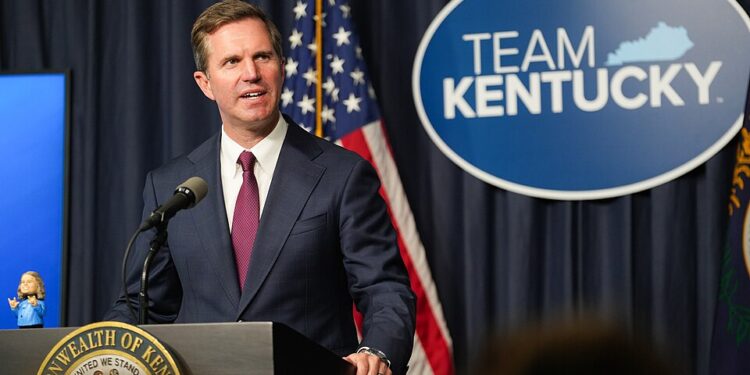
Kentucky Gov. Andy Beshear is escalating pressure on Republican Sen. Mitch McConnell, demanding that the longtime senator make a brief public appearance to reassure Kentucky voters about his health and ability to continue serving in the U.S. Senate.
Beshear, a Democrat, raised the issue Sunday during an appearance on CBS News’ Face the Nation, saying he has received no response from McConnell despite publicly calling for the senator to address his constituents.
The Kentucky governor said McConnell could settle many of the questions surrounding his recovery with something as simple as a two-minute television interview, telephone appearance or recorded video.
The dispute comes after McConnell returned home following a weeks-long hospital and rehabilitation stay, renewing a broader debate over the health, transparency and accountability of aging elected officials in Washington.
Beshear Demands Public Appearance From McConnell
During his CBS interview, Beshear said he had heard “absolutely nothing back” from McConnell.
The governor stressed that he personally wishes the Republican senator good health and does not want to see him suffer. However, Beshear argued that McConnell has an obligation to provide Kentucky residents with greater reassurance about his condition.
In Beshear’s view, voters — not political leaders in Washington — are ultimately McConnell’s bosses.
That argument formed the centerpiece of the governor’s criticism.
Beshear said McConnell could call into a national television program for approximately two minutes, speak with Fox News or simply record a short message for Kentucky residents.
According to Beshear, McConnell has not done so.
The Democratic governor characterized the senator’s lack of a public appearance as an accountability issue, suggesting Kentucky voters deserve to see and hear directly from the man representing them in Washington.
McConnell’s Health Becomes a Political Issue
McConnell’s health has attracted considerable attention because of his prominent position in American politics and his decades of service in the Senate.
The Kentucky Republican has been one of the most consequential conservative lawmakers of the modern era.
As the former Senate Republican leader, McConnell played a central role in major legislative battles, federal spending negotiations and judicial confirmations.
Perhaps most significantly for conservative voters, McConnell was instrumental in advancing Republican judicial nominees during President Donald Trump’s first administration, helping establish a conservative majority on the U.S. Supreme Court.
That political legacy means questions surrounding McConnell’s ability to continue serving carry consequences far beyond Kentucky.
The controversy also arrives as Republicans navigate major battles involving the economy, federal spending, immigration, national security and President Trump’s agenda.
Beshear Takes Aim at Republican Leadership
Beshear expanded his criticism beyond McConnell during the interview.
He also targeted Senate Majority Leader John Thune, arguing that the Republican leader has a responsibility to ensure senators under his leadership remain capable of performing their official duties.
Beshear then turned the discussion into a broader criticism of Senate Republicans and President Trump.
The Kentucky governor accused Republican senators of failing to hold themselves accountable and claimed GOP lawmakers were unwilling to challenge the president.
That portion of Beshear’s remarks moved the discussion beyond McConnell’s health and directly into the larger partisan battle between Democrats and Republicans in Washington.
For conservative readers, that distinction matters.
There is a legitimate public-interest question surrounding the health and capacity of any elected official, regardless of political party. However, Beshear’s decision to connect McConnell’s recovery with an attack on Trump and Republican senators demonstrates how quickly questions about an individual lawmaker’s health can become part of a much larger political fight.
McConnell Returns Home After Lengthy Recovery
McConnell announced on Aug. 6 that he had returned home following an extended period of medical care and rehabilitation in the Washington, D.C., area.
The senator issued a statement saying he would continue his recovery from home.
McConnell expressed appreciation for the support he received from friends, colleagues and Kentucky residents while also thanking the doctors, nurses, therapists and other medical professionals who cared for him.
He said his doctors had recommended that he maintain an intensive physical therapy regimen at home during the Senate’s state work period.
Importantly, McConnell also indicated that his recovery would not completely remove him from his official responsibilities.
The senator said he intended to remain engaged with his staff and Senate colleagues on important government business while continuing physical therapy.
That statement offered some reassurance about McConnell’s involvement in Senate affairs, but Beshear maintains that Kentucky voters deserve something more direct.
Should Elected Officials Have to Prove They Can Serve?
The political clash raises a question that increasingly confronts American voters: How transparent should elected officials be about their health?
Members of Congress make decisions affecting Social Security, Medicare, taxes, retirement savings, health care, immigration, national defense and the broader U.S. economy.
Those responsibilities make the physical and mental capacity of elected officials a legitimate concern for the Americans they represent.
The issue is not limited to Republicans or Democrats.
Washington has repeatedly faced controversy surrounding older politicians whose health problems raised questions about whether they remained capable of carrying out demanding public responsibilities.
Americans may disagree about how much private medical information politicians should disclose. But voters also have an obvious interest in knowing whether their representatives can participate in votes, negotiations, hearings and other essential government business.
That tension between medical privacy and public accountability is likely to remain an important political issue as America’s leadership continues to age.
McConnell’s Political Legacy Looms Large
McConnell has represented Kentucky in the Senate since 1985, making him one of the longest-serving senators in American history.
During that time, he became one of Washington’s most influential Republican power brokers.
His leadership proved particularly important during Trump’s first term, when Senate Republicans confirmed three Supreme Court justices and numerous federal judges.
Those confirmations reshaped the federal judiciary and created a conservative legal legacy that could influence American law for generations.
McConnell has also been involved in decades of debates over taxes, government spending, national defense, entitlement programs and the federal budget.
That history helps explain why developments involving his health continue attracting national attention.
Kentucky Voters Await McConnell’s Next Move
For now, McConnell says he is recovering at home, undergoing intensive physical therapy and remaining engaged in Senate business.
Beshear says that is not enough.
The Democratic governor wants McConnell to speak directly to the public, arguing that even a two-minute appearance would give Kentucky residents an opportunity to evaluate the senator for themselves.
Whether McConnell accepts that challenge remains to be seen.
If he makes a public appearance, the controversy could quickly lose momentum. If he remains out of public view, Democrats may continue using the issue to pressure McConnell and Republican Senate leadership.
Either way, the episode is becoming about more than one senator’s recovery.
It touches on an increasingly important question for voters across the country: When an elected official faces serious health concerns, how much transparency do the American people deserve?