
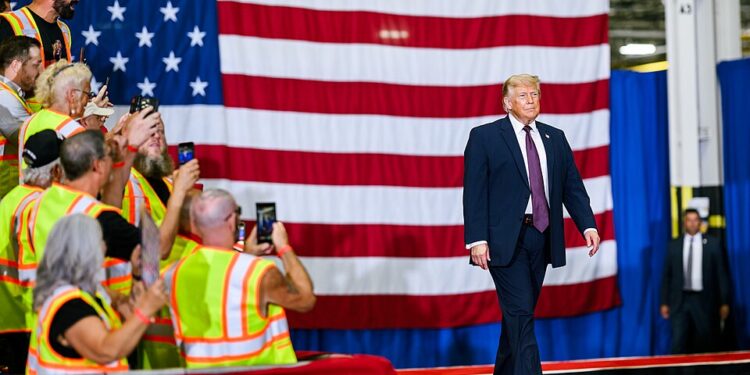
President Donald Trump is praising a major new defense agreement between Saudi Arabia, Turkey, and Pakistan, describing the pact as an important development that could reshape regional security and reduce the burden placed on the United States.
Trump welcomed the newly signed Mecca Joint Defence Agreement on Sunday, arguing that the partnership shows American allies are increasingly prepared to take greater responsibility for their own national defense.
The agreement comes at a critical moment for U.S. foreign policy, with ongoing concerns involving Iran, missile and drone threats, military spending, energy security, and America’s long-term commitments throughout the Middle East.
For American taxpayers who have watched Washington spend enormous sums maintaining military commitments overseas for decades, the development could have significant implications.
Trump Praises Saudi Arabia, Turkey and Pakistan
Trump publicly congratulated the leaders of Saudi Arabia, Turkey, and Pakistan following the agreement.
The president said he was “very happy” that the three nations had finalized the pact and described it as evidence that countries in the region are beginning to cooperate more closely on their own security.
Trump also emphasized his belief that countries should have a greater ability to protect themselves rather than depending excessively on the United States.
The president called the agreement a “big, bold, and important first step.”
That reaction is consistent with one of Trump’s longstanding foreign-policy priorities: encouraging U.S. allies and security partners to shoulder more of the financial and military responsibility for their own defense.
What Is the Mecca Joint Defence Agreement?
Saudi Arabia, Turkey, and Pakistan signed the Mecca Joint Defence Agreement on Aug. 7 amid heightened concerns about regional instability and threats involving missiles and drones.
The three countries have important security relationships with the United States, while Turkey is also a longtime member of NATO.
At the center of the agreement is a collective-defense commitment.
The agreement states that military aggression against any one of the three member nations would be treated as a threat to the entire alliance.
The concept resembles the collective-security principle associated with NATO, although the new agreement does not necessarily require an automatic military response.
That distinction is important.
Exactly how Saudi Arabia, Turkey, and Pakistan would respond during an actual military confrontation could depend on the circumstances and decisions made by their respective governments.
Nevertheless, establishing a formal collective-defense commitment represents a potentially significant development for security in the Middle East and surrounding region.
Why the New Defense Pact Matters to America
The agreement could matter to Americans because the United States has maintained extensive military, diplomatic, and economic interests throughout the Middle East for generations.
Washington has spent substantial resources protecting American interests, supporting allies, maintaining military installations, deploying service members, and attempting to preserve stability in strategically important areas.
Trump has repeatedly questioned arrangements in which the United States carries what he considers an unfair share of the defense burden.
His position has been particularly visible in discussions involving NATO defense spending.
Trump has consistently pressured allies to strengthen their armed forces and devote more of their own resources to national security.
The Saudi-Turkish-Pakistani agreement potentially advances that objective by creating a framework in which three major U.S. partners cooperate more closely with one another.
American Taxpayers Could Have a Stake
The debate surrounding overseas defense commitments is not simply about military strategy.
It also involves taxpayer dollars.
Defense spending, foreign military commitments, energy security, international trade, and regional stability can ultimately have economic consequences for American households.
For older Americans in particular, concerns about federal spending, government debt, inflation, retirement security, and the responsible use of taxpayer money remain important parts of the national debate.
If America’s partners become more capable of providing for their own defense, supporters of Trump’s approach could argue that Washington may eventually have greater flexibility in determining where American military resources are needed most.
That does not mean the United States would abandon its allies.
Instead, Trump’s argument has generally centered on burden-sharing: allies should remain partners while contributing more substantially to their own security.
Saudi Arabia Brings Major Regional Influence
Saudi Arabia remains one of the most economically and strategically important countries in the Middle East.
The kingdom has invested heavily in its military and has longstanding security ties with Washington.
Saudi leaders have also been working to diversify the country’s economy and expand domestic industries, including defense manufacturing.
Its participation gives the new agreement substantial economic and geopolitical importance.
Saudi Arabia’s location and influence in global energy markets also mean that instability involving the kingdom can have consequences extending far beyond the Middle East.
Developments affecting regional security can influence oil markets, international shipping, business confidence, and ultimately costs faced by consumers.
Turkey Adds NATO Experience
Turkey brings a different set of capabilities to the partnership.
As a NATO member, Turkey has decades of experience operating within a major multinational defense alliance.
The country also possesses a large military and has developed an increasingly sophisticated domestic defense industry.
Turkish companies have become particularly prominent in areas including unmanned aircraft and other military technologies.
That experience could prove valuable as the three countries determine how their new security arrangement will function in practice.
Turkey’s geographic position is also strategically significant, connecting Europe, the Middle East, and the Black Sea region.
Pakistan Adds Significant Military Strength
Pakistan has maintained extensive military ties with Saudi Arabia for decades.
The country possesses a large and experienced armed forces establishment and occupies a strategically important position in South Asia.
Closer cooperation between Pakistan, Saudi Arabia, and Turkey could therefore create a substantial new security partnership connecting the Middle East and South Asia.
The countries are expected to expand military cooperation as they develop the agreement.
That could potentially include additional training, joint exercises, defense-industry partnerships, intelligence cooperation, and strategic planning.
The precise scope of those activities will become clearer as the governments begin implementing the pact.
Iran Remains a Major Factor
The agreement also arrives during a period of heightened concern about Iran and regional security.
Saudi Arabia and other Gulf countries have spent years evaluating how best to protect themselves against missile, drone, and other potential threats.
Modern warfare has made air defense, intelligence sharing, surveillance, cybersecurity, and early-warning capabilities increasingly important.
A coordinated defense structure could allow participating countries to combine some of their resources and expertise.
However, much will depend on how the agreement is implemented.
A document promising collective defense is one thing. Coordinating military forces during an actual emergency is considerably more complicated.
Questions Still Surround the Agreement
Despite Trump’s enthusiastic reaction, several important questions remain.
The agreement does not appear to guarantee an automatic military response whenever one member is attacked.
That leaves uncertainty about what the collective-defense commitment would mean during a real crisis.
Political relationships can also change over time, and Saudi Arabia, Turkey, and Pakistan each have their own national interests and foreign-policy priorities.
The effectiveness of the agreement will therefore depend on whether those interests remain aligned when difficult decisions arise.
American policymakers will likely watch closely as the three governments establish the practical details of their partnership.
Trump’s “America First” Strategy Comes Into Focus
Trump’s praise for the agreement highlights a broader question surrounding America’s role in the world.
How much responsibility should the United States carry for protecting friendly countries?
Trump has spent years arguing that America can maintain strong alliances without allowing other nations to rely disproportionately on American military power and taxpayer resources.
His supporters view that approach as common-sense burden-sharing.
The president’s critics have sometimes argued that aggressive demands on allies could strain longstanding relationships.
The new agreement provides an interesting test of those competing arguments.
If U.S. partners develop stronger military capabilities while maintaining close relations with Washington, Trump could point to the development as evidence that allies can assume greater responsibility without weakening American partnerships.
What Happens Next?
The most important question now is whether the Mecca Joint Defence Agreement develops into a meaningful military partnership or remains primarily a diplomatic commitment.
Saudi Arabia, Turkey, and Pakistan will need to determine how their armed forces coordinate, what obligations each country assumes, and how they would respond to a genuine security emergency.
Those decisions could have consequences for U.S. national security, American military planning, global energy markets, defense spending, and the broader balance of power across the region.
For now, Trump is making clear that he welcomes the development.
Rather than viewing stronger cooperation among the three U.S. partners as a challenge to American influence, the president is presenting it as evidence that allies can become more capable of defending themselves.
For Americans concerned about national security, federal spending, military readiness, and the cost of America’s overseas commitments, that could become an important part of the foreign-policy debate.
And for Trump, the message is straightforward: strong allies do not necessarily require a weaker America. In his view, allies capable of carrying more of their own defense burden could ultimately leave the United States stronger, more flexible, and better positioned to put American interests first.