
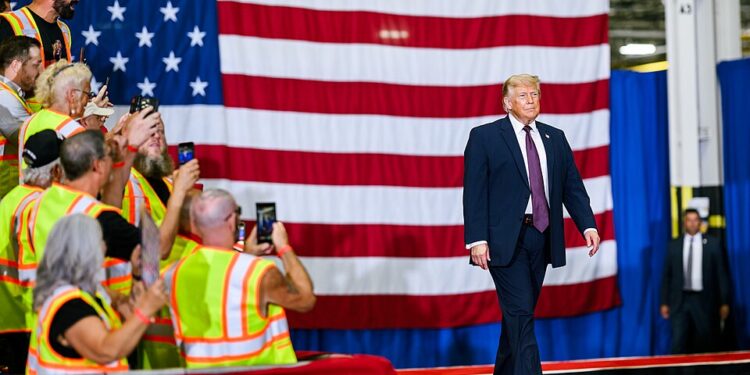
President Donald Trump is putting a spotlight on dramatic changes taking place in Washington, D.C., as his administration moves ahead with an aggressive campaign to clean up, restore and reshape parts of the nation’s capital.
Trump celebrated the progress Tuesday, pointing to thousands of repairs and improvements that his administration says have already been completed across Washington.
The president also showcased restoration work at the White House, where several major projects have become part of Trump’s broader effort to leave a lasting mark on one of America’s most historic properties.
While critics continue raising questions about costs and the scale of the changes, Trump is making the case that America’s capital should be safe, clean and worthy of representing the most powerful nation in the world.
And he appears eager for Americans to see the results.
Trump Touts Major Washington Cleanup
Trump highlighted the administration’s beautification campaign in a series of posts on Truth Social.
According to figures promoted by the president, approximately 2,300 lights have been repaired across Washington.
Another 1,460 benches have either been rehabilitated or installed, while more than 500 instances of graffiti have been cleaned up.
Those numbers give Trump a straightforward message to take to voters: His administration isn’t simply talking about improving Washington—it wants Americans to see physical evidence of the changes.
For residents and visitors, basic improvements such as working lights, maintained benches and graffiti removal may seem relatively small compared with the enormous political battles taking place in Congress.
But they can have a major impact on how people perceive a city.
A nation’s capital is more than another metropolitan area. It is where millions of Americans visit monuments honoring the country’s founders, veterans and national history.
Trump has repeatedly argued that Washington should look the part.
Trump Shows Off White House Restoration
The president quickly followed his Washington announcement by showcasing restoration work at the White House.
Trump shared photographs of the restored Thomas Jefferson Columns and praised the finished appearance.
“The Restoration of the Thomas Jefferson Columns at the White House — The work turned out beautifully!” Trump wrote on Truth Social.
The photographs gave Americans another glimpse at Trump’s increasingly ambitious effort to transform and restore portions of the White House complex.
The president has long shown an intense interest in architecture, construction and presentation, and that approach has become especially visible during his current term.
Some changes have involved restoration and maintenance.
Others have been far more dramatic.
Trump Has Big Plans for the People’s House
Since returning to office in January 2025, Trump has pursued a number of significant changes to the White House and its grounds.
One of the most visible involved the famous White House Rose Garden.
The grassy central portion of the garden was replaced with a stone patio, producing a dramatically different appearance.
Trump defended the decision on practical grounds, arguing that the old lawn could become difficult to use when weather conditions were poor.
That mattered because the Rose Garden has traditionally been used for presidential announcements, ceremonies, meetings with foreign leaders and other important events.
A hard surface allows the area to accommodate guests, tables, chairs and equipment without many of the problems associated with wet or damaged grass.
Critics disliked the dramatic change to such a recognizable location.
Trump saw things differently.
For the president, the project represented a combination of appearance and practicality—two themes that have become central to his White House renovation agenda.
White House Ballroom Sparks Bigger Battle
The biggest and most controversial project is Trump’s planned White House ballroom and accompanying East Wing redevelopment.
The original East Wing was demolished to make way for the project, creating one of the most significant physical transformations of the White House complex in generations.
Trump has argued that the White House needs a permanent large-scale venue for major events.
For decades, presidents hosting large state dinners and other gatherings have sometimes relied on temporary structures.
Trump wants a permanent solution.
Supporters can argue that the world’s leading superpower should have an appropriate facility for hosting foreign leaders and major national events.
Critics have focused instead on the project’s enormous size, financing, historical implications and legal questions surrounding its construction.
Those disagreements have now moved well beyond ordinary political criticism.
The ballroom project has faced serious legal challenges over whether the administration has the authority to proceed with such extensive construction without additional congressional authorization.
That battle has helped turn what might ordinarily be an architectural story into a major political and legal fight.
Nearly $1 Billion Price Tag Draws Attention
Then there is the money.
Recent reporting estimates that construction projects on the White House grounds could total at least $900 million, with one estimate putting the figure at approximately $927 million.
That broader figure encompasses considerably more than cosmetic decorating, making it important to distinguish between individual renovations and the administration’s larger construction program.
Nevertheless, the enormous price tag has provided Trump’s opponents with plenty of ammunition.
Critics are questioning whether such extensive spending is justified and how much of the cost should ultimately fall on taxpayers.
Trump’s defenders have another side to the argument.
The White House isn’t simply the president’s residence.
It is a working government complex, an internationally recognized American landmark, a venue for diplomacy and a highly sensitive national security facility.
Maintaining and modernizing such a property inevitably carries significant costs.
The political argument is over how far those improvements should go—and how much Americans should be willing to spend.
Trump’s Washington Makeover Goes Beyond the White House
The most politically significant part of Trump’s announcement may actually have little to do with ballrooms or historic columns.
Instead, it could be the basic improvements happening across Washington.
Working streetlights.
Clean public spaces.
Maintained benches.
Removing graffiti.
These are highly visible issues that ordinary Americans can understand without needing to follow a complicated debate in Congress.
For older Americans in particular, the condition of the nation’s capital can carry symbolic importance.
Washington contains the White House, U.S. Capitol, Lincoln Memorial, Washington Monument, Arlington National Cemetery and countless other reminders of American history.
Millions of families, veterans and schoolchildren travel there every year.
Trump’s argument is essentially that those Americans deserve a capital that is clean, orderly, safe and well maintained.
That message fits neatly into the president’s broader focus on law and order, infrastructure and restoring traditional American institutions.
Critics Question Trump’s Sweeping Changes
Not everyone is celebrating.
Trump’s sweeping makeover of Washington and the White House has faced opposition from preservation groups, political opponents and others concerned about costs and historic preservation.
Some critics believe the president is changing iconic locations too aggressively.
Others have questioned the legal authority behind certain construction projects.
The White House ballroom has become the clearest example of that dispute, with its future becoming the subject of a major court battle.
Those concerns deserve scrutiny, especially when historic federal property and hundreds of millions of dollars are involved.
But Trump appears determined to push forward with his larger vision wherever legally possible.
The president isn’t hiding the changes.
He is advertising them.
Trump Turns Beautification Into a Political Message
Trump’s Tuesday posts demonstrate how even construction and maintenance can become part of a larger political argument.
The administration can point to thousands of repaired lights, restored or newly installed benches and hundreds of graffiti cleanups as tangible accomplishments Americans can actually see.
Opponents can point to escalating construction costs and question whether Trump’s more ambitious projects are necessary.
That creates a remarkably simple debate.
Is Trump spending too much and changing too much?
Or is he finally giving America’s capital the attention and investment it deserves?
For conservative voters who have spent years hearing concerns about crime, disorder, deteriorating infrastructure and neglected public spaces, Trump’s message may have considerable appeal.
The president is presenting his Washington agenda as something bigger than a renovation project.
He wants it viewed as a restoration of America’s front door.
And judging by his latest posts, Trump is more than happy to make the results part of his political record.