
President Donald Trump made a remarkable statement about North Korea’s nuclear capabilities Wednesday, telling reporters that leader Kim Jong Un possesses 57 powerful nuclear weapons while suggesting that his personal relationship with the North Korean leader remains an important part of U.S. diplomacy.
Trump also declined to reveal whether he and Kim are currently exchanging private letters, adding another layer of intrigue to a relationship that has repeatedly attracted international attention.
The comments come as the Trump administration confronts major national-security questions involving North Korea, Iran and the broader threat of nuclear proliferation.
For Americans concerned about military preparedness, nuclear weapons and U.S. leadership abroad, Trump’s remarks provide a revealing look at how the president intends to approach one of the world’s most unpredictable governments.
Trump Won’t Say Whether He Is Writing To Kim
Trump was taking questions from reporters outside the White House when he was asked whether he and Kim were exchanging written correspondence.
“I can’t tell you that,” Trump responded.
The president’s refusal to provide a direct answer is significant because private correspondence played an unusually prominent role in his relationship with Kim during his first administration.
Trump and Kim exchanged approximately 27 letters during that period as the two governments attempted to move from confrontation toward diplomacy.
Journalist Bob Woodward was later given access to correspondence between the two leaders.
Trump’s latest answer leaves open the possibility that private communication could once again be playing a role in negotiations between Washington and Pyongyang. However, Trump did not confirm that any current correspondence exists.
Trump Says Kim Has 57 Nuclear Weapons
Trump then made one of the most consequential claims of the exchange.
According to the president, Kim possesses 57 “very powerful” nuclear weapons.
Trump argued that North Korea should never have been allowed to build such a formidable nuclear capability and criticized previous U.S. leadership for failing to prevent it.
“If I were president, I wouldn’t have allowed it,” Trump said.
The precise size of North Korea’s nuclear arsenal has long been difficult to determine independently because of the secretive nature of Kim’s government. Trump’s figure therefore represents the president’s public characterization of North Korea’s capabilities rather than an independently confirmed inventory disclosed during his remarks.
Whatever the exact number, North Korea’s nuclear program remains a serious national-security concern for the United States and its allies.
Trump Defends His Relationship With Kim
Trump also defended something that has generated controversy since his first administration: his willingness to cultivate a personal relationship with Kim.
“But I get along with him,” Trump said. “And you know what? The fact that I get along with him, that’s a good thing. Not a bad thing.”
Trump has repeatedly argued that maintaining communication with America’s adversaries can reduce the chances of war.
That philosophy became especially visible during his first term.
Trump and Kim initially exchanged heated rhetoric as tensions over North Korea’s missile and nuclear programs intensified. The relationship later shifted dramatically toward direct diplomacy and historic face-to-face meetings.
For Trump supporters, that transformation demonstrated the potential benefits of negotiating from a position of strength while keeping diplomatic channels open.
Critics have questioned whether the personal diplomacy produced enough concrete concessions from North Korea.
The fundamental question remains the same: Can Trump’s relationship with Kim translate into measurable improvements in American and allied security?
Trump Says Kim Is “Going To Be Fine”
Another portion of Trump’s remarks is likely to generate considerable discussion.
The president said he knows Kim “very well” and predicted that the North Korean leader is “gonna be fine” as long as America has what Trump considers strong leadership.
“As long as we have a smart president, he’s going to be fine,” Trump said.
The president suggested the situation could look very different under weaker leadership.
Trump’s comments reflect his broader argument that personal diplomacy combined with American military and economic strength can discourage adversaries from taking actions that threaten the United States.
But dealing with North Korea remains extraordinarily complicated.
Kim oversees a heavily armed government that has spent decades developing ballistic missiles and nuclear weapons despite international sanctions and diplomatic pressure.
That makes any potential negotiations between Trump and Kim a high-stakes matter for U.S. national security.
Trump Draws A Line Between North Korea And Iran
Trump also connected his discussion of North Korea with another major foreign-policy challenge: Iran.
“I can’t let Iran have a nuclear weapon,” the president told reporters.
The comparison highlights a difficult reality confronting Washington.
North Korea already possesses nuclear weapons. Preventing additional countries from obtaining them is therefore a major component of America’s nonproliferation strategy.
Trump’s position appears to be that the United States must deal pragmatically with North Korea’s existing capabilities while preventing Iran from reaching the same position.
For Americans who remember the Cold War and decades of concern about nuclear conflict, the stakes surrounding nuclear proliferation are difficult to overstate.
A world containing additional nuclear-armed governments could create new dangers for the United States, its military personnel and its allies.
Another Trump-Kim Meeting Could Be Coming
Trump also provided a straightforward answer when reporters asked whether he expects to meet Kim later this year.
“Yeah, I will be,” Trump said.
A new meeting would revive one of the most unconventional diplomatic relationships in modern American history.
During Trump’s first administration, the two leaders participated in unprecedented summits intended to reduce tensions and explore possible denuclearization.
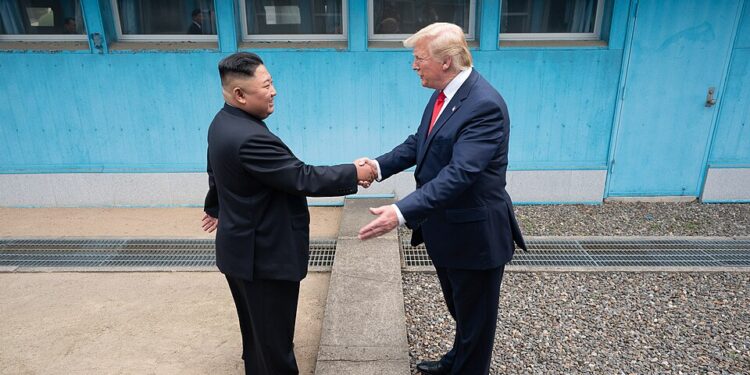
Trump also made history in 2019 when he crossed the military demarcation line at the Korean Demilitarized Zone and briefly entered North Korea while meeting Kim.
Those encounters captured worldwide attention.
They did not, however, result in North Korea surrendering its nuclear arsenal, meaning another round of diplomacy would begin with many of the fundamental security questions still unresolved.
U.S. Military Exercises Become Part Of The Story
Trump’s comments also come after the president called for Defense Secretary Pete Hegseth to scale back certain military exercises near North Korea.
Trump characterized Kim’s government as “unthreatening and respectful” during his presidency and indicated that the United States could adjust some military activity accordingly.
That approach could become an important part of any renewed negotiations.
Supporters of Trump’s strategy may view reducing certain exercises as a reasonable diplomatic tool when doing so lowers tensions without compromising American security.
Others may argue that military exercises involving the United States and its allies provide an important deterrent against North Korean aggression.
The key issue is whether Washington can encourage cooperation from Pyongyang without weakening America’s ability to protect itself and its allies.
Why Trump’s Comments Matter For Americans
North Korea may be thousands of miles away, but its nuclear and missile programs have direct implications for American national security.
The United States maintains important alliances with South Korea and Japan, and American military personnel remain stationed throughout the region.
Any serious confrontation on the Korean Peninsula could therefore have consequences extending far beyond North Korea’s borders.
There is also a broader concern.
If nuclear weapons are seen as providing hostile governments with protection from outside pressure, other countries could have greater incentive to pursue nuclear programs of their own.
Preventing that kind of proliferation has been a major American foreign-policy objective under presidents of both parties.
Trump’s Personal Diplomacy Faces Another Major Test
Trump has long argued that his willingness to speak directly with controversial foreign leaders should be considered a strength rather than a liability.
His relationship with Kim may soon provide another test of that strategy.
Communication between Washington and Pyongyang could potentially reduce the risk of misunderstanding or accidental escalation. But diplomacy will ultimately be judged by whether it produces meaningful results for the United States.
Trump’s disclosure about what he described as Kim’s 57 nuclear weapons underscores just how serious the challenge has become.
If another Trump-Kim summit takes place, Americans will be watching for more than photographs and handshakes.
They will want to know whether the talks make the United States safer, protect American troops and allies, reduce the danger of nuclear conflict and prevent North Korea’s weapons program from becoming an even greater threat.
For Trump, the challenge is clear: maintaining communication with Kim while demonstrating that diplomacy can deliver concrete national-security results.
With nuclear weapons potentially hanging over the negotiations, few foreign-policy issues carry higher stakes.