
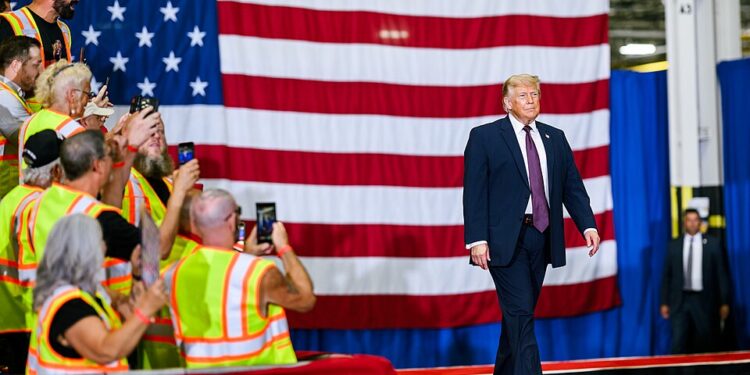
President Donald Trump is facing a surprising revolt from fellow Republicans after unveiling a new plan designed to lower beef prices for American families.
The disagreement puts two major conservative priorities on a collision course: lowering grocery prices for consumers and protecting American ranchers from increased foreign competition.
Trump announced Friday that the United States will temporarily allow substantially more imported ground-beef products into the country without triggering higher out-of-quota tariffs.
The president says the move will help bring relief to Americans frustrated by expensive trips to the grocery store.
But Republicans from some of America’s biggest cattle-producing states are warning that the short-term solution could come at the expense of the very ranchers Trump has repeatedly promised to defend.
Trump Moves to Bring Down Beef Prices
Under Trump’s plan, the United States will allow up to 300,000 metric tons of ground-beef products to be imported over a 90-day period without the normal out-of-quota tariff.
Trump said foreign suppliers have committed to selling that beef at prices 25 percent below current market levels.
The president argues the additional supply can help ease prices for consumers while America’s cattle herd rebuilds.
Beef prices have become a particularly noticeable part of the broader cost-of-living debate because Americans encounter them directly at supermarkets, restaurants and backyard cookouts.
At the same time, the domestic cattle supply has fallen to historically low levels, making it difficult to quickly increase American beef production.
Trump says his temporary import strategy is intended to address both problems.
“We wanna get the beef prices down,” Trump told reporters Friday, saying lower prices are what voters want.
For Americans watching every dollar at the supermarket, that message is easy to understand.
But ranch-state Republicans say there is another side to the story.
Republicans Warn American Ranchers Could Pay the Price
Sen. Tim Sheehy of Montana was among the Republicans who quickly challenged Trump’s decision.
Sheehy acknowledged that the president wants to help consumers but warned that increasing foreign beef imports could hurt American ranching families, many of whom strongly support Trump and the Republican Party.
Other Republicans raised similar concerns.
Sens. Deb Fischer and Pete Ricketts of Nebraska and Steve Daines of Montana criticized the decision, while Republican House members including Mike Flood, Adrian Smith, Thomas Massie, Kat Cammack, Dusty Johnson and Troy Downing also voiced objections.
Their concern is that bringing additional lower-priced foreign beef into the American market could put downward pressure on domestic cattle prices.
That could potentially reduce the financial incentive for ranchers to expand their herds — exactly when the United States needs more cattle to increase domestic beef supplies over the long term.
The dispute has therefore created an unusual political dilemma for Trump.
Lower Grocery Prices vs. Protecting American Producers
Trump has spent years promoting an America First economic agenda built around domestic manufacturing, American energy and support for U.S. farmers and ranchers.
At the same time, Americans expect the president and Congress to address the prices they encounter in everyday life.
Those priorities aren’t always easy to reconcile.
Allowing additional beef imports could increase supply and potentially provide some relief to consumers. But cattle producers fear that bringing foreign beef into the country at below-market prices could weaken domestic producers.
That tension is especially important in rural America.
Farmers and ranchers have traditionally been a crucial Republican constituency, and many cattle-producing communities strongly supported Trump.
Republicans criticizing the plan aren’t necessarily rejecting Trump’s goal of reducing grocery prices. Instead, they’re questioning whether increasing imports is the right way to accomplish it.
Trump Defends His Relationship With Ranchers
Trump pushed back against suggestions that his decision represents an abandonment of American cattle producers.
“The ranchers are great. They’re my people. I love the ranchers,” Trump told reporters.
The president praised American producers and argued that the country nevertheless needs additional help getting beef prices under control.
Trump appears to view the policy as a temporary bridge rather than a permanent shift toward greater dependence on imported beef.
His critics remain skeptical.
Justin Tupper, president of the United States Cattlemen’s Association, delivered one of the sharpest responses to the administration’s move.
“You don’t put America first by putting U.S. cattle producers last,” Tupper said.
That statement captures the central argument coming from the cattle industry: Consumer prices matter, but so does America’s ability to produce its own food.
America’s Cattle Herd Is Part of the Problem
The controversy comes as the United States deals with a cattle shortage that cannot be reversed overnight.
Rebuilding cattle herds takes time. Ranchers must decide to retain breeding animals, produce more calves and wait for those animals to reach market weight.
That means there is no instant solution to America’s beef-supply problem.
The Trump administration is betting that temporarily increasing imported supplies can help consumers while domestic production recovers.
Some ranchers argue that the policy could have the opposite effect.
If additional foreign competition reduces cattle prices received by American producers, ranchers could have less incentive to expand their operations.
That creates the possibility of a short-term versus long-term tradeoff.
Consumers may welcome any relief they see at the meat counter today, while producers are focused on what the policy could mean for America’s beef supply tomorrow.
Where Will the Imported Beef Come From?
Another major question remains unanswered.
Trump has not publicly identified which countries will provide the additional beef.
When reporters asked the president where the imports would originate, Trump declined to reveal the countries involved.
“I don’t wanna say,” Trump responded.
He did, however, promise that Americans would receive high-quality beef.
The lack of details could fuel additional questions from Republicans and cattle producers who want to know which foreign suppliers will benefit from the tariff relief.
Consumers may also want to know where the beef sold at lower prices is being raised and processed.
Could Trump’s Plan Actually Lower Beef Prices?
That could become the most important question of all.
Trump says the agreement is designed to substantially reduce ground-beef prices for working families, but the eventual impact at grocery stores will depend on several factors.
Import volumes are only one part of the retail price consumers ultimately pay.
Processing costs, transportation, labor, retailer margins, consumer demand and the size of America’s cattle herd can all influence the price on the supermarket shelf.
That means shoppers will ultimately judge the policy by what happens when they reach the checkout counter.
If prices noticeably decline, Trump could point to the agreement as evidence that his administration acted aggressively to address food costs.
If consumers see little difference while ranchers face additional competition, Republican critics will have a much stronger argument against the policy.
The Midterm Elections Raise the Stakes
The timing makes the disagreement even more significant.
With the midterm elections approaching, affordability remains one of the biggest concerns facing American households.
Older Americans may be particularly sensitive to persistent food inflation because many retirees live on fixed or relatively predictable monthly incomes.
Working families face the same basic problem: When groceries, utilities, insurance and other necessities become more expensive, there is less money left over at the end of the month.
Trump clearly wants voters to see that his administration is willing to take action to lower everyday costs.
Republicans from agricultural states, however, don’t want that relief to come by weakening American producers.
Both sides are therefore arguing that they are protecting American families — they simply disagree over the best way to do it.
An America First Debate Inside the GOP
The beef controversy is becoming more than a disagreement about one agricultural product.
It raises a fundamental question about what America First economics should look like in practice.
Should Washington temporarily allow more foreign competition when doing so could reduce prices for consumers?
Or should policymakers protect American producers even if limited domestic supplies mean consumers pay higher prices in the short term?
Trump has made his choice clear.
He wants beef prices down, and he believes temporarily increasing imports can help accomplish that goal while America’s cattle herd recovers.
A growing group of Republicans from cattle country isn’t convinced.
For Trump, the political calculation is straightforward but risky: Americans want relief from high grocery bills, while ranchers want assurance that Washington isn’t going to sacrifice domestic agriculture for cheaper imports.
Whether the president can deliver lower prices without hurting American cattle producers will determine who ultimately wins this Republican beef battle.