
President Donald Trump is getting some unexpected support from across the political aisle as Washington debates one of the biggest economic and national security issues facing the United States: the rapidly growing race for artificial intelligence.
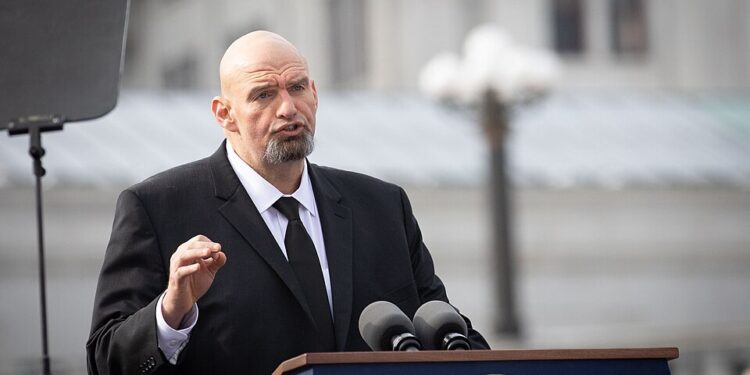
Democratic Sen. John Fetterman of Pennsylvania is warning that excessive restrictions on artificial intelligence and the data centers needed to power it could ultimately strengthen China at America’s expense.
Fetterman made his position clear Saturday while responding to an analysis examining the increasingly competitive AI race between the United States and China.
Fetterman wrote on X that America’s national security depends heavily on maintaining leadership in artificial intelligence and a strong, dominant energy sector.
The Pennsylvania Democrat then pushed back against growing political opposition to massive data centers and concerns about the future of artificial intelligence.
“China continues to fuel and benefit from our overreaction,” Fetterman wrote. “I reject the political pandering and hyperbole over data centers or AI doomsdaying.”
His remarks put him surprisingly close to Trump on an issue that could have major consequences for American jobs, energy production, technology investment and national security.
Fetterman Backs American AI Leadership
Fetterman has increasingly argued that the United States cannot afford to slow down while China continues investing in advanced technology.
His message is straightforward: America needs to remain the global leader in artificial intelligence rather than risk allowing Beijing to gain the upper hand.
Earlier this month, Fetterman responded to reports surrounding efforts to pause or restrict AI development by warning about what such a move could mean for the United States.
Fetterman argued that the United States must remain at the forefront of AI development or risk allowing China to set the standards and terms for the technology’s future.
It is a position that puts Fetterman at odds with some figures on the political left.
Sen. Bernie Sanders of Vermont and Rep. Alexandria Ocasio-Cortez of New York have backed legislation seeking a moratorium on new AI data centers while federal safeguards are developed.
Fetterman has gone in the opposite direction.
In March, he criticized the idea of stopping new AI data center construction, describing that approach as “China First.”
That disagreement highlights a growing divide in Washington over how the United States should balance technological expansion with concerns about electricity prices, water consumption, the environment and the effect AI could have on American workers.
Trump Pushes America to Build
Trump, meanwhile, has been making a similar argument about the importance of expanding America’s AI infrastructure.
The president has urged governors and local officials to consider the enormous economic investment that can accompany major data center projects.
“The construction jobs are enormous,” Trump said during remarks at the White House.
Trump argued that local communities could benefit from new jobs, investment and tax revenue when large AI facilities are constructed in their areas.
For communities searching for new sources of economic growth, those promises could be attractive.
But the rapid construction of data centers has also generated opposition around the country.
Trump acknowledged that the industry has a public relations problem as Americans become increasingly concerned about enormous computing facilities appearing in their communities.
Americans Have Concerns About Data Centers
The political challenge is significant.
Large data centers can require substantial amounts of electricity and water, leading residents and public officials to question how new facilities could affect utility bills, natural resources and surrounding communities.
Polling has shown considerable resistance to having the facilities built close to where people live.
Those concerns mean Trump and other supporters of rapid AI expansion face a difficult balancing act.
The United States wants to maintain its technological advantage over China, but policymakers also face pressure to ensure ordinary Americans do not end up carrying an unfair share of the costs associated with the AI boom.
The debate is therefore becoming about much more than technology.
It increasingly involves energy production, electricity costs, construction jobs, tax revenue, national security and America’s long-term economic competitiveness.
Trump Moves to Speed Up AI Infrastructure
The Trump administration has already taken steps to accelerate development.
Trump signed an executive order in July designed to streamline the federal permitting process for qualifying data center projects.
The administration’s broader objective is to make it easier for companies to build the enormous infrastructure required to develop and operate increasingly powerful artificial intelligence systems.
Trump believes the stakes are enormous.
The president has suggested that artificial intelligence could eventually become even more consequential than the internet.
“We’re leading by a lot with AI. We want to keep it that way,” Trump said.
At the same time, Trump has not called for eliminating oversight entirely.
“We want to regulate, but we want to have regulation where they can continue to lead, not regulation that’s going to stifle a very important industry,” he said.
That distinction could become increasingly important as Congress, state governments and local communities consider new restrictions on AI development.
China Becomes the Common Concern
China is ultimately what brings Trump and Fetterman together on this issue.
The two politicians disagree on plenty, but both are warning that the United States could pay a serious price if domestic opposition prevents America from keeping pace with its largest technological competitor.
Artificial intelligence is no longer simply about chatbots and consumer technology.
Advanced AI could affect manufacturing, military capabilities, cybersecurity, medicine, financial services, transportation and countless other industries.
That makes leadership in the field both an economic and national security priority.
The question facing Washington is how aggressively America should pursue that advantage — and what safeguards should accompany the expansion.
An Unusual Political Alliance
Fetterman’s comments are especially noteworthy because support for Trump’s policies from prominent Democrats remains relatively unusual.
This does not mean Fetterman has suddenly become a supporter of Trump’s broader agenda.
Instead, it shows how competition with China can sometimes cut across traditional party lines.
Trump wants America to expand AI infrastructure and maintain its technological lead.
Fetterman is now making a remarkably similar argument, warning that overreaction at home could become an advantage for Beijing.
Meanwhile, opposition to new data centers is unlikely to disappear. Americans continue to have legitimate questions about electricity demand, water usage, environmental effects and whether the economic benefits promised by developers will reach local residents.
Those concerns will have to be addressed as America’s AI industry grows.
But on the larger question of whether the United States should remain aggressive in the global technology race, Trump has gained an important Democratic voice making the case that slowing down could come with consequences.
For an administration determined to keep America ahead of China in artificial intelligence, Fetterman’s position provides a notable boost from the other side of the aisle.