
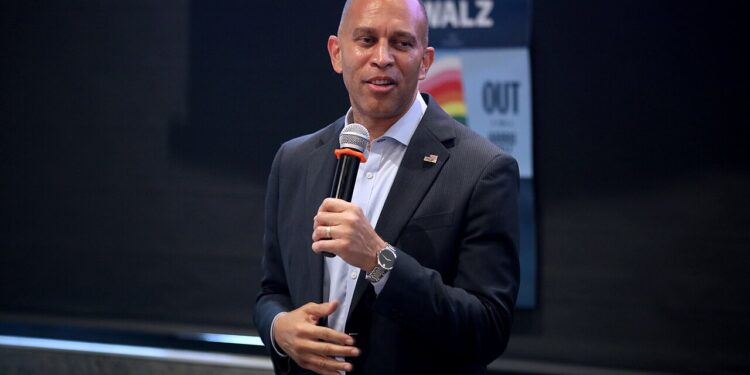
House Minority Leader Hakeem Jeffries is facing growing backlash from his own side after meeting privately with Jared Kushner, President Donald Trump’s son-in-law and longtime adviser.
The unexpected meeting has created a political headache for the top House Democrat just months before the 2026 midterm elections, when control of Congress will once again be decided by American voters.
Jeffries and Kushner reportedly discussed some of the biggest issues facing families across the country, including housing, immigration and the high cost of living.
But for some progressive activists and Democratic commentators, simply sitting down with a prominent member of Trump’s inner circle was already a step too far.
Now Jeffries is defending his decision while facing criticism from people who believe Democrats should be confronting the Trump political operation rather than looking for areas of potential cooperation.
Jeffries Confirms Meeting With Jared Kushner
Jeffries publicly confirmed the meeting Monday after reports about the private discussion generated national attention.
According to Jeffries, Kushner requested the meeting and the Democratic leader agreed to participate in order to discuss America’s affordability problems.
The meeting reportedly took place privately in New York City.
Housing costs, immigration and the broader cost-of-living debate were among the subjects discussed as potential areas where Democrats and the Trump administration could possibly find common ground.
Kushner also reportedly suggested that Jeffries speak with White House chief of staff Susie Wiles.
That possibility is particularly noteworthy because Jeffries has spent years serving as one of Trump’s most prominent Democratic opponents in Congress.
Despite the fierce political disagreements between the two parties, however, the meeting suggests that conversations may still be taking place behind the scenes.
Affordability Takes Center Stage
Jeffries defended his willingness to communicate with people connected to the Trump administration by focusing heavily on affordability.
That issue remains a major concern for Americans dealing with the everyday expenses of housing, groceries, utilities, insurance and other household necessities.
Jeffries said Democrats intend to demand major policy changes addressing affordability whenever they communicate with the administration.
He has also argued that Republicans have pursued an overly rigid governing strategy and said Democrats will continue opposing policies they believe hurt American families.
At the same time, the meeting demonstrates the complicated political reality facing congressional leaders.
Americans frequently say they want Washington to solve problems instead of engaging in endless partisan fighting. But compromise can become politically dangerous when each party’s most committed supporters expect their leaders to take a harder line.
Jeffries is now discovering exactly how difficult that balance can become.
Progressive Backlash Hits Jeffries
Some prominent voices on the political left reacted angrily after learning about the Kushner meeting.
Journalist Mehdi Hasan argued that Jeffries should be preparing to investigate Kushner if Democrats regain control of the House rather than meeting with him to discuss areas of agreement.
Michelle Kinney, co-founder of The Mayday Network, also expressed outrage over the meeting on social media, arguing that congressional scrutiny of Kushner would be more appropriate than private discussions.
Political commentator Dean Obeidallah questioned why Jeffries did not anticipate that news of the meeting could eventually become public.
He argued that the controversy risks creating an unnecessary distraction for Democrats heading into the November elections.
Those reactions reveal a significant challenge for Democratic leadership.
Many progressive activists want their party to maintain aggressive opposition to Trump and the people surrounding him. Moderate and independent voters, however, may be more receptive to lawmakers working across party lines when they believe cooperation could produce tangible results.
Jeffries is attempting to navigate both political realities at once.
Why The Kushner Meeting Matters
The controversy is about more than one private meeting.
For years, Democrats have made opposition to Trump a central part of their political message. That history makes any attempt to cooperate with people in Trump’s orbit particularly sensitive.
Kushner also isn’t a stranger to bipartisan negotiations.
During Trump’s first term, Kushner and Jeffries were involved in work surrounding criminal justice reform, including the bipartisan First Step Act.
Their latest conversation therefore did not emerge entirely out of nowhere.
What has changed is the political environment.
The country is approaching another crucial midterm election, Republicans hold a narrow House majority, and Democrats see an opportunity to regain control of the chamber.
That raises the stakes surrounding practically every decision made by Jeffries.
Conservatives May See An Opening
From a conservative perspective, the controversy presents an interesting contrast.
Progressive critics are attacking Jeffries for communicating with Kushner even though the reported conversation involved housing, immigration and affordability — issues that directly affect millions of Americans.
Republicans could use that reaction to argue that parts of the Democratic base are more interested in opposing Trump than finding areas where Washington can actually accomplish something.
At the same time, conservatives should not mistake one meeting for a major political alliance.
Jeffries remains a fierce opponent of the Trump administration and has made clear that Democrats intend to challenge Republican policies they strongly oppose.
After confirming the meeting, Jeffries also emphasized that his willingness to talk does not mean Trump allies will escape Democratic scrutiny.
The more important question is whether discussions like this one eventually produce meaningful legislation or simply remain political conversations.
The 2026 Midterms Raise The Stakes
The controversy arrives with control of the House hanging in the balance.
Republicans currently hold a narrow majority, giving Democrats a realistic opportunity to flip the chamber in November.
If Democrats win enough seats to take control, Jeffries would be the leading candidate to become the next speaker of the House.
That would dramatically increase his influence over the legislative agenda while giving Democrats control of House committees and investigative authority.
It could also fundamentally change the final two years of Trump’s current term.
A Republican-controlled House would provide the president with a much friendlier environment for advancing his agenda. A Democratic-controlled House could create substantially more resistance, investigations and legislative gridlock.
That makes the battle for Congress one of the most important political contests of 2026.
Jeffries Faces A Difficult Political Choice
The Kushner controversy exposes the difficult choice confronting Jeffries and other Democratic leaders.
If Democrats refuse to cooperate with the Trump administration under virtually any circumstances, Republicans can accuse them of prioritizing partisan politics over results.
If Democratic leaders attempt to find common ground with Trump officials, however, they risk angering progressive activists who want stronger resistance.
Jeffries appears determined to argue that Democrats can do both: oppose Trump when they believe he is wrong while remaining willing to discuss policies that could benefit Americans.
Whether Democratic voters accept that strategy remains to be seen.
What Happens Next?
There is currently no indication that the Jeffries-Kushner meeting produced a formal agreement on immigration, housing or affordability.
But the political fallout has already begun.
Jeffries has been forced to explain why the meeting occurred, while critics on the left have made clear that they are uncomfortable with Democratic leadership cooperating with people closely associated with Trump.
The controversy could become even more important if Democrats capture the House.
Jeffries may then have to decide whether his role is primarily to block Trump’s agenda or negotiate with the White House on issues where bipartisan agreements remain possible.
For voters tired of Washington gridlock, cooperation on issues such as housing and the cost of living may sound reasonable.
For some Democratic activists, however, working with Trump’s allies appears to be a line they do not want party leaders to cross.
With the November midterms approaching, Jeffries is learning that reaching across the political divide can carry a price of its own.