
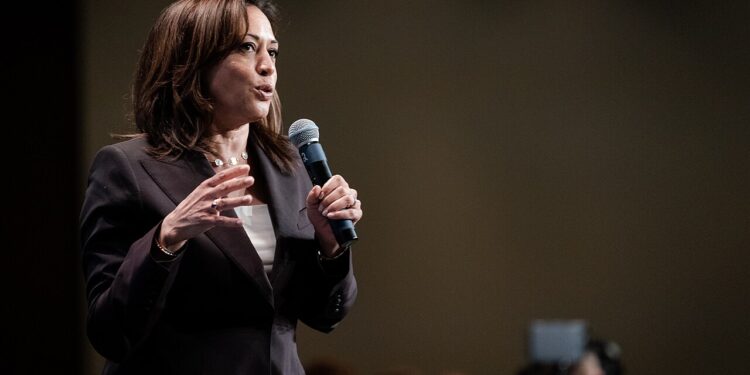
Kamala Harris is running into an uncomfortable political reality as Democrats battle for control of Congress and key state offices: Some candidates would rather campaign without her.
Several Democrats running in competitive races are distancing themselves from the former vice president, even as Harris offers endorsements, fundraising assistance and campaign support across the country.
In Iowa, Democratic candidates have openly rejected the idea of Harris campaigning alongside them. In Alaska, former Rep. Mary Peltola’s Senate campaign pushed back after a Harris political group sent a fundraising appeal on her behalf.
Other Democrats, however, are taking the opposite approach.
Sen. Jon Ossoff in Georgia has welcomed Harris’s assistance, while Michigan Senate candidate Abdul El-Sayed has publicly thanked her for her endorsement.
The dramatically different reactions reveal a larger challenge for the Democratic Party heading into a crucial election season — and could offer an early warning about Harris’s political future if she decides to make another run for president in 2028.
Iowa Democrats Distance Themselves From Kamala Harris
Some of the strongest resistance to Harris is coming from Iowa, where Democrats face the difficult task of winning voters in a state that has moved toward Republicans in recent elections.
Iowa state Rep. Josh Turek, who is seeking a U.S. Senate seat, was asked whether he wanted Harris to campaign for him.
His answer was a short “no.”
Turek even chuckled when responding to the question, making it clear that a campaign appearance by the former vice president was not part of his strategy.
Iowa gubernatorial candidate Rob Sand has taken a similar position.
When asked whether Harris or former President Joe Biden should campaign for him, Sand responded, “No thanks.”
“Let’s move on,” Sand said. “We need some new leadership.”
For Democrats trying to win in Republican-leaning territory, the decision highlights the difficult balance between accepting help from nationally known party leaders and establishing an independent political identity.
Democrats Face A Kamala Harris Dilemma
The disagreement over Harris comes down largely to geography.
Democratic candidates running in solidly blue areas may benefit from appearances by nationally recognized party figures who can raise money and energize Democratic voters.
Candidates competing in red or purple states face a different calculation.
Republicans can use appearances by national Democrats to portray their opponents as closely aligned with the party’s Washington leadership.
Democratic strategist Anthony Coley, who worked in the Biden administration, acknowledged the problem.
Coley said Democratic candidates trying to win red states have to “distinguish themselves from a national Democratic brand that is deeply unpopular.”
Because Harris was the Democratic Party’s 2024 presidential nominee, she remains closely connected to that national brand.
Coley nevertheless argued that Harris maintains considerable goodwill among Democratic voters.
The question is whether that popularity inside the party translates into an advantage in the places Democrats most desperately need to win.
Alaska Democrat Pushes Back After Harris Fundraising Appeal
The political risks became especially apparent in Alaska.
Former Democratic Rep. Mary Peltola is attempting to defeat Republican Sen. Dan Sullivan in a state where association with national Democratic leaders can give Republicans a powerful line of attack.
Harris’s Fight for the People PAC sent a fundraising appeal supporting Peltola.
Instead of embracing the assistance, Peltola’s campaign emphasized its independence.
“Mary isn’t seeking endorsements from anyone from the Lower 48 — her focus is and always will be Alaska,” her campaign told The New York Times.
Republicans quickly used the situation to connect Peltola to Harris.
Democratic mega-donor John Morgan offered an even stronger assessment of Harris’s value in competitive elections.
“She is a huge liability,” Morgan said, arguing that candidates with a legitimate chance of winning would have reason to keep their distance.
Morgan specifically pointed to what happened in Alaska as an example of the potential political consequences.
Harris Still Welcomed By Some Democrats
Not every Democrat is running away from the former vice president.
In Georgia, Democratic Sen. Jon Ossoff has welcomed Harris’s support as he fights for reelection.
Harris participated in a Women for Ossoff campaign call and also made a fundraising appeal on the senator’s behalf.
An Ossoff campaign representative said the senator appreciates the assistance and backing Harris has provided as he seeks another term.
The calculation in Georgia is considerably different from the one facing Democrats in Iowa or Alaska.
Black voters represent an essential part of the Democratic coalition in Georgia, and Harris could potentially help Ossoff energize some of those voters.
Georgia Democratic strategist Fred Hicks said Harris’s involvement makes sense because Black voters, particularly Black women, are a critical Democratic constituency in the state.
That illustrates why there is no single Democratic strategy for dealing with Harris.
What may be a political liability in one state could still be an advantage somewhere else.
Michigan Candidate Embraces Harris Endorsement
Michigan Democratic Senate candidate Abdul El-Sayed has also welcomed Harris’s support.
After Harris endorsed El-Sayed following his primary victory, he said he was “grateful” for her backing.
El-Sayed has also described the former vice president’s support as “critical.”
Harris could potentially help Democrats increase turnout among Black voters in Detroit, an important constituency for El-Sayed in the general election.
But Michigan also demonstrates the uncertainty surrounding Harris.
One Democratic strategist pointed to the results of the 2024 election and Harris’s performance in parts of Michigan, including Dearborn.
The strategist contrasted that performance with Democratic Sen. Elissa Slotkin’s success on the same ballot.
“I think you’d rather have surrogates who can help,” the strategist said.
That is ultimately the question Democratic campaigns must answer before inviting Harris onto the campaign trail.
Does she bring in more voters than she potentially drives away?
Kamala Harris’ 2024 Loss Still Matters
Harris’s complicated position within the Democratic Party cannot be separated from the 2024 presidential election.
As the party’s most recent presidential nominee, Harris remains one of America’s best-known Democrats.
That gives her considerable political advantages.
She can attract media attention, help candidates raise money and appeal to important parts of the Democratic base.
But Republicans can also use her involvement to connect local Democratic candidates to the Biden-Harris administration and national Democratic policies.
Jamal Simmons, who served as Harris’s communications director during her vice presidency, said candidates have to consider the political realities of their individual states.
“The VP did very well in some places and didn’t do great in others, and if you’re in a state where she didn’t perform well, it may not help you to have her campaign with you this fall,” Simmons said.
“Each candidate has a different problem they’re trying to solve.”
That explains why Democrats are reaching such different conclusions about Harris.
Harris Continues Endorsing Democratic Candidates
Despite the resistance from some campaigns, Harris remains actively involved in Democratic politics.
She has offered endorsements or fundraising assistance to candidates in several competitive elections.
Among them are Peltola in Alaska, Arkansas congressional candidate Chris Jones and Maine Senate candidate Troy Jackson.
Jones enthusiastically welcomed Harris’s endorsement in his campaign for Arkansas’s 2nd Congressional District.
He said he was “honored” to receive her support and added that it meant a great deal to his campaign.
Minnesota Lt. Gov. Peggy Flanagan’s Senate campaign has also spoken warmly about Harris.
The former vice president contacted Flanagan following her primary victory.
“Peggy was proud to campaign for Vice President Harris and appreciated her calling to congratulate her following her primary victory,” a Flanagan campaign spokesperson said.
The campaign added that Flanagan values her relationship with Harris.
Some Democrats Are Staying Quiet
Other Democratic candidates have adopted a third strategy: neither rejecting Harris nor making her support a centerpiece of their campaigns.
Maine Senate candidate Troy Jackson, former North Carolina Gov. Roy Cooper and Texas state Rep. James Talarico have said relatively little publicly about Harris’s support.
That silence could be deliberate.
Candidates in closely contested races have little incentive to create unnecessary controversy, particularly when accepting support from a national political figure could become material for Republican campaign advertisements.
There may also be another reason Democrats are proceeding cautiously.
The 2028 presidential election is already looming in the background.
Is Kamala Harris Planning Another Presidential Run?
Harris’s possible political future makes these campaign decisions even more significant.
The former vice president has been weighing another run for the White House.
If Harris enters the 2028 Democratic presidential primary, politicians who closely embraced her during the current election cycle could face questions about whether they intend to support her presidential campaign.
That creates an incentive for ambitious Democrats to remain neutral.
Hicks suggested some candidates may be thinking about exactly that.
“People do not want to be seen as taking a side in 2028,” he said.
“It’s not as much about the past as it is about the future.”
Democratic strategist Maria Cardona cautioned against drawing sweeping conclusions from individual campaign decisions this early.
According to Cardona, candidates are primarily interested in doing whatever gives them the best opportunity to win their races.
“What we all want here is for our candidates to win no matter where they are,” she said.
Democrats Make Their Choice On Harris
The conflicting reactions show how complicated Harris’s position has become.
She remains a major Democratic figure capable of raising money and energizing loyal party voters.
In states such as Georgia, campaigns may see Harris as a valuable asset capable of motivating constituencies Democrats need to turn out.
In states such as Iowa and Alaska, however, Democratic candidates appear much more interested in demonstrating their independence from the national party.
That divide could become one of the most important tests of Harris’s political strength following her 2024 presidential defeat.
If Democrats embracing Harris outperform expectations, she could emerge from the election with renewed influence and a stronger argument for another presidential campaign.
If candidates distancing themselves from her perform better, the questions about her future inside the Democratic Party will only grow louder.
For now, Democrats are making their calculations one race at a time.
Some want Harris by their side.
Others are keeping their distance.
And several candidates appear determined to prove they can win without her.