
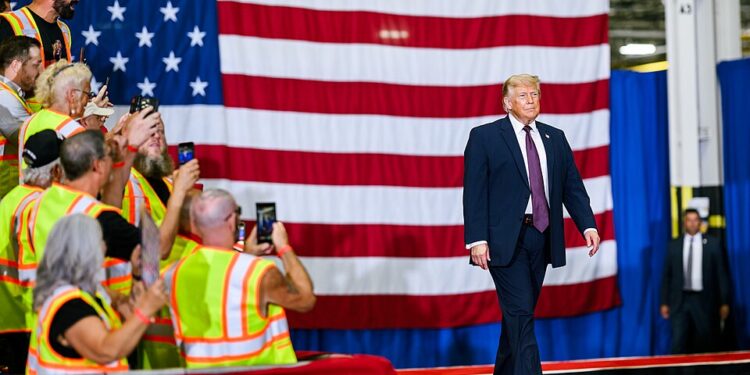
President Donald Trump is preparing to make his record a major part of the Republican Party’s midterm message, but some GOP strategists acknowledge the approach comes with a serious political gamble.
Trump remains enormously influential among Republican voters, and his ability to generate enthusiasm could be critical in November. But national polling also shows the president struggling with independents and receiving poor marks from voters on major issues including inflation.
That leaves Republican candidates confronting a difficult question: Will putting Trump at the center of the midterms drive conservatives to the polls — or motivate Democrats and swing voters against the GOP?
The answer could help determine which party controls Congress.
Trump Reportedly Plans Major Midterm Advertising Push
Trump isn’t limiting his involvement to rallies and endorsements for Republican candidates.
According to The Atlantic, the president has discussed using part of the roughly $400 million available to his primary super PAC to promote his administration’s record and respond to Democratic attacks.
The reported plan includes television advertising highlighting Trump’s accomplishments, effectively creating a national message that would run alongside individual Republican House and Senate campaigns.
There is a straightforward argument behind the strategy.
Trump and his allies believe the administration has accomplishments that aren’t receiving enough attention and that voters need to hear directly about issues such as border security, deregulation and the economy.
But making Trump a dominant figure in the midterms could also create problems for Republicans fighting for swing voters.
Trump’s Poll Numbers Create A GOP Problem
Trump remains extremely popular inside the Republican Party.
Outside the GOP, however, the political picture becomes considerably more difficult.
Polling cited by The Hill and Decision Desk HQ showed Trump’s national job approval well below his disapproval rating.
The divide becomes even more pronounced when voters are separated by party.
An Economist/YouGov poll cited in the original reporting found overwhelming approval for Trump among Republicans while Democrats overwhelmingly disapproved. Independents also leaned heavily against the president.
Those numbers demonstrate the dilemma facing Republican candidates.
A candidate who distances himself too much from Trump could alienate conservatives whose votes are essential in November.
But embracing Trump too closely could make it harder to persuade independents.
Inflation Could Be Trump’s Biggest Midterm Weakness
The economy is likely to be one of the most important issues of the election, and inflation could become a major vulnerability for Republicans.
RealClearPolitics polling averages cited in the original reporting showed substantially more Americans disapproving than approving of Trump’s handling of inflation.
That matters because household expenses remain an immediate concern for millions of Americans.
Unlike political controversies in Washington, higher grocery bills, utility costs, insurance premiums and other everyday expenses are felt directly around the kitchen table.
Republicans therefore have a strong incentive to convince voters that Trump’s economic agenda will improve their financial situation.
Democrats have an equally strong incentive to make the election a referendum on the cost of living.
Republicans Need Trump Voters To Show Up
There is another factor Republicans cannot ignore: turnout.
Trump has repeatedly demonstrated an ability to motivate voters who may not be as enthusiastic about traditional Republican candidates.
Republican strategist Dan Judy described the difficult choice facing GOP campaigns.
Keeping Trump at a distance could cost Republicans some of the enthusiasm they need from their base, while tying vulnerable candidates too closely to an unpopular president could hurt them with swing voters.
That balancing act could become particularly important in suburban congressional districts and competitive Senate races.
A few thousand votes could determine some contests.
Trump’s Grip On The Republican Party Remains Strong
Whatever his national approval numbers, there is little evidence that Republican voters are abandoning Trump.
The Economist/YouGov polling cited in the original report found that 80% of Republicans approved of Trump’s job performance while only 15% disapproved.
That gives Trump considerable political leverage.
Republican candidates know that his endorsement can carry enormous weight with conservative primary voters. They also know that attacking or rejecting the president could anger the very voters they need to turn out in November.
The situation is very different among Democrats.
Only a tiny percentage of Democratic respondents in the same polling approved of Trump’s performance.
The result is an intensely polarized electorate in which Trump can simultaneously be one of the Republican Party’s greatest turnout assets and one of the Democrats’ strongest motivating forces.
Trump Highlights Warning About Republican Midterm Trouble
Trump recently amplified concerns about the GOP’s midterm prospects himself.
The president shared a social media post from conservative commentator Matt Van Swol warning that Republicans could be heading toward a midterm reckoning if the party fails to recognize its political problems.
Trump then promoted a list of accomplishments that he believes Republicans should be talking about.
Some of the claims on that list are politically disputed, but Trump’s broader message was unmistakable.
Rather than running away from his presidency, Trump wants Republicans to defend the administration’s record and make the case that voters are better off under GOP leadership.
That philosophy appears to be driving the proposed advertising campaign.
Trump Allies Want Republicans Talking About The Border
Supporters of the strategy argue that Republicans have major accomplishments they can sell to voters.
Barry Bennett, who served as a senior adviser during Trump’s 2016 presidential campaign, pointed specifically to border security.
Bennett argued that Republicans should aggressively remind Americans of the administration’s immigration record while warning voters about what Democratic control of Washington could mean for those policies.
His larger argument is that presidential speeches and social media posts aren’t enough.
Many Americans do not follow politics every day.
They may instead encounter political messages through television commercials, online videos, social media and local news.
A coordinated advertising campaign would give Republicans another way to put Trump’s preferred message in front of those voters.
Democrats Are Happy To Make The Election About Trump
Democrats don’t appear interested in helping Republicans move the spotlight away from the president.
Several Democratic candidates in competitive Senate races have repeatedly invoked Trump while attacking Republican policies.
Georgia Sen. Jon Ossoff and Michigan Democratic nominee Abdul El-Sayed are among those making Trump a prominent part of their campaign messaging.
The strategy is easy to understand.
Just as Trump’s supporters can be highly motivated to vote for candidates aligned with him, his opponents can be highly motivated to vote against those candidates.
Democrats believe Trump’s unfavorable ratings among independents could give them an opening in competitive races.
El-Sayed, for example, recently attacked Trump’s business credentials and economic policies during a town hall.
Republicans are therefore unlikely to have the option of keeping Trump out of the campaign even if some candidates would prefer to do so.
Democrats will put him there themselves.
Midterm Battle Could Come Down To Trump
That sets up an unusual political contest.
Republicans could spend hundreds of millions of dollars telling Americans why Trump’s presidency has benefited the country.
Democrats could spend their own money arguing precisely the opposite.
Both strategies depend on the same assumption: Trump remains the most powerful political figure in the election.
The disagreement is over whether his presence ultimately helps or hurts Republicans.
In heavily Republican areas, candidates have little reason to distance themselves from a president who remains overwhelmingly popular with GOP voters.
Battleground races are different.
Republican candidates in those states and districts need conservatives to turn out, but they may also need independents and moderate voters to win.
Too much distance from Trump risks weakening support among the Republican base.
Too much Trump risks alienating voters in the middle.
Why Trump’s Midterm Gamble Matters
The stakes extend far beyond individual campaigns.
Control of the House and Senate will determine how much of Trump’s agenda Republicans can advance during the remainder of his term.
A Republican Congress could give the administration greater ability to pursue its legislative priorities.
Democratic control of either chamber could create significant obstacles while increasing congressional investigations and political confrontations with the White House.
That makes turnout especially important.
Trump’s team appears to believe the best way to produce that turnout is to remind Americans what his administration says it has accomplished and give voters a clear choice between the president’s agenda and Democratic control.
Some Republicans see tremendous potential in that approach.
Others see danger.
Both may have a point.
The Bottom Line
Republicans face a political calculation with no easy solution.
Trump remains overwhelmingly popular with the GOP base, giving Republican candidates a powerful incentive to embrace his record and mobilize his supporters.
At the same time, his weaker standing with independents — combined with voter concerns about inflation and other major issues — means vulnerable Republicans cannot assume that a Trump-centered election automatically works in their favor.
Democrats clearly believe the president is a political liability and are already working to connect Republican candidates directly to him.
Trump and his allies believe the opposite: that aggressively promoting his administration’s accomplishments can energize conservatives, persuade undecided voters and carry Republican candidates across the finish line.
That debate will not be settled by strategists or opinion polls.
Voters will settle it in November.