
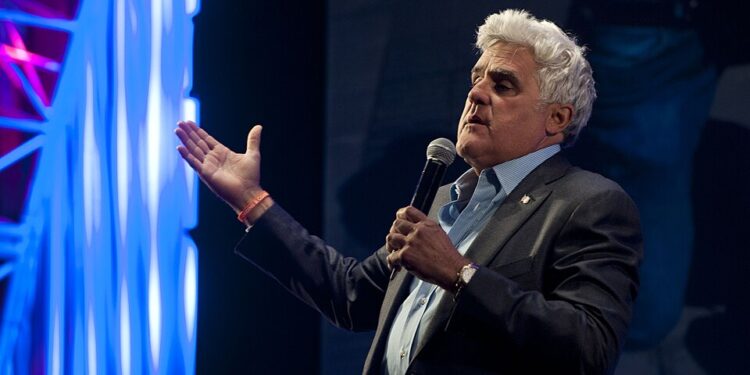
Jay Leno is drawing attention for a very different approach to political comedy — and his comments highlight just how far late-night television has moved from the style that once defined programs such as “The Tonight Show.”
The legendary comedian says his job is simple: make people laugh.
That means Leno has little interest in building a comedy routine around attacking one political party while entertaining the other.
During an interview released Sept. 9, Leno explained that his live audiences include Americans with a wide range of political views, including supporters of President Donald Trump.
For Leno, alienating a major portion of the crowd simply does not make sense.
“I get beat up for this all the time,” Leno said during an appearance on the “Unexpired” podcast.
He explained that when he performs somewhere such as Indiana, a substantial portion of the audience may support Trump. His goal, Leno said, remains getting laughs rather than delivering a political lecture.
Jay Leno Says Comedy Should Come Before Politics
Leno spent more than two decades behind the desk at NBC’s “The Tonight Show,” making him one of the most recognizable figures in American late-night television.
His philosophy was heavily influenced by Johnny Carson, the longtime “Tonight Show” host who preceded him.
According to Leno, both men believed political comedy worked best when everyone was fair game.
“I mean, Johnny and I used to pride ourselves on making fun of both sides equally,” Leno said.
He acknowledged that this approach can now generate criticism in an entertainment environment where political divisions have become increasingly visible.
The difference is significant.
Rather than asking viewers to agree with his political views before enjoying the joke, Leno says the objective should still be laughter.
Leno’s Philosophy Stands Apart From Jimmy Kimmel
That approach offers a noticeable contrast with Jimmy Kimmel, who has become increasingly outspoken about political and public-policy issues during his years hosting ABC’s “Jimmy Kimmel Live!”
Kimmel has also acknowledged that his political commentary affected how Republican viewers viewed his program.
During a 2017 interview with CBS, Kimmel said his popularity among Republicans had fallen significantly after he began speaking publicly about issues including health care and gun policy.
He acknowledged that losing viewers was not ideal for a television host.
However, when CBS correspondent Tracy Smith asked about Republicans who had stopped watching, the conversation produced a remark that attracted considerable attention.
“Good riddance?” Smith asked.
“Well, not ‘good riddance,’ but riddance,” Kimmel responded.
Kimmel also said he would make the same politically charged commentaries again despite the potential audience consequences.
Two Very Different Approaches to Late-Night Television
The contrast between Leno and Kimmel illustrates a larger debate surrounding modern entertainment.
Should late-night hosts openly embrace political causes and risk losing viewers who disagree?
Or should comedians try to make Republicans, Democrats and independents laugh at everyone — including themselves?
Leno clearly favors the second approach.
Entertainment journalist Christian Toto told Fox News Digital that touring comedians often face different pressures than television personalities because live performers regularly appear before politically mixed crowds.
Toto argued that some television hosts have instead developed audiences with increasingly defined political preferences. That assessment is his interpretation of the changes affecting late-night entertainment rather than an objective measurement of every late-night audience.
Leno Says Audiences Have Changed
This is not the first time Leno has raised concerns about the relationship between politics and comedy.
He has previously explained that audiences increasingly try to determine whether a political joke is attacking or supporting their side before deciding how to react.
That can create problems for comedians whose primary objective is simply getting the biggest possible laugh.
Leno has repeatedly returned to the comedy philosophy he associates with Carson: politicians from either party can become the punchline.
The important part, in his view, is that the comedian does not become so predictable that half the audience already knows who will always be attacked.
Jimmy Fallon Also Learned How Political Late Night Had Become
Another moment illustrating the changing atmosphere came during the 2016 presidential campaign.
Jimmy Fallon interviewed Trump on “The Tonight Show” and famously tousled the Republican candidate’s hair during a lighthearted segment.
The appearance generated intense criticism from people who believed Fallon had treated Trump too casually.
Fallon later said he regretted how he handled the backlash and disputed claims that his intention had been to “normalize” Trump.
Toto cited that controversy while arguing that Fallon faced pressure after pursuing the type of broadly accessible entertainment traditionally associated with Leno.
The episode demonstrated how difficult it had become for late-night hosts to separate entertainment from politics during a highly polarized election.
Leno Still Believes Both Sides Should Get Joked About
Despite those changes, Leno has shown little indication that he intends to abandon his approach.
His reasoning is rooted in the reality of touring America.
A comedy club or theater audience can contain Trump supporters, Democrats, independents and people who simply want an evening away from politics.
A performer who immediately dismisses part of that crowd risks turning entertainment into something closer to a political rally.
Leno instead says comedians should concentrate on finding material everyone can recognize and laugh about.
His comments also revive memories of an era when late-night programs attempted to attract the broadest audience possible rather than appealing primarily to one political demographic.
Podcasts Are Challenging Traditional Late Night
Leno also believes the entertainment landscape itself has changed.
Traditional late-night television once occupied an enormous place in American culture. Millions of viewers regularly watched hosts such as Carson and Leno because relatively few alternatives existed.
That world is gone.
Today, audiences can choose from podcasts, streaming services, YouTube channels and independent creators in addition to traditional network television.
Leno has even described Joe Rogan as “the new Johnny Carson,” arguing that podcasts increasingly fill the cultural role once dominated by network late-night programs. Fox News reported that Leno made the comparison while discussing how fragmented modern audiences have become.
Is America Ready for Less Partisan Comedy?
Leno’s comments raise a broader question about the future of comedy.
Americans certainly disagree about politics.
But Leno appears to believe those disagreements do not have to prevent people from laughing in the same room.
His approach is straightforward: Republicans can be the target of jokes. Democrats can be the target of jokes. Presidents can be mocked. So can members of Congress and celebrities.
Nobody receives permanent protection — and nobody has to become the permanent enemy.
Kimmel has chosen a more outspoken political approach and has openly acknowledged that some Republican viewers turned away from his program. Leno, by contrast, says he still wants to entertain audiences that include people on different sides of the political divide.
Whether the old-school approach can reclaim a larger place in late-night entertainment remains uncertain.
But Leno has made his own priority clear.
When people come to see a comedian, he believes they came for one thing above everything else:
To laugh.