
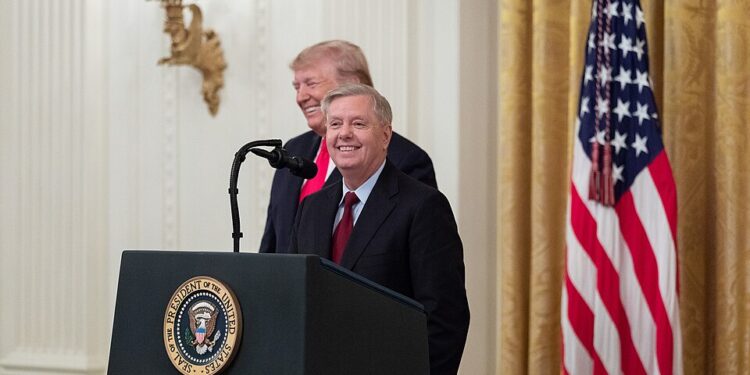
The House of Representatives has finally approved a sweeping Russia and Iran sanctions bill that the late Sen. Lindsey Graham spent months pushing through Congress.
The legislation, named the Lindsey O. Graham Sanctioning Russia and Iran Act of 2026, passed the House on Wednesday by a 262-159 vote.
The Senate previously approved the bill 86-11 in August, meaning the measure is now headed to President Donald Trump for final action.
For Graham’s colleagues and supporters, the vote also carried a deeply personal significance.
The longtime South Carolina Republican, who died at age 71 earlier this year, had made passage of the sanctions package one of his final major priorities in Washington.
Graham Made the Sanctions Bill a Major Priority
Before his death, Graham repeatedly urged Congress to increase economic pressure on Russia over its war in Ukraine.
The senator believed tougher sanctions could weaken Moscow’s ability to finance the conflict while giving the United States additional leverage in efforts to reach a negotiated settlement.
Graham had described passage of the legislation as potentially one of the most consequential achievements of his Senate career, according to lawmakers who worked with him on the measure.
After his death, lawmakers renamed the bill in his honor.
The House vote now brings Graham’s months-long effort one step closer to becoming federal law.
Bill Takes Aim at Russia’s Energy Revenue
At the center of the legislation is an effort to reduce the flow of money supporting Russia’s economy and military operations.
The measure would impose additional sanctions on Russian officials, oligarchs, banks, financial institutions and other individuals or organizations accused of supporting Moscow’s war effort.
It also targets Russia’s so-called shadow fleet — ships and businesses accused of helping Russian oil reach international markets while avoiding existing sanctions.
Supporters argue that energy exports remain one of Moscow’s most important sources of revenue and that restricting those sales could increase economic pressure on Russian President Vladimir Putin.
Trump Could Impose Tariffs as High as 100%
One of the most closely watched provisions gives President Trump authority to impose tariffs of up to 100% on certain major countries purchasing Russian oil or natural gas.
The legislation focuses on the largest buyers of Russian energy and countries accused of helping Moscow evade existing sanctions.
That provision could have major implications for countries including China and India, both of which have purchased substantial amounts of Russian energy.
Supporters believe the threat of tariffs could force foreign governments to reconsider their economic relationship with Moscow.
Critics, however, have raised concerns about giving the president additional tariff authority and about the possible impact on international trade.
That disagreement became one of the major sticking points as the legislation moved through the House. Reuters reported that the tariff provisions were a key source of opposition even though the overall sanctions effort attracted bipartisan support.
Iran Is Also Targeted
Despite the bill’s heavy focus on Russia and Ukraine, Iran is another major target.
The legislation extends the Iran Sanctions Act for another five years, preserving sanctions authority aimed at limiting funding for Iran’s energy and weapons sectors.
The measure therefore combines two major U.S. foreign-policy priorities into a single sanctions package.
Supporters say the legislation is designed to make it more difficult for both Russia and Iran to obtain money and resources that could support military operations.
Republicans Say Economic Pressure Could Bring Putin to the Table
Republican supporters of the legislation argue that stronger sanctions could help change Putin’s calculations about continuing the war.
Rep. Michael McCaul of Texas was among the lawmakers who pushed for House passage.
Supporters have argued that imposing heavier economic costs on Moscow — while also pressuring countries that purchase Russian energy — could strengthen America’s bargaining position and make negotiations more attractive to the Kremlin.
The Kremlin has taken the opposite view.
On Thursday, Russian officials said the new sanctions, if signed into law, could make negotiations over Ukraine more difficult rather than easier.
That disagreement underscores the larger debate surrounding economic sanctions: supporters see them as leverage, while opponents argue they can sometimes harden diplomatic positions.
House Vote Ends Months of Uncertainty
Passage of the bill was far from guaranteed.
Although the Senate overwhelmingly approved the legislation in August, the House delayed action while lawmakers debated the tariff provisions and the broader scope of presidential authority.
Questions remained over whether enough Republicans and Democrats would ultimately support the measure.
Those questions were answered Wednesday when the House voted 262-159 in favor of passage.
The legislation had enough bipartisan support to overcome opposition from members concerned about its trade provisions.
Lindsey Graham’s Final Push Clears Congress
For Graham’s longtime colleagues, the vote represents more than another sanctions package.
It completes a legislative effort the South Carolina senator had pursued aggressively before his death.
Graham spent years advocating a tougher American approach toward Putin and arguing that Washington should use its enormous economic influence to pressure countries helping finance Russia’s war.
Now Congress has approved legislation carrying his name and reflecting one of his final major foreign-policy priorities.
The next decision belongs to President Trump.
If the legislation is signed into law, the United States will gain additional tools to sanction Russian interests, pressure major buyers of Russian energy and extend existing sanctions targeting Iran.
For lawmakers who worked alongside Graham, House passage marks the conclusion of a political battle that continued even after the senator was gone — and fulfills one of the last major goals he pursued on Capitol Hill.