
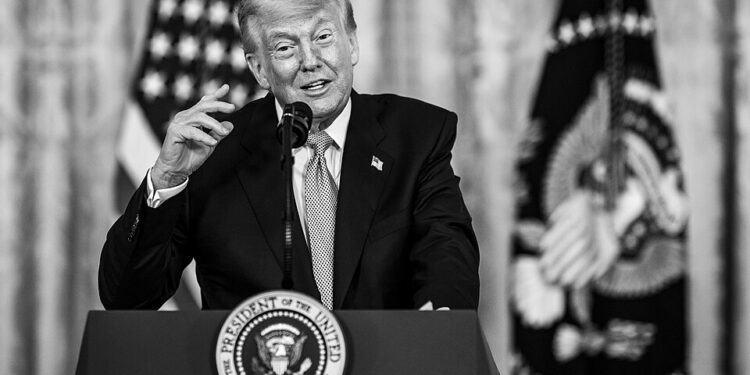
Democrats are raising new objections to a taxpayer-funded television advertisement featuring President Donald Trump, but one prominent House Democrat admits there may be little Congress can do to stop it before the midterm elections.
Rep. Jamie Raskin of Maryland, the ranking Democrat on the House Judiciary Committee, discussed the controversy Friday during an appearance on MS NOW.
Raskin argues that the advertisement crosses legal and ethical lines because federal money was used to produce and broadcast material prominently featuring the president.
The White House strongly disputes that characterization.
Administration officials say the video is a public-service announcement designed to promote patriotic themes and highlight the administration’s agenda rather than a campaign advertisement urging Americans to vote for a particular candidate.
That disagreement has now created another political fight in Washington just weeks before voters head to the polls.
Trump Featured Throughout Government-Funded Advertisement
The advertisement features Trump declaring that America will defeat communism, socialism and Marxism.
It also includes a fast-moving collection of images from Trump’s presidency, along with messages highlighting subjects such as tax cuts, American manufacturing and support for law enforcement.
Near the end of the commercial, viewers are told that the advertisement was “Paid for by the U.S. Government.”
CBS News reported that taxpayer money funded the campaign and that the advertisement began appearing on television outlets including Fox News.
The White House maintains that the advertisements are legitimate government communications rather than election-related campaign material.
Officials have pointed out that Trump himself is not on the ballot in the upcoming congressional elections and that the advertisement contains no direct appeal telling viewers how to vote.
Raskin Raises Questions About Federal Law
Raskin sees the matter differently.
He has argued that the advertisement appears political and questioned whether government employees involved in producing it could have violated federal restrictions on partisan political activity.
Among the laws Raskin has cited is the Hatch Act, which limits certain political activities by federal employees.
Those allegations have not been established by a court or other final legal ruling.
Raskin has also criticized the use of taxpayer money for an advertisement that prominently promotes Trump and highlights accomplishments associated with his administration.
The White House, however, says the material is intended to communicate with the American public rather than influence an election.
Democrats Admit Their Immediate Options Are Limited
During his television appearance, Raskin was pressed on an important practical question: What can Democrats actually do about the advertisement before the election?
His answer revealed the limits lawmakers currently face.
Raskin said Democrats could submit formal complaints to government oversight authorities, publicly challenge the administration and document what they believe are violations.
But he also acknowledged that the approaching election leaves little time for those complaints to produce an immediate result.
That means Democrats may be forced to continue objecting publicly while pursuing formal reviews through federal oversight channels.
The controversy illustrates a recurring challenge in Washington: even when lawmakers believe an administration has violated government ethics or political-activity rules, investigations and enforcement proceedings can take considerable time.
Musician Objects to Use of His Song
The advertisement is also facing criticism from the musician whose work appears in the commercial.
The video uses “Love Me,” a song by artist JMSN.
JMSN has publicly said that he did not authorize his music to be used for the advertisement and indicated that he was considering legal options.
That potential dispute is separate from the political and government-spending questions raised by Raskin and other Democrats.
The artist’s objections could potentially involve copyright or licensing issues, depending on how the music was obtained and what agreements were in place.
White House Defends the Advertisement
The administration has rejected suggestions that the commercial is simply a taxpayer-funded campaign advertisement.
The White House described the videos as public-service announcements intended to encourage patriotism and highlight issues the administration considers important.
Officials also argued that previous presidential administrations have used government funds for public-information advertising campaigns.
Critics counter that this particular advertisement differs because Trump appears throughout much of the video and the commercial emphasizes achievements associated with his presidency.
That disagreement is likely to remain at the center of the dispute.
Political Fight Comes Just Before Midterms
The timing of the advertisement has added another layer to the controversy.
Both Republicans and Democrats are intensifying their political messaging as the congressional midterm elections approach.
Trump has repeatedly warned against socialism and communism while emphasizing taxes, manufacturing, immigration, public safety and other issues important to his political coalition.
Democrats, meanwhile, have increasingly focused their attacks on questions involving executive authority, government spending and the administration’s use of federal resources.
Raskin’s comments suggest Democrats will continue drawing attention to the advertisement even if they cannot immediately stop it.
For now, the disagreement comes down to two competing interpretations.
Democrats such as Raskin argue that taxpayers are funding material that functions like political advertising.
The White House says Americans are instead seeing a legitimate government message promoting the administration’s priorities.
With the midterm elections approaching, that debate is unlikely to disappear anytime soon.