
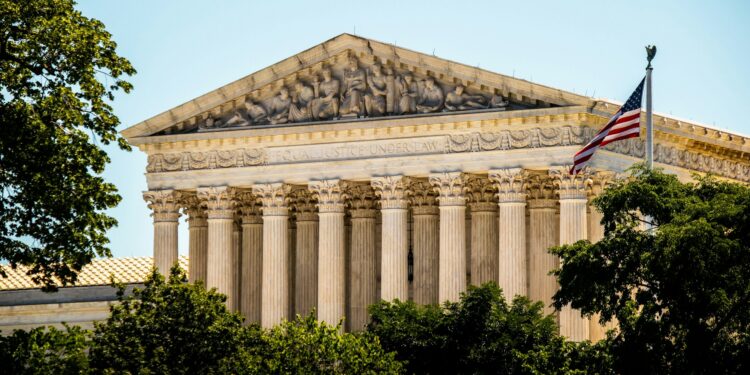
Missouri Republican Gov. Mike Kehoe is voicing disappointment after the U.S. Supreme Court delivered a major ruling in the state’s closely watched congressional redistricting battle.
The decision means Missouri will use its older congressional map in the November 2026 election — even though voters participated in the August primary under a newer set of district boundaries.
Kehoe, who supported Missouri’s redistricting effort, said voters deserved greater consistency.
Kehoe said he was disappointed that the Supreme Court’s decision would force Missouri to use a different congressional map in November than the one used during the primary.
He added that voters should have been able to rely on clear, consistent election rules rather than seeing them change between the primary and general election.
Despite his disagreement with the outcome, Kehoe said Missouri officials will comply with the ruling.
Supreme Court Blocks Missouri’s 2025 Congressional Map
The U.S. Supreme Court ruled September 25 that federal courts cannot require Missouri to use the congressional map enacted by the Republican-controlled state government in 2025.
That means the state will conduct its November congressional elections using the boundaries adopted in 2022.
The Supreme Court said that, under Missouri law as interpreted by the Missouri Supreme Court, the newer map has not yet legally taken effect because voters successfully triggered a referendum on the measure.
According to the Court, the 2025 map will not become effective unless Missouri voters approve it.
The decision settles, at least for the upcoming election, a complicated battle involving Missouri lawmakers, state courts, federal courts and groups challenging the redistricting plan.
Why Missouri Republicans Wanted the New Map
Missouri Republicans approved the new congressional boundaries in 2025 as part of a broader mid-decade redistricting effort.
The map could have given Republicans a chance to capture seven of Missouri’s eight U.S. House seats instead of the six seats held under the previous boundaries.
A major part of the redistricting plan centered on the Kansas City-area seat held by Democratic Rep. Emanuel Cleaver.
The new boundaries altered the political makeup of that district in a way that could have made it more competitive for Republicans.
President Donald Trump and national Republican leaders had supported efforts to redraw congressional maps as both parties focused heavily on control of the U.S. House.
But the Missouri plan quickly became tied up in litigation.
Missouri Used the New Map During the Primary
Adding to the controversy, Missouri already used the 2025 map for its August 4 primary election.
More than 1.2 million Missouri voters participated in that election under the newer congressional boundaries, according to filings submitted to the Supreme Court.
That created an unusual situation.
Candidates competed for their party nominations under one map, but the general election will now be held under another.
Republicans contesting the change argued in federal court that using different congressional maps for the primary and general election created constitutional issues.
A federal appeals court agreed with parts of that argument and moved toward requiring Missouri to use the newer map.
The U.S. Supreme Court stepped in and blocked that result.
Missouri Supreme Court Changed the Course of the Fight
The dispute changed dramatically after the Missouri Supreme Court ruled September 3 that a referendum challenging the 2025 map had qualified for the November ballot.
The state court concluded that the newer congressional map could not legally take effect unless voters approved it.
The U.S. Supreme Court highlighted that conclusion in its ruling, stating that the 2022 map — not the 2025 map — is the map that must currently be used under Missouri law.
The referendum remains an important part of the dispute because Missouri voters will ultimately have an opportunity to decide whether the 2025 boundaries should take effect.
Supreme Court Points to Election Timing
Timing also played a significant role in the Supreme Court’s decision.
By the time the latest legal challenge reached the justices, the November election process was already underway.
Election officials had been preparing to use the 2022 map, and voting preparations had advanced considerably.
The Court rejected efforts to force another change to the congressional boundaries during the ongoing election process.
Its September 25 order specifically directed lower federal courts not to prohibit use of the 2022 map and not to require Missouri to use the 2025 map.
No justice publicly noted a dissent from the order.
Kehoe Says Missouri Will Follow the Ruling
Kehoe made clear that his administration disagrees with the situation voters now face.
His main criticism centered on the fact that Missourians participated in the primary under one congressional map and will now vote in the general election under another.
Still, the Republican governor said the state will follow the Supreme Court’s decision.
That means Missouri voters will head to the polls in November using the congressional districts first adopted in 2022.
What Happens Next?
The Supreme Court ruling resolves an immediate question: which congressional map Missouri will use for the 2026 general election.
But it may not represent the end of the broader redistricting fight.
Missouri voters are expected to have a direct say on the 2025 congressional map through the November referendum.
The outcome could determine whether those newer congressional boundaries eventually take effect for future elections.
For now, however, Missouri’s 2022 congressional map remains in place — delivering a setback to Republican efforts to use the newer boundaries during the crucial 2026 midterm elections.
The episode also demonstrates how redistricting battles can quickly move from state legislatures to state courts, federal courts and ultimately the U.S. Supreme Court, with control of congressional seats potentially hanging in the balance.