
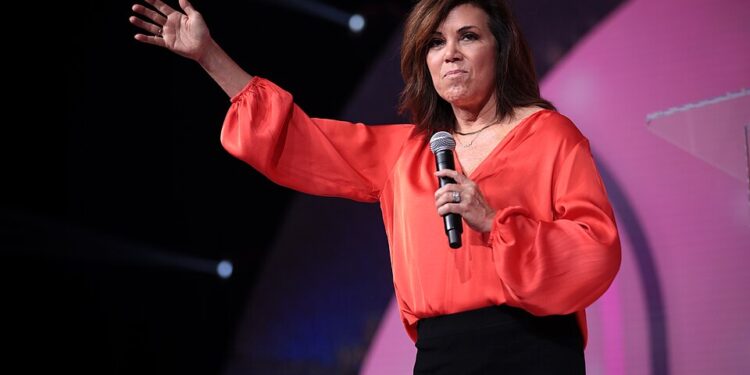
A closely watched U.S. Senate race is developing in Minnesota, where Republican Michele Tafoya is showing surprising strength in a state Democrats have dominated in federal elections for years.
Recent polling shows Tafoya running nearly even with Democratic Lt. Gov. Peggy Flanagan in the race for Minnesota’s open Senate seat, raising the possibility of an unusually competitive contest heading into the November election.
For Republicans, the numbers are significant. Minnesota has not elected a Republican U.S. senator since Norm Coleman, who left office in 2009.
Minnesota Senate Polls Show Tight Race
One recent InsiderAdvantage survey found Flanagan receiving 46% support compared with 45% for Tafoya.
That narrow margin follows other surveys showing a similarly close contest.
A Co/efficient poll found Flanagan ahead by just one percentage point, 43% to 42%, while a SurveyUSA poll conducted for KSTP showed the two candidates tied at 42% each.
Taken together, the polling suggests Minnesota could become one of the more competitive Senate races of the 2026 midterm elections.
Polls are only snapshots of voter sentiment, and results can vary depending on methodology, turnout assumptions and the number of undecided voters. Still, several close surveys in succession have drawn increasing attention to the contest.
Republicans See Opportunity in Minnesota
Tafoya’s improving position has attracted notice from conservative political commentators and strategists.
Republican strategist Dustin Grage highlighted the recent polling on social media, while CNN political commentator Scott Jennings pointed to the series of close surveys and suggested the race deserved greater attention.
Democratic political figures have noticed as well. Neera Tanden, president of the Center for American Progress, described the polling as concerning for Democrats in a social media post.
The attention reflects the potential significance of the race.
Minnesota has traditionally been difficult territory for Republican Senate candidates. A competitive Republican campaign there could force both parties to devote additional money, advertising and organizational resources to the state during the closing weeks of the election.
Michele Tafoya Makes Transition From Sports to Politics
Tafoya is already familiar to millions of Americans because of her lengthy career in sports broadcasting.
She spent years covering major sporting events and became particularly well known as an NFL sideline reporter for NBC Sports. She also previously worked for ESPN.
After leaving full-time sports broadcasting, Tafoya became increasingly involved in political commentary before eventually launching her Senate campaign.
Her campaign is centered on several issues that have become major priorities for Republican voters.
They include immigration enforcement, government accountability, public safety, the cost of living and concerns about fraud involving taxpayer-funded programs.
Fraud and Government Spending Take Center Stage
Tafoya has placed particular emphasis on allegations of fraud involving public programs in Minnesota.
Her campaign has called for stronger oversight of taxpayer dollars, tougher penalties for fraud and greater accountability for government agencies responsible for distributing public funds.
The issue could resonate with voters concerned about wasteful government spending, especially at a time when household budgets remain under pressure from higher prices.
For many older voters, questions surrounding taxes, government efficiency and responsible use of public money are likely to remain important throughout the campaign.
Immigration Remains a Major Divide
Immigration is another major difference between the candidates.
Tafoya has supported President Donald Trump’s tougher approach to illegal immigration and has emphasized stronger enforcement of existing immigration laws.
Republicans nationally have made border security and immigration enforcement central issues heading into the 2026 midterms.
Flanagan has taken a different approach and has criticized aggressive federal immigration enforcement actions.
That contrast gives Minnesota voters a clear choice between two substantially different approaches to immigration policy.
Candidates Split on Cultural Issues
The candidates also differ sharply on social and cultural questions.
Tafoya has opposed policies allowing transgender women to compete in women’s sporting events, arguing that biological differences should remain a consideration in athletic competition.
Her campaign describes its broader platform as an effort to restore what it calls “courage and common sense” in government.
Flanagan has generally supported Democratic positions on LGBTQ rights and other social policy questions.
These issues could become especially important among suburban and rural voters as both campaigns attempt to motivate their respective bases.
Flanagan Campaign Focuses on Healthcare and Working Families
Flanagan is running on a platform emphasizing healthcare, labor rights, abortion access and financial assistance for working families.
She has supported expanding government involvement in healthcare and has promoted policies aimed at reducing costs for middle- and lower-income households.
Flanagan has also called for changes to Social Security taxation, an issue likely to attract attention from older Minnesota residents.
Social Security, Medicare and retirement security remain especially important concerns for voters over age 50, making economic policy a potentially important factor in the race.
Israel, Ukraine and Foreign Policy Enter the Debate
The candidates also differ on foreign policy.
Flanagan has supported limiting certain U.S. weapons sales to Israel while backing continued assistance to Ukraine.
Her campaign has also advocated stronger action against unfair Chinese trade practices.
Tafoya has generally aligned herself more closely with Republican and Trump administration priorities on national security and foreign policy.
Foreign policy is unlikely to be the only issue deciding the race, but international conflicts and U.S. military commitments could influence voters concerned about federal spending and America’s role overseas.
Cost of Living Could Be Critical
Pocketbook concerns may ultimately prove especially important.
Across the country, voters continue to focus on grocery prices, energy bills, housing costs, taxes and retirement expenses.
Tafoya has made reducing costs for middle-class Americans part of her campaign message.
Flanagan has also emphasized economic relief but favors a more government-centered approach involving healthcare programs, labor protections and assistance for working families.
The debate therefore extends beyond whether costs should come down. The candidates disagree substantially over how government should respond.
Minnesota Could Become a National Senate Battleground
The Minnesota contest has received less national attention than several other high-profile Senate races.
That could change quickly if polling continues to show a narrow margin.
Both parties are fighting for every available Senate seat, and an unexpectedly competitive contest in Minnesota could alter campaign spending decisions nationwide.
Republicans would view a Minnesota victory as a major breakthrough in traditionally Democratic territory.
Democrats, meanwhile, are seeking to keep the seat following Sen. Tina Smith’s decision not to seek another term.
Independent Voters Could Decide the Outcome
Another major factor is Minnesota’s sizable bloc of independent voters.
In a race separated by only a few percentage points, voters without a strong attachment to either major party could prove decisive.
Third-party candidates may also affect the final result by drawing support away from the Republican and Democratic nominees.
That makes turnout particularly important.
Both campaigns will need to persuade undecided voters while ensuring their most reliable supporters actually cast ballots.
A Race Few Expected to Be This Close
Minnesota may have once appeared to offer Democrats a clearer advantage in the race for the open Senate seat.
Recent polling suggests the contest deserves much closer attention.
Tafoya’s ability to remain competitive represents an encouraging development for Republicans seeking to expand the Senate map into traditionally Democratic territory.
Flanagan, however, continues to hold narrow leads in several surveys, and substantial uncertainty remains before Election Day.
With major issues including inflation, immigration, Social Security, taxes, government spending, public safety and President Trump’s agenda hanging over the campaign, Minnesota could emerge as one of the most important Senate races to watch in the final stretch of the 2026 midterm elections.