
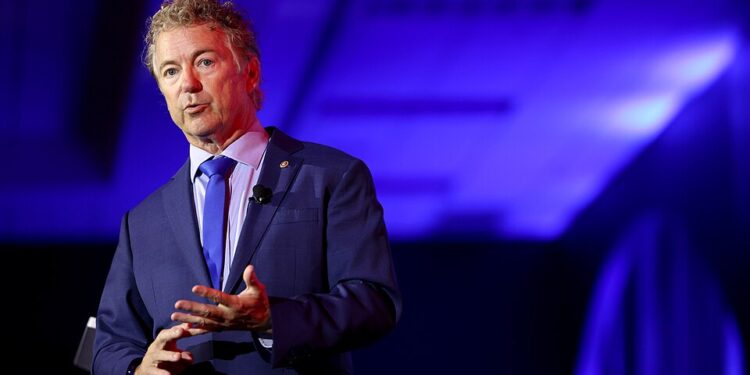
Republican Sen. Rand Paul of Kentucky is sounding the alarm over inflation, federal debt and the declining purchasing power of the American dollar, arguing that many families are struggling to make their money stretch as far as it once did.
Paul’s criticism is especially notable because it comes from within President Donald Trump’s own party.
In a recent post on X, Paul argued that Americans are still paying the price for years of inflation and rising federal debt.
“The $40 trillion deficit translates to more than $360,000 per American taxpayer,” Paul wrote. He added that although the federal government is adding to the debt at a slower pace than during former President Joe Biden’s administration, Americans have still lost substantial buying power.
Paul then offered a direct example.
“If you’re making $50K/year, you’re poorer than you were a few years ago because inflation compounds over time,” he wrote.
The Kentucky senator’s comments have renewed a broader debate over one of the most important economic questions facing American families: Are paychecks actually keeping up with the rising cost of living?
Rand Paul Warns About Americans’ Purchasing Power
Paul’s argument focuses primarily on purchasing power.
Simply put, purchasing power measures how much Americans can actually buy with the money they earn.
A worker may receive raises over several years, but if the price of groceries, housing, insurance, utilities and transportation rises even faster, that worker can still end up financially worse off.
That distinction has become increasingly important following several years of elevated inflation.
Prices surged dramatically during Biden’s presidency, particularly between 2021 and 2023. Inflation reached more than 9 percent in June 2022 before gradually cooling.
However, falling inflation does not mean prices return to their previous levels.
It simply means prices are generally increasing more slowly.
For millions of families, that means today’s grocery, housing and insurance bills remain considerably higher than they were several years ago.
Trump Says His Administration Inherited an Inflation Crisis
Trump has repeatedly argued that his administration inherited a severely damaged economy from Biden.
“We inherited from the last administration an economic catastrophe and an inflation nightmare,” Trump said during his first address to Congress after returning to office.
The president has frequently pointed to the sharp inflation experienced during Biden’s term while promoting his own economic agenda.
Trump has argued that tax policy, deregulation, domestic energy production and investment will ultimately strengthen the economy and increase prosperity for American families.
Paul’s criticism does not necessarily dispute the scale of the inflation experienced during the Biden years.
Instead, he is warning that the cumulative effects of inflation continue to reduce what American paychecks can purchase.
Why Inflation Still Matters Even When It Falls
Inflation can be confusing because a lower inflation rate does not necessarily mean consumers are seeing lower prices.
Consider a simple example.
If an item that once cost $100 rises to $120 during a period of high inflation, slowing inflation does not automatically push the price back to $100.
The price may simply rise more slowly from the new $120 level.
That is one reason many Americans continue to report frustration with the cost of everyday necessities even when headline inflation statistics improve.
For retirees and households living on relatively fixed incomes, the effect can be particularly noticeable.
Higher food, insurance, energy and housing costs can consume a growing portion of monthly income.
America’s National Debt Adds Another Concern
Paul also tied his warning to the rapidly growing national debt.
The federal debt has now surpassed $40 trillion, adding urgency to a longstanding debate over government spending, taxes and borrowing.
Paul has built much of his political career around criticizing excessive federal spending.
Unlike some lawmakers who focus primarily on spending by the opposing party, Paul has frequently criticized large spending packages supported by Republicans as well as Democrats.
His latest comments continue that pattern.
Paul argues that persistent federal deficits eventually have consequences for taxpayers and the broader economy.
Supporters of higher government spending often counter that borrowing can be justified for priorities such as national defense, infrastructure, economic emergencies and other major programs.
The dispute over spending is likely to remain one of Washington’s most significant economic battles.
Are Americans Really Poorer Today?
The answer depends largely on how the question is measured.
Paul is correct that inflation reduces the purchasing power of each dollar.
If someone’s salary rises by 3 percent while their living expenses rise by 5 percent, that person effectively loses purchasing power.
But that does not necessarily mean every American household has become poorer.
Wages, investment portfolios, home values and household wealth can all influence a family’s overall financial position.
Some households have benefited from rising wages or investment gains.
Others have faced rapidly increasing expenses that have overwhelmed those gains.
That makes broad comparisons between the Trump and Biden economies more complicated than simply looking at one statistic.
Grocery Bills Continue to Shape Economic Views
For many Americans, economic conditions are judged less by government reports and more by what happens during everyday purchases.
Grocery bills are one of the clearest examples.
Even after inflation slowed from its 2022 peak, many supermarket prices remained well above their pre-pandemic levels.
Families purchasing meat, eggs, dairy products, produce and household supplies may therefore continue to feel financial pressure despite improvements in headline inflation numbers.
Housing costs have created similar concerns.
Rent, mortgage payments, property taxes and homeowners insurance can represent some of the largest expenses in a household budget.
When those costs rise, families often have less money available for savings, travel and discretionary purchases.
Energy Prices Remain Another Economic Pressure Point
Gasoline and other energy costs also remain important to household budgets.
Trump has frequently argued that gasoline prices were significantly higher during portions of Biden’s presidency.
Energy prices, however, can change quickly because of global oil markets, geopolitical conflicts, refinery capacity, seasonal demand and government policy.
That means both presidents have governed during periods when energy costs moved substantially higher or lower.
For Americans who commute long distances or live in rural communities, even relatively small changes in gasoline prices can have a noticeable monthly impact.
Small businesses that rely heavily on transportation can face similar pressure.
Wages Versus Prices May Be the Most Important Measure
One of the clearest ways to evaluate household finances is by comparing wage growth with inflation.
When wages consistently increase faster than prices, purchasing power generally improves.
When prices rise faster than wages, families can feel increasingly squeezed.
That relationship may be more meaningful to many Americans than broader economic measurements such as stock market indexes or overall economic growth.
A strong stock market can increase household wealth for investors, for example, while having little immediate impact on someone struggling to pay a grocery or utility bill.
Why Rand Paul’s Criticism Is Politically Significant
Paul’s warning stands out because it comes from a Republican senator criticizing economic conditions during a Republican administration.
Democrats have also criticized Trump over affordability, tariffs and other economic policies.
Paul’s argument, however, comes from a different perspective.
The Kentucky senator has consistently emphasized federal spending, deficits and monetary stability regardless of which party controls Washington.
That places him among Republicans urging their own party to take a more aggressive approach to reducing federal borrowing.
His comments also demonstrate that disagreements over fiscal policy remain significant within the Republican Party.
The Economic Debate Is Likely to Intensify
Inflation, wages and affordability are expected to remain major issues as voters evaluate the economy heading into the 2026 midterm elections.
Trump and his allies are likely to continue emphasizing the high inflation that occurred during Biden’s presidency while arguing that their policies are creating stronger long-term economic conditions.
Critics will likely focus on current household expenses and question whether Americans are experiencing enough improvement in their daily finances.
Paul’s position introduces another dimension to that debate.
Instead of focusing solely on which political party deserves blame, he is warning that Washington’s long-term borrowing and spending habits could continue weakening Americans’ financial position.
The Bottom Line
Americans are facing a complicated economic picture.
Inflation is far below its 2022 peak, but many prices remain substantially higher than they were before the inflation surge began.
Wages have risen as well, although those gains have not affected every household equally.
At the same time, the federal debt has climbed above $40 trillion, intensifying concerns about Washington’s long-term fiscal direction.
Paul’s comments highlight the issue that may ultimately matter most to families: not simply how many dollars Americans earn, but how much those dollars can actually buy.
For households dealing with higher grocery bills, housing costs, insurance premiums and energy expenses, purchasing power is likely to remain one of the most closely watched measures of the economy.