
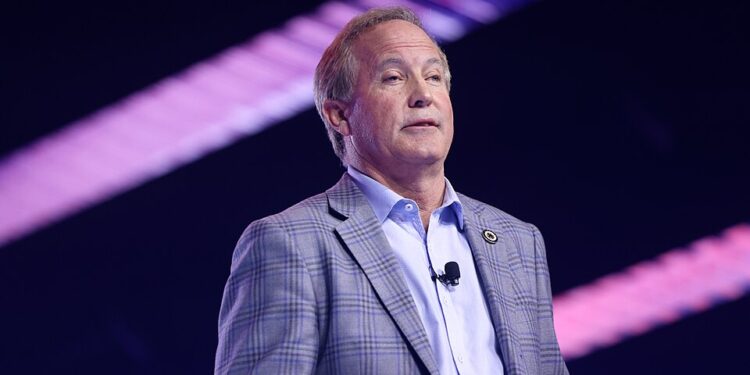
President Donald Trump got a big reaction in Texas after using some unusually colorful language to describe Republican Senate candidate Ken Paxton — and then immediately making clear that he strongly supports him.
During an October 1 appearance at a Peterbilt Motors facility in Denton, Texas, Trump recalled how Paxton stood with him during some of his most difficult political and legal battles.
Trump said Paxton had been at his side “more than anybody” before joking that the Texas attorney general could sometimes be a “pain in the a**.”
The audience laughed.
Trump then quickly shifted from humor to praise, calling Paxton “the greatest attorney general in the United States of America.”
“We need Ken so badly, and that’s why I’m here,” Trump said.
A transcript and contemporary reporting confirm both the remark and Trump’s subsequent endorsement of Paxton.
Trump Makes Clear Where He Stands
Despite the attention generated by Trump’s joke, the president left little doubt about his position in the Texas Senate race.
Trump is backing Paxton against Democratic nominee James Talarico as Republicans work to retain their Senate majority in the November 3 midterm elections.
The Texas contest has become more competitive than Republicans might ordinarily expect in a state that has not elected a Democrat to the U.S. Senate in decades.
Trump’s Texas appearance was part of a larger campaign push ahead of Election Day, with additional stops planned across the country as Republicans seek to motivate voters.
For Trump, Paxton’s past loyalty appears to remain an important part of that relationship.
Paxton Stood With Trump During Major Political Battles
Paxton became a prominent Trump ally following the 2020 presidential election.
The Texas attorney general filed a lawsuit at the U.S. Supreme Court challenging election results in several states won by Joe Biden. The Supreme Court declined to hear the case.
Years later, Trump continues to mention Paxton’s support when explaining why he wants Republicans to send him to Washington.
That history was front and center during Trump’s remarks in Denton.
The president’s message was essentially twofold: he is comfortable publicly teasing Paxton, but he still considers the Texas Republican an important political ally.
Reported Paxton Comments Add Another Twist
Trump’s remarks also came shortly after reports surfaced about comments Paxton allegedly made during a private fundraiser.
According to Reuters, citing reporting from The New York Times, Paxton was recorded saying Republican polling numbers declined following Trump’s September convention in Dallas.
Paxton reportedly told the gathering that after the convention, “everybody’s numbers dropped.”
A senior Paxton campaign adviser disputed the characterization of the recording and said the campaign’s own polling presented a more favorable picture.
Trump was subsequently asked about the reported comments.
The president said he had not heard Paxton make them directly and acknowledged that it was possible the Dallas event had affected polling.
Even so, he continued to publicly support Paxton and traveled to Texas to campaign alongside him.
The episode illustrates a relationship that can include public disagreements without necessarily ending the political alliance between the two men.
Texas Senate Race Gets Much More Attention
The political stakes surrounding Trump’s visit extend well beyond one memorable remark.
Paxton and Talarico are competing for a Senate seat that could matter in the battle for control of Congress.
Recent polling has pointed to a close contest, although results vary depending on the survey and methodology.
A Fox News poll conducted September 24 through September 28 found Talarico at 51% and Paxton at 49% among likely voters.
That two-point difference was within the poll’s three-percentage-point margin of sampling error for likely voters, meaning the survey did not establish a statistically clear leader.
The same poll interviewed 1,203 registered Texas voters, including 881 categorized as likely voters.
Different surveys have produced different results throughout the campaign, reinforcing an important point for readers: polls provide a snapshot of voter opinion at a particular moment and are not election results.
Trump Uses Texas Visit to Talk Manufacturing
The Senate race was only one part of Trump’s Texas appearance.
Standing inside the Peterbilt facility, Trump focused heavily on manufacturing, energy and federal regulations.
At one point, he held up a glass containing a small amount of water while criticizing truck emissions requirements established during the Biden administration.
Trump argued that previous regulations forced manufacturers to add costly equipment to vehicles for what he characterized as relatively small fuel savings.
He then poured out the glass to emphasize his argument.
The demonstration quickly generated attention online, with Trump supporters and critics interpreting the moment very differently.
Supporters viewed it as an effective visual illustration of Trump’s broader argument against costly federal regulations.
Critics questioned both the demonstration and Trump’s description of the environmental rules.
Rather than dwelling on the social-media reaction, the policy issue behind the moment is more significant: federal emissions and fuel-efficiency requirements can affect vehicle design, manufacturing costs, fuel consumption and environmental outcomes, and debates over those tradeoffs have continued across administrations.
Trump Puts American Manufacturing at Center Stage
Trump has long made domestic manufacturing a central part of his economic message.
His appearance at a heavy-truck factory gave him an opportunity to return to familiar themes involving American jobs, energy production, regulations and trade.
Speaking to workers and supporters, Trump argued that his policies are designed to make it easier for American companies to produce goods domestically.
Those arguments are likely to remain prominent throughout the final weeks of the midterm campaign as both parties compete over economic issues.
Recent polling indicates that economic concerns remain important to voters heading into November, adding significance to campaign appearances at factories and manufacturing plants.
Bad Weather Changes Trump’s Travel Plans
Following his Texas appearance, Trump headed toward Durant, Oklahoma, for another Republican campaign event.
Bad weather altered the president’s travel plans, leading him to make the journey by motorcade rather than by air.
Trump commented about the trip on Truth Social, joking about the speed of “The Beast,” the nickname commonly used for the heavily armored presidential limousine.
He later arrived in Oklahoma and addressed supporters.
The Oklahoma stop formed another part of Trump’s broader midterm campaign swing as Republicans work to increase enthusiasm before Election Day.
Trump Praises Oklahoma Supporters
During his remarks in Oklahoma, Trump thanked voters for their longstanding political support.
Oklahoma has backed Trump by wide margins in presidential elections, and the president emphasized his appreciation for the state.
He also discussed immigration, taxes, energy and other issues that have become central themes for Republicans during the 2026 campaign.
But even after leaving Texas, Paxton remained part of Trump’s message.
Trump again promoted the Republican Senate candidate and predicted that voters would send him to Washington.
Paxton later publicly thanked Trump for his support.
Why Trump’s Paxton Remark Drew Attention
The most memorable line from Trump’s Texas appearance may have been his description of Paxton as a “pain in the a**.”
But focusing only on the joke risks missing the larger political message.
Trump criticized Paxton in a playful and highly public way while simultaneously offering him an enthusiastic endorsement.
That combination is not entirely new.
Trump has previously joked about Paxton’s appearance, clothing and speaking style while also repeatedly praising his performance as Texas attorney general. Roll Call documented similar comments during Republican events in Dallas in September.
That makes Thursday’s remark less an indication of a political break and more another example of Trump’s unconventional relationship with one of his longtime Texas allies.
All Eyes Turn Toward November
For Paxton, Trump’s endorsement could help motivate Republican voters who remain strongly supportive of the president.
At the same time, the latest public polling shows why neither campaign can take the race for granted.
Fox News’ late-September survey showed only a two-point difference among likely voters, within the survey’s margin of error.
Other polling has produced different margins, so the most accurate conclusion at this stage is simply that surveys have shown a competitive contest.
Voters will ultimately decide the race on November 3.
Until then, both campaigns are likely to continue fighting for turnout while national political figures devote increasing attention to Texas.
And after Trump’s latest appearance, one thing is unmistakable: the president may enjoy giving Ken Paxton a hard time, but he is still publicly campaigning to put him in the United States Senate.