
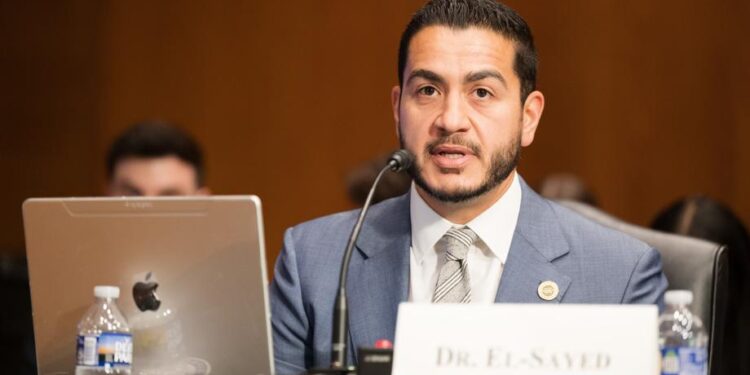
President Donald Trump sparked laughter during a White House event Friday after revealing the surprisingly simple reason he intentionally uses a different name for a Democratic Senate candidate.
The president made the remarks while celebrating Christopher Columbus and defending one of America’s longstanding national holidays against efforts to replace or reconsider its traditional observance.
During his speech, Trump singled out Michigan Democratic Senate candidate Abdul El-Sayed, whom he has repeatedly referred to by a different name.
When explaining his reasoning, Trump offered a short response that quickly became one of the most talked-about moments of the event.
“I don’t know. I feel like it,” Trump said.
The audience responded with laughter as the president continued criticizing Democrats over their positions on Columbus Day and American history.
Trump Explains Why He Uses Different Name For Democrat
The exchange occurred as Trump discussed the political debate surrounding Columbus Day, a federal holiday that has faced growing criticism from progressive activists in recent years.
Trump brought up El-Sayed, who is running for the U.S. Senate in Michigan against Republican Mike Rogers.
Rather than using the candidate’s actual name, Trump referred to him as “Mohammed El-Fayed.”
The president acknowledged that others call the candidate Abdul El-Sayed but made clear that he prefers his own version.
When recalling being asked why he uses the alternate name, Trump delivered his explanation without hesitation.
The response reflected Trump’s familiar political style, which frequently involves humor, pointed criticism, and unconventional nicknames for his opponents.
Throughout his political career, Trump has used memorable labels to challenge Democrats, Republican rivals, and prominent media personalities.
While his supporters often appreciate his unscripted remarks, critics argue that such comments distract from more substantive political issues.
This latest exchange also highlighted a larger disagreement between Trump and Democrats over how the United States should recognize its history.
WATCH:
Trump on Abdul El-Sayed: I call him Mohammed Al Fayad. Some people call him Abdul. I call him Mohammad. Somebody said, “Why?” I said, “I don’t know. I feel like it.” https://t.co/XtGtQUMevS
— Clash Report (@clashreport) October 9, 2026
Trump Takes Strong Stand On Columbus Day
The president’s remarks came during an event celebrating the installation of a Christopher Columbus statue near the White House.
The 13-foot monument is a reproduction of a statue that protesters toppled during demonstrations in July 2020.
The new monument stands near the Eisenhower Executive Office Building, which houses important federal offices adjacent to the White House.
Trump celebrated the statue’s return as an important symbol of America’s historical heritage.
“I resurrected Christopher Columbus,” the president declared.
He also expressed satisfaction that Columbus was once again being publicly honored in the nation’s capital.
The president criticized activists who have pushed to remove monuments honoring historical figures, arguing that such efforts threaten important elements of America’s national identity.
For many Americans, particularly those with Italian-American heritage, Columbus Day has long represented an opportunity to celebrate cultural traditions and historical contributions.
Others believe that recognizing Indigenous Peoples’ Day provides an important opportunity to acknowledge Native American communities and their experiences.
The competing perspectives have turned Columbus Day into a recurring political and cultural debate.
Michigan Senate Candidate Draws Trump’s Attention
Trump’s criticism of El-Sayed centered on the Democrat’s public support for Indigenous Peoples’ Day.
In October 2025, El-Sayed published a social media statement recognizing Indigenous communities in Michigan and acknowledging the hardships experienced by Native Americans.
The message emphasized dignity and self-determination for Indigenous populations.
During Friday’s event, Trump accused the Democratic candidate of wanting to abolish Columbus Day.
However, El-Sayed’s referenced social media statement did not explicitly call for eliminating the federal holiday.
That distinction is important because recognizing Indigenous Peoples’ Day does not necessarily require ending Columbus Day.
Former President Joe Biden previously issued proclamations recognizing both observances.
Trump has taken a different approach by placing renewed emphasis on defending Columbus Day and protecting monuments associated with American history.
His remarks Friday demonstrated that the president intends to keep the issue in the national spotlight.
Why The Michigan Senate Race Is Important
The controversy also comes during an important election year, with control of Congress at stake in the November 2026 midterm elections.
Michigan is expected to remain a significant political battleground as Republicans and Democrats compete for a closely watched U.S. Senate seat.
Republican Mike Rogers and Democrat Abdul El-Sayed represent competing visions for the state’s political future.
The candidates face an electorate concerned about major national issues, including inflation, household expenses, immigration, public safety, and the direction of the federal government.
Trump’s decision to mention El-Sayed during a White House event illustrates how closely the president is following important congressional contests.
It also highlights the role that debates over American history and cultural traditions continue to play in national politics.
While economic concerns and government policies remain central to the election, disagreements over historical monuments and federal holidays have become increasingly visible.
For voters who place a high value on preserving national traditions, Columbus Day remains a meaningful issue.
Trump Promises To Protect American Heritage
Beyond his remarks about the Democratic candidate, Trump delivered a clear message about the Christopher Columbus statue and other historical monuments.
The president pledged to protect the newly installed monument throughout the remainder of his administration.
He argued that removing historical symbols risks diminishing the nation’s understanding of its own past.
Supporters of preserving these monuments contend that historical figures should be evaluated within the broader context of their time rather than judged exclusively by modern political standards.
Opponents of certain monuments argue that public memorials should also reflect the experiences of communities historically excluded from traditional accounts of American history.
These competing arguments have influenced debates over statues, school curricula, public celebrations, and government recognition of historical events.
Trump has consistently positioned himself as a defender of traditional American symbols and holidays.
His Columbus Day remarks reinforced that message while drawing fresh attention to Michigan’s Senate contest.
Another Unscripted Trump Moment Grabs Attention
Friday’s exchange was another example of Trump’s ability to turn an ordinary political speech into a widely discussed national moment.
What began as an event celebrating Christopher Columbus expanded into a discussion about Democratic candidates, historical preservation, and political differences over American traditions.
The president’s explanation for using an incorrect name was brief, but it captured the attention of those watching.
For supporters, the moment demonstrated Trump’s unscripted speaking style and willingness to confront political opponents.
For critics, it raised questions about his choice to deliberately misname a candidate rather than focus exclusively on policy disagreements.
Regardless of how Americans interpret the remark, the broader political debate over Columbus Day and historical monuments remains unresolved.
With the November midterm elections approaching, issues involving American heritage, national identity, and the direction of the country are likely to remain part of the political conversation.