
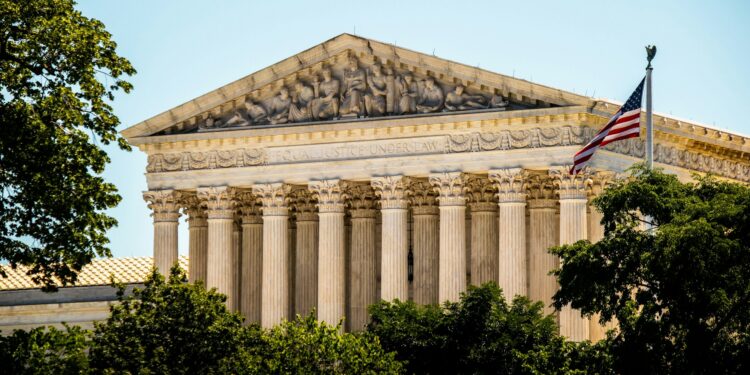
Republicans have secured another major victory at the U.S. Supreme Court, delivering an important boost to GOP campaign organizations as the November midterm elections quickly approach.
In a decision issued Wednesday, October 14, the nation’s highest court sided with Republican groups and the Federal Communications Commission (FCC) in an ongoing legal battle over discounted television and radio advertising rates.
The ruling allows a policy benefiting political party committees to remain in place while the legal dispute continues.
The decision comes at a critical moment for President Donald Trump and congressional Republicans, who are preparing for competitive races that could determine control of Congress.
With Election Day scheduled for November 3, the ability to purchase additional campaign advertising at discounted rates could become an important advantage during the final weeks of the election season.
Supreme Court Delivers Another Victory for Republicans
The Supreme Court’s latest decision concerns federal regulations governing how much political candidates and party organizations must pay for television and radio advertisements.
Under federal law, qualified candidates receive special advertising rates during designated periods before elections.
These rates, commonly called the “lowest unit charge,” prevent broadcasters from charging qualifying candidates more than their most favorable comparable commercial advertising rates.
However, the FCC issued guidance in March extending those favorable rates to certain political party advertisements coordinated with candidates and qualifying joint fundraising committees.
Democratic candidates challenged that interpretation, arguing that the law specifically protects individual candidates rather than political organizations more broadly.
The dispute eventually reached a federal appeals court, which ordered the FCC to resolve the Democrats’ administrative challenge before the midterm elections.
Republican organizations and the FCC asked the Supreme Court to intervene.
The justices agreed, temporarily blocking the lower court’s order and allowing the existing advertising policy to continue.
Why the Supreme Court Decision Matters
Although the case involves technical federal advertising regulations, its implications for the 2026 elections are significant.
Political campaigns spend enormous amounts of money on television advertisements, particularly in closely contested congressional races.
Advertising costs can rise substantially as Election Day approaches and campaigns compete for limited airtime.
Access to discounted rates allows qualifying political organizations to stretch their campaign budgets further.
That means more opportunities to reach voters, explain policy positions, and respond to competing campaign messages.
For Republicans, the timing of Wednesday’s decision is especially important.
The party’s national campaign committees entered the closing months of the election season with a considerable financial advantage over their Democratic counterparts.
According to Federal Election Commission figures reported by Reuters, the three major national Republican committees held approximately $233 million in cash at the end of August.
Comparable Democratic committees reported approximately $130 million, along with nearly $18 million in debt.
Those financial differences could make discounted advertising particularly valuable to Republican organizations in competitive races.
Democrats Challenge the FCC’s Advertising Policy
The legal challenge was brought by four Democratic congressional candidates, including Sen. Jon Ossoff of Georgia, former Sen. Sherrod Brown of Ohio, former North Carolina Gov. Roy Cooper, and Rep. Kristen McDonald Rivet of Michigan.
Their argument centers on whether the FCC has the authority to expand access to favorable advertising rates beyond the candidates expressly identified under federal law.
Democrats maintain that the agency’s interpretation improperly extends the benefits of the existing statute.
The FCC, meanwhile, has defended its interpretation of the rules governing coordinated political advertising.
Republican organizations have also argued that the legal challenge should proceed through the appropriate administrative review process before federal courts consider the underlying dispute.
The Supreme Court’s latest action favors that position.
Importantly, the justices did not permanently settle whether the FCC’s interpretation is lawful.
Instead, the ruling blocks the appeals court’s attempt to force a faster agency decision.
That distinction means the broader legal disagreement remains unresolved.
Two Supreme Court Justices Oppose the Decision
The Supreme Court’s October 14 ruling was issued without a full, signed opinion from an individual justice.
However, two liberal members of the Court publicly indicated that they disagreed with the decision.
Justices Sonia Sotomayor and Ketanji Brown Jackson would have denied the request to block the lower court’s order.
The Court currently has a 6-3 conservative majority.
This latest action follows an earlier September 4 decision in which the Supreme Court also sided with Republican organizations in the same advertising dispute.
That earlier ruling restored the FCC’s policy after a federal appeals court had blocked it.
The October decision represents another favorable development for Republican campaign committees, even as the underlying case remains subject to further proceedings.
Republicans Gain Another Advantage Before Election Day
The dispute over advertising rates is only one part of a broader series of legal developments affecting political campaign spending.
In June, the Supreme Court struck down longstanding federal limits on coordinated spending between political parties and their candidates.
That decision allowed national party committees to spend additional money supporting candidates through coordinated campaign activities.
The financial effects have already become apparent.
According to Reuters, Republican organizations spent more than $48 million beyond the previous coordinated-spending limits during July and August.
Democratic organizations also exceeded the former limits, but by less than $4 million over the same period.
Combined with Wednesday’s ruling on discounted advertising rates, these developments give Republican campaign organizations additional flexibility in how they deploy their financial resources.
However, the advertising policy itself is not restricted to Republicans. Qualifying Democratic organizations can also benefit from the same rates.
The potential Republican advantage comes primarily from the party’s larger available campaign funds and its ability to purchase more advertising under the current rules.
What Happens Next for Republicans?
With the November 3 midterm elections approaching, both parties are concentrating their resources on competitive House and Senate races.
For President Trump and Republican leaders, maintaining control of Congress remains a central political objective.
The outcome could influence the administration’s ability to advance its legislative priorities during the remainder of Trump’s presidency.
Meanwhile, Democrats are seeking to gain congressional seats and increase their influence over the federal government’s direction.
The Supreme Court’s latest ruling does not determine which party will win those contests.
Voter turnout, individual candidates, economic concerns, and local political conditions will ultimately shape the results.
Nevertheless, Wednesday’s decision gives Republican campaign organizations another favorable legal outcome at a time when every advertising dollar matters.
The broader dispute over political advertising regulations could return to the courts in the future.
For now, the FCC’s policy remains in effect, and Republican organizations can continue using the favorable advertising rates available under its current interpretation.
As the country approaches another closely watched election, the Supreme Court’s decision highlights just how important campaign finance rules have become in the battle for control of Washington.