
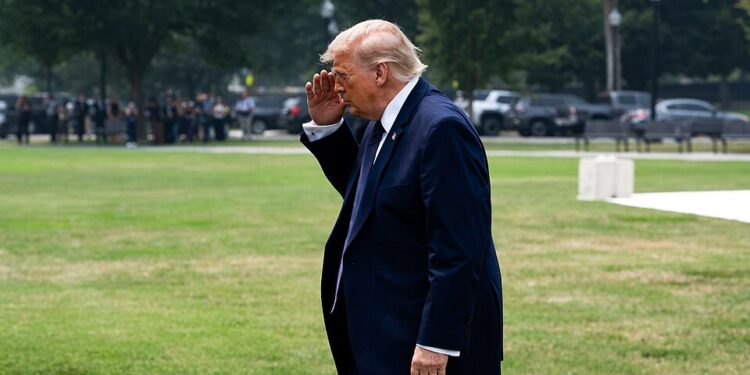
President Donald Trump is facing unexpected pressure from members of his own Republican Party after several GOP lawmakers joined Democrats in demanding that he reverse a controversial agreement with Russia.
The disagreement centers on Trump’s recent decision to ease restrictions on Russian diesel fuel exports, a move the White House says could help lower energy prices for Americans.
However, a growing number of Republicans are questioning whether the agreement could benefit Russian President Vladimir Putin while offering little financial relief to American families.
The dispute has created an unusual divide within the Republican Party just weeks before the November midterm elections, when economic concerns, national security, and rising energy costs are expected to remain important issues for voters.
Republicans Send Trump a Direct Warning
Five House Republicans have joined 17 Democrats in signing a letter urging President Trump to cancel his agreement involving Russian diesel fuel.
The Republican lawmakers include Don Bacon of Nebraska, Brian Fitzpatrick of Pennsylvania, Michael McCaul of Texas, Dan Newhouse of Washington, and Joe Wilson of South Carolina.
Their demand comes after Trump announced an arrangement on October 9 that would allow additional Russian diesel fuel to enter international energy markets.
The lawmakers are concerned that the agreement could provide Moscow with additional revenue while Russia continues its war against Ukraine.
They are also questioning whether the arrangement will deliver the lower fuel prices that American consumers have been hoping to see.
The letter represents a notable disagreement within the GOP, particularly because Republicans have generally supported Trump’s efforts to address rising energy costs and strengthen the American economy.
However, these lawmakers believe the potential national security consequences of the agreement should not be overlooked.
Why Trump Made the Deal With Russia
President Trump announced the diesel arrangement as part of his administration’s broader effort to address high energy prices.
Under the agreement, Russia was expected to make approximately 300,000 metric tons of diesel available to the global marketplace immediately, followed by another 500,000 metric tons in November.
Trump has argued that increasing fuel supplies could help stabilize international energy markets and reduce costs.
Diesel prices are particularly important because the fuel powers much of America’s commercial transportation industry.
Trucks delivering groceries, agricultural equipment operating on farms, and machinery used in construction all depend heavily on diesel.
When diesel becomes more expensive, businesses frequently face higher operating expenses.
Those costs can eventually affect consumers through increased prices for food, household necessities, and other everyday products.
For Americans managing household budgets or living on fixed retirement incomes, rising transportation and grocery expenses can create additional financial pressure.
The administration believes expanding available fuel supplies is one way to address these concerns.
However, Republican critics are questioning whether purchasing or allowing additional Russian diesel onto the international market is the appropriate solution.
GOP Lawmakers Raise Concerns About Putin
The biggest objection from Republican lawmakers involves the possibility that Russia could use additional energy revenue to support its military operations.
Since Russia launched its full-scale invasion of Ukraine in 2022, the United States and its allies have imposed economic restrictions intended to limit Moscow’s ability to finance the conflict.
Energy exports remain an important source of revenue for the Russian government.
Critics of Trump’s agreement argue that easing restrictions could weaken existing sanctions and reduce pressure on Putin to negotiate an end to the war.
Another concern involves whether the additional Russian diesel will significantly affect American fuel prices.
The global diesel market is enormous, and some energy analysts have questioned whether the quantities involved in Trump’s agreement are large enough to produce substantial price reductions.
That uncertainty has become a central part of the controversy.
While the White House believes increased supply could provide economic benefits, skeptical lawmakers say those benefits must be weighed against the possibility of strengthening Russia financially.
Senate Republicans Also Break With Trump
The disagreement is not limited to the House.
Six Republican senators recently joined six Democratic senators in calling on President Trump to reconsider the Russian diesel agreement.
The Republican senators included Mitch McConnell of Kentucky, Susan Collins of Maine, John Cornyn of Texas, Lisa Murkowski of Alaska, Thom Tillis of North Carolina, and Alan Armstrong of Oklahoma.
Their letter argued that the agreement could undermine American foreign policy objectives and weaken efforts to hold Russia accountable for its actions in Ukraine.
The senators also expressed concern that additional Russian fuel sales might provide limited relief to American consumers.
Several of the Republicans involved hold influential positions on committees responsible for national security, government spending, and foreign policy.
Their opposition demonstrates that the disagreement extends beyond a handful of lawmakers.
It also raises questions about whether Congress could pursue legislative action to restrict the administration’s ability to move forward with the arrangement.
White House Defends Trump’s Decision
Despite the criticism, President Trump has defended the agreement as an effort to help stabilize global energy prices.
The president has emphasized that the Russian diesel would be released into the international marketplace rather than exclusively purchased by the United States.
His argument is that increasing available fuel supplies could help reduce economic pressure worldwide, including on American businesses and consumers.
The administration has also maintained that lowering energy costs remains a priority.
Trump’s approach reflects a broader debate about how the United States should handle relationships with foreign governments when economic interests and national security concerns overlap.
Supporters of the arrangement see potential value in expanding energy supplies during a period of elevated prices.
Critics believe the administration should avoid agreements that could weaken economic restrictions against Russia.
The disagreement leaves the White House facing difficult questions about how to balance domestic economic priorities with America’s international commitments.
Could Congress Take Action Against Trump’s Deal?
Some Republicans are already considering steps beyond public criticism.
Rep. Brian Fitzpatrick of Pennsylvania has announced plans to pursue bipartisan legislation that would block Russian oil purchases.
Fitzpatrick has indicated that he wants to bring the proposal to a House vote, potentially forcing lawmakers to take a public position on the issue.
Such a vote could create an uncomfortable situation for Republican leaders who support the president but also favor strong sanctions against Moscow.
It remains unclear whether Congress would ultimately approve legislation restricting the agreement or whether lawmakers could gather enough support to overcome potential opposition from the White House.
The administration also faces an October 18 deadline associated with implementing newly approved Russia sanctions legislation.
That law contains provisions allowing presidential waivers under certain circumstances, creating another potential area of disagreement between Congress and the administration.
For now, lawmakers are increasing pressure on Trump to reconsider the arrangement before taking additional action.
Why This Matters for American Families
The controversy involves more than diplomatic disagreements in Washington.
Energy prices directly affect the American economy, particularly industries responsible for producing and transporting essential goods.
Farmers depend on diesel to operate equipment and transport crops.
Trucking companies rely on diesel to deliver products throughout the country.
Manufacturers and construction businesses also face increased operating expenses when fuel prices rise.
As transportation costs increase, consumers may eventually see those expenses reflected in the prices they pay for everyday necessities.
That makes affordable energy an important concern for millions of households.
At the same time, national security remains a significant issue for lawmakers who believe economic sanctions are necessary to discourage Russian aggression.
The central question is whether Trump’s agreement can provide meaningful energy relief without undermining those security objectives.
Until more information becomes available about the agreement’s economic effects, the answer remains uncertain.
Midterm Elections Add Political Pressure
The growing disagreement comes at a sensitive moment for the Republican Party.
With the November 3 midterm elections approaching, candidates are preparing to defend their records on the economy, energy prices, and foreign policy.
Republicans have emphasized their commitment to affordable energy and economic stability.
However, the Russian diesel agreement has introduced a new debate about how those goals should be achieved.
Some Republican lawmakers believe the administration should prioritize maintaining strong economic pressure on Putin.
Others see potential benefits in allowing additional fuel supplies to reach international markets.
The disagreement could become more significant if Congress moves forward with legislation challenging the president’s decision.
For voters, the controversy raises broader questions about energy independence, America’s relationship with Russia, and the government’s ability to address rising costs without creating additional foreign policy risks.
What Happens Next for Trump?
President Trump now faces pressure from both chambers of Congress to reconsider his agreement with Russia.
Five House Republicans have joined Democrats in demanding that the arrangement be canceled, while a separate bipartisan group of senators has raised similar objections.
The White House has defended its approach, arguing that expanding fuel supplies could help ease the financial burden created by high energy prices.
However, the Republican lawmakers challenging the decision believe the potential benefits may not outweigh the national security concerns.
The coming days could bring further developments as Congress considers its options and the administration approaches an important sanctions deadline.
For Trump, the challenge is demonstrating that his energy strategy can deliver meaningful benefits to American consumers without providing an unintended advantage to Russia.
Whether the president changes course or stands by the agreement, the controversy has exposed a significant disagreement among Republicans over one of the administration’s most consequential foreign policy decisions.
And with the midterm elections approaching, the political consequences of that disagreement remain to be seen.