
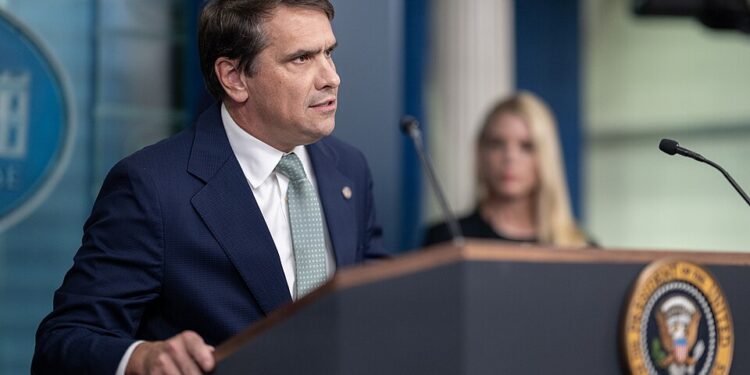
Attorney General Todd Blanche delivered a sharp rebuke to CBS News on Sunday, accusing the network of misleading viewers during a heated exchange over the Trump administration’s controversial election lawsuit in Alaska.
The confrontation unfolded on CBS’s Face the Nation, where host Margaret Brennan questioned Blanche about the Justice Department’s effort to prevent certification of Alaska’s upcoming Senate election under certain circumstances.
Blanche immediately challenged Brennan’s description of the situation, accusing her of presenting an incomplete account of the dispute.
The exchange quickly escalated into a tense disagreement over election integrity, federal authority, and the responsibility of major news organizations to accurately report the facts.
At the center of the controversy is a highly unusual election involving two candidates with nearly identical names.
And with control of the U.S. Senate potentially at stake, the legal battle has attracted national attention.
Trump Attorney General Confronts CBS Host
During Sunday’s interview, Brennan questioned Blanche about the Justice Department’s lawsuit against Alaska election officials.
The case involves Republican Sen. Dan Sullivan, who is seeking reelection against Democratic challenger Mary Peltola.
But another candidate, Daniel J. Sullivan Jr., is also on the ballot.
The similarities between the two names have raised concerns among Republican officials that voters could mistakenly support the wrong candidate.
Brennan characterized the administration’s lawsuit as an effort to block certification of the election if the Republican incumbent loses.
Blanche strongly objected.
The attorney general accused Brennan of misleading viewers by failing to explain the concerns surrounding the second Sullivan’s candidacy.
He pointed to an earlier determination by Alaska election officials that the additional candidate had entered the race with the intention of confusing voters.
Brennan pushed back, noting that Alaska’s courts had allowed the candidate to remain on the ballot.
The disagreement became increasingly contentious as both challenged the other’s interpretation of the facts.
At one point, Blanche told Brennan that she was not being truthful with viewers.
The interview highlighted a familiar conflict between the Trump administration and national news organizations, particularly when politically sensitive legal issues are involved.
Why the Justice Department Is Taking Action
The controversy began months before the upcoming November 3 election.
Daniel J. Sullivan Jr., a retired educator, entered the Senate race against Republican incumbent Dan Sullivan and Democrat Mary Peltola.
Alaska election officials initially attempted to prevent the similarly named candidate from appearing on the ballot.
They argued that his candidacy appeared designed to create confusion among voters.
However, the dispute eventually reached Alaska’s courts.
The state Supreme Court upheld a decision allowing Daniel J. Sullivan Jr. to participate in the election.
That ruling did not settle the federal government’s concerns.
The Justice Department subsequently filed a lawsuit seeking protections in the event voter confusion affects the final election results.
The administration argues that election officials should not certify a potentially affected result without appropriate legal review.
Blanche maintains that the goal is not to have the federal government select Alaska’s next senator.
Instead, he says the department wants safeguards that would allow election officials and courts to examine possible confusion if the race is close enough for those votes to matter.
President Trump Acknowledges His Role
President Donald Trump has also publicly addressed the dispute.
When reporters questioned him about the Justice Department’s lawsuit, Trump acknowledged encouraging legal action.
The president has criticized the ballot situation, expressing concern that the presence of another candidate with the same first and last name could interfere with voters’ intentions.
The administration’s involvement has intensified scrutiny of the election.
Republicans are working to maintain their Senate majority, making competitive races particularly important.
Although Alaska has historically favored Republican candidates in many statewide elections, the Senate contest between Sullivan and Peltola has drawn increasing attention.
A close result could have implications for the balance of power in Washington.
However, the existence of a close election would not, by itself, establish that voters were confused or that election laws were violated.
Those questions would require evidence and legal review.
Alaska Officials Have Already Addressed Ballot Confusion
One important detail in the dispute is how the two Sullivan candidates are identified.
Alaska’s ballot distinguishes the Republican incumbent from the similarly named challenger.
Sen. Sullivan appears with his middle initial and is identified as both a registered Republican and the incumbent.
Daniel J. Sullivan Jr. appears separately, without a listed party affiliation.
Critics of the Justice Department’s lawsuit argue that these distinctions give voters sufficient information to identify their preferred candidate.
Among those critics is Republican Sen. Lisa Murkowski of Alaska.
Murkowski publicly opposed the federal lawsuit, arguing that the state had already addressed concerns about the two names.
Her opposition demonstrates that the disagreement is not strictly divided along party lines.
Republican Sen. Thom Tillis also questioned the timing of the lawsuit, although he acknowledged that the underlying ballot issue warranted attention.
For now, the dispute remains a legal disagreement rather than proof of election misconduct.
CBS Interview Raises Questions About Federal Election Authority
Another major issue emerged during the exchange between Blanche and Brennan.
How far can the federal government go when challenging election procedures established by individual states?
Under the American election system, states are primarily responsible for administering elections, subject to applicable federal constitutional and statutory requirements.
The Justice Department argues that federal law provides a basis for its intervention.
Blanche said the administration is seeking a legal process to preserve and review relevant election evidence if questions arise after voting concludes.
Brennan challenged that explanation by pointing to the lawsuit’s requested restrictions on certification.
That distinction matters.
While Blanche described the administration’s intentions as protective, the lawsuit seeks judicial intervention that could delay certification under certain conditions.
The courts will ultimately determine whether the federal government has established a valid legal basis for that intervention.
The interview also revealed competing interpretations of the state court proceedings.
Blanche emphasized the original concerns raised by election officials.
Brennan noted that Alaska’s courts had ruled against excluding the second candidate.
Both facts are important to understanding why the controversy remains unresolved.
Why the Alaska Senate Election Matters
The Alaska dispute could become particularly important if the election produces a narrow result.
The state’s ranked-choice voting system adds another layer of complexity.
Under that system, voters rank candidates in order of preference rather than simply choosing one name.
If no candidate receives a majority of first-choice votes, additional counting rounds can help determine the winner.
This makes it important to distinguish between ordinary votes for a candidate and votes allegedly resulting from mistaken identity.
The Justice Department has raised concerns that voters could select Daniel J. Sullivan Jr. while intending to support the Republican incumbent.
But determining whether individual voters were actually confused presents substantial practical and legal questions.
Votes for one candidate cannot simply be assumed to belong to another.
Any effort to challenge an election outcome would need to address those questions through the applicable legal process.
What Happens Next?
With Election Day scheduled for November 3, attention now turns to both the courts and Alaska voters.
Several possibilities remain.
If Sen. Sullivan wins comfortably, the particular circumstances identified in the Justice Department’s lawsuit may have little effect on the election’s outcome.
If he loses by a narrow margin, however, the federal case could become a significant factor in the certification process.
A court would have to consider the legal arguments and available evidence before ordering any relief.
Meanwhile, the exchange between Blanche and Brennan has placed another spotlight on the relationship between the Trump administration and the national news media.
The attorney general insists that the Justice Department is taking legitimate steps to protect the election process.
His critics argue that the federal government should not intervene in a state election based on concerns that have not yet been demonstrated in actual voting results.
The central question remains whether the Justice Department’s proposed safeguards are legally justified—or whether they represent unnecessary federal interference in an election administered by Alaska.
For voters watching this dispute unfold, the ultimate decision will rest with the courts and the election process, not the television confrontation.
And as the Senate race approaches, the controversy is likely to remain a closely watched test of election law, political accountability, and public trust.