
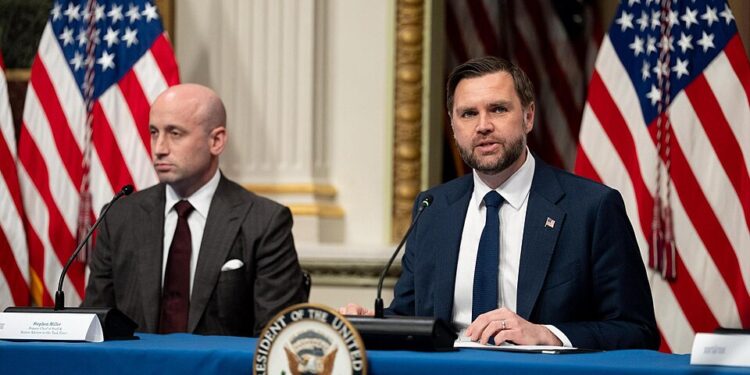
President Donald Trump has responded to Vice President JD Vance’s unusually direct criticism of the political consequences of the war with Iran, acknowledging that the conflict played a significant role in Republicans’ devastating losses during the 2026 midterm elections.
But while Trump agreed with much of his vice president’s assessment, he also made it clear that there was one important point he believed Vance should have emphasized.
The president addressed the controversy during an interview on CBS’s 60 Minutes on Sunday, November 8, offering new insight into the administration’s response to the Republican Party’s election setbacks.
Trump’s response revealed that the two leaders agree about the political damage caused by the conflict, even as questions continue about the future of the Republican Party.
Vance Delivers Blunt Warning Following Republican Losses
The controversy began after Vance publicly addressed the Republicans’ disappointing performance in the November 3 midterm elections.
Democrats secured control of both chambers of Congress after flipping at least seven Senate seats and more than two dozen House districts, delivering a major setback to Trump’s political agenda.
In a lengthy social media post, Vance pointed directly to the ongoing conflict with Iran as the primary reason Republicans lost support.
“The reason we lost is the war,” Vance wrote.
His assessment represented a significant acknowledgment from one of the administration’s highest-ranking officials.
Rather than blaming campaign messaging or individual Republican candidates, Vance suggested that the administration’s foreign policy decisions had become a major concern for voters.
The vice president also identified other issues Republicans must confront, including rising living expenses, inflation, and America’s relationship with Israel.
His comments highlighted the difficult political environment facing Republicans as they attempt to regain the confidence of Americans who previously supported Trump.
Trump Responds To Vance’s Unexpected Remarks
During his CBS interview, Trump was asked whether he agreed with Vance’s explanation for the Republican Party’s election losses.
The president offered a direct response.
“I don’t disagree with it,” Trump said.
That acknowledgment was significant because Vance’s remarks had generated questions about whether the vice president was distancing himself from the administration’s decisions.
However, Trump made clear that Vance had discussed the matter with him before publishing his comments.
According to the president, Vance approached him to ask what he thought about sharing his assessment publicly.
Trump indicated that he had no objection to the vice president expressing his views.
The exchange suggested that the public disagreement some observers anticipated was less substantial than it initially appeared.
Nevertheless, Trump acknowledged that he wanted Vance to address an additional issue.
Trump Reveals The One Thing He Wanted Vance To Say
Although Trump agreed that the Iran conflict hurt Republicans politically, he believed Vance should have explained whether he would support making the same military decision again.
For Trump, that question separates the political consequences of the war from the national security arguments behind it.
The president emphasized that he remains convinced the United States was right to confront Iran over its nuclear ambitions.
“My answer is an emphatic yes, because you can’t let Iran have a nuclear weapon,” Trump said.
Trump argued that preventing Iran from obtaining nuclear weapons was more important than the political consequences facing Republicans.
He also maintained that the decision could ultimately be remembered favorably, even if its immediate effects have been difficult for the administration.
The president’s comments underscored his belief that major national security decisions should not be determined solely by their impact on elections.
At the same time, his acknowledgment of the political fallout highlighted the challenges confronting Republicans following their losses.
Iran Conflict Raises Economic Concerns Among American Voters
The political debate surrounding the war extends beyond national security.
Vance’s assessment also drew attention to the economic pressures facing American households, particularly rising prices and the cost of everyday necessities.
The conflict with Iran has contributed to concerns about energy markets and gasoline prices, adding to broader frustrations over affordability.
For families managing monthly budgets, higher transportation and household expenses can have a noticeable impact.
Those pressures can be especially significant for retirees and Americans living on fixed incomes, whose budgets may offer limited flexibility when essential costs increase.
Trump previously acknowledged that higher gasoline prices associated with the conflict likely contributed to Republican election losses.
However, the president continues to argue that the potential security risks of allowing Iran to develop nuclear weapons outweigh those short-term economic and political consequences.
That position has become a central part of the administration’s defense of its foreign policy.
Republicans now face the challenge of explaining that argument while responding to voters who are increasingly focused on their financial circumstances.
Republicans Face Growing Questions About Their Future
The midterm election results have created a difficult political landscape for the Republican Party.
With Democrats set to control both the House and Senate when the new Congress convenes, Trump will face additional obstacles in advancing his legislative priorities.
The results have also prompted a broader debate about the direction Republicans should take ahead of the 2028 presidential election.
Vance, who is widely viewed as a potential future presidential candidate, has emphasized the importance of understanding why some voters abandoned Republican candidates.
His remarks suggest that addressing the economic consequences of foreign policy decisions could become a significant issue within the party.
Meanwhile, Trump’s response indicates that he believes Republicans can acknowledge those political consequences without rejecting the administration’s broader national security objectives.
The distinction could become increasingly important as party leaders debate how to rebuild their coalition.
Republicans must also determine how to address inflation, energy costs, immigration, government spending, and other issues that continue to influence voter priorities.
What Trump’s Response Means Moving Forward
Trump’s reaction to Vance’s comments offered an important glimpse into the relationship between the president and vice president following a difficult election.
Despite the blunt nature of Vance’s assessment, Trump did not publicly rebuke him for connecting Republican losses to the Iran conflict.
Instead, the president largely agreed with the political analysis while defending the decision that helped create those consequences.
Vance, for his part, has argued that Republicans must openly acknowledge why they lost if they hope to rebuild voter support.
Both leaders appear to recognize that the war has created challenges for their party, even though Trump remains convinced that confronting Iran was necessary.
For Republicans, the immediate challenge is determining how to address those concerns while preparing for a Congress controlled by Democrats.
The debate also raises broader questions about how the party will balance national security, economic affordability, and its America First priorities in the years ahead.
Ultimately, Vance’s remarks have placed a difficult political reality directly in front of the Trump administration: Republicans must address voter frustration while defending the decisions they believe are essential to America’s security.
Whether that approach can restore confidence among Republican voters remains an important question as the party looks toward 2028.