
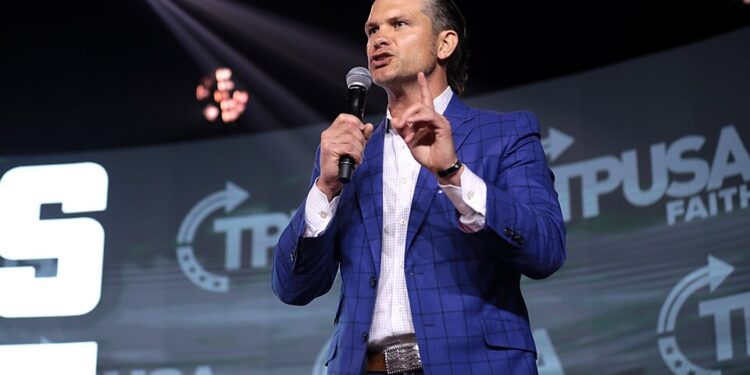
Defense Secretary Pete Hegseth delivered a fiery response to his political critics Tuesday, blasting an effort to impeach him while defending President Donald Trump’s military leadership and America’s armed forces.
Speaking at a Pentagon news conference on November 10, Hegseth rejected accusations that his handling of military operations justified removing him from office.
The defense secretary accused his opponents of turning legitimate political disagreements into an impeachment battle, arguing that their actions risk undermining America’s national security.
“This is not patriotism. This is sabotage,” Hegseth declared.
His remarks came as Congress prepared to consider eight articles of impeachment introduced by Republican Rep. Thomas Massie of Kentucky.
However, the controversy took another dramatic turn later Tuesday when House Republicans successfully blocked the effort from advancing.
Hegseth Fires Back at Republican Critic
The impeachment resolution accused Hegseth of misconduct involving several major military operations conducted under the Trump administration.
Massie’s allegations focused on U.S. military actions involving Iran, Yemen, Venezuela, and suspected drug-trafficking operations in international waters.
The Kentucky congressman argued that Hegseth had exceeded his authority and violated laws governing military operations.
Other allegations concerned the protection of civilians during armed conflicts and possible retaliation against Democratic Sen. Mark Kelly.
Hegseth strongly disputed the accusations.
He maintained that the military operations were authorized by President Trump, conducted lawfully, and carried out by American service members fulfilling their responsibilities.
The defense secretary argued that lawmakers who disagree with the president’s military strategy should pursue those disagreements through established congressional procedures rather than impeachment.
Hegseth also accused Massie of using the controversy to attract attention during his final months in Congress.
Trump Administration Defends Military Decisions
During the news conference, Hegseth defended several major operations that have drawn criticism from lawmakers.
Among them were American military actions against Iranian targets, operations involving Houthi forces in Yemen, and strikes targeting suspected drug-trafficking vessels.
He also defended the military operation that resulted in the capture of Venezuelan leader Nicolás Maduro.
Hegseth characterized these actions as necessary efforts to protect American interests and confront threats to national security.
The defense secretary emphasized that military personnel operate under civilian leadership and should not become political targets simply because members of Congress disagree with decisions made in Washington.
His comments reflected the Trump administration’s broader argument that military operations must remain focused on national security objectives rather than partisan disputes.
Massie, however, maintains that questions about military effectiveness do not eliminate the government’s responsibility to follow the Constitution and federal law.
That disagreement has become central to the growing controversy surrounding the Pentagon.
President Trump Stands Behind Hegseth
President Trump quickly demonstrated that he had no intention of abandoning his defense secretary.
Following Hegseth’s public remarks, Trump praised his response and sharply criticized Massie’s impeachment effort.
The president awarded Hegseth an enthusiastic “A” for his defense, making clear that the administration continued to support him.
Vice President JD Vance also weighed in, questioning whether policy disagreements should be treated as impeachable offenses.
Vance argued that Congress has several constitutional methods available to challenge executive branch decisions without attempting to remove a Cabinet official.
The White House separately issued a formal statement opposing the impeachment resolution.
Administration officials argued that the proceedings could weaken America’s military position and distract Congress from other national priorities.
For Trump and his allies, the controversy represents another confrontation over presidential authority, military leadership, and congressional oversight.
House Republicans Deliver Major Setback to Impeachment Effort
Despite the attention surrounding Massie’s resolution, the impeachment effort suffered a significant defeat Tuesday evening.
The Republican-controlled House voted 211-204 to refer the resolution to the House Judiciary Committee.
That procedural decision effectively prevented the articles of impeachment from advancing to a full House vote during the current congressional session.
Massie was the only Republican to oppose the motion, joining Democrats who wanted the impeachment effort to proceed.
The outcome represented an important political victory for Hegseth and the Trump administration.
It also demonstrated that Republican lawmakers were largely unwilling to support removing the defense secretary over the allegations presented.
Nevertheless, the vote did not resolve every question surrounding the military operations.
Critics can continue pursuing congressional investigations, and the matter could return when the next Congress takes office.
Democrats Could Revive the Controversy
Although Republicans successfully stopped the immediate impeachment effort, Hegseth may face additional scrutiny in the months ahead.
Democrats are preparing to assume control of Congress in January 2027 following their victories in the midterm elections.
That change in leadership could provide Democratic lawmakers with new opportunities to investigate the Pentagon and revisit accusations against senior Trump administration officials.
The possibility of renewed proceedings means the political dispute could continue well beyond Tuesday’s vote.
Supporters of congressional oversight argue that lawmakers have a responsibility to examine potential violations of federal law, regardless of which political party controls the White House.
Hegseth and his defenders maintain that the allegations reflect disagreements over military policy rather than evidence of impeachable misconduct.
The debate is likely to remain a major issue as Washington prepares for a new balance of power in Congress.
Hegseth Refuses to Back Down
For Hegseth, the controversy has become about more than his own position within the Trump administration.
The defense secretary has framed the impeachment campaign as a challenge to America’s military leadership during a period of serious international tensions.
His supporters argue that political disagreements should not interfere with the military’s ability to carry out lawful orders and protect American interests.
Critics counter that national security decisions must remain subject to constitutional limits and independent congressional review.
Both concerns are important parts of the American system of government, which divides authority between the executive and legislative branches.
The immediate political outcome, however, is clear.
House Republicans have stopped the impeachment resolution from advancing, and President Trump continues to stand behind his defense secretary.
Hegseth has made it clear that he has no plans to retreat from defending the administration’s military record. With another political showdown potentially approaching in January, the battle over his leadership may be only beginning.