
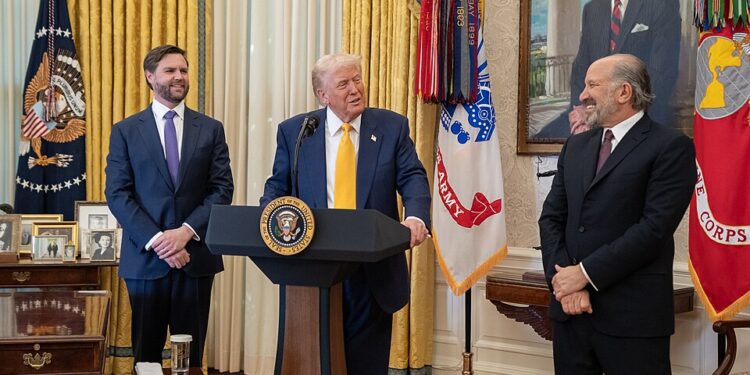
President Donald Trump has delivered a surprising new directive to Vice President JD Vance, ordering him to shift his attention away from negotiations involving Iran and concentrate on alleged corruption, crime, and government fraud in Democrat-controlled states and cities across America.
The announcement marks a significant change in responsibilities for Vance, who has played a central role in the administration’s diplomatic efforts involving Iran.
Trump made the announcement Thursday, November 12, outlining his desire to make government accountability and the protection of American taxpayer dollars a greater priority.
The president also identified several Democratic-led states where he believes federal authorities should take a closer look at potential financial misconduct.
Trump Gives Vance a Major New Assignment
In a statement published on Truth Social, Trump announced that he wanted Vance to devote his full attention to investigating alleged corruption and criminal activity within Democratic-controlled jurisdictions.
The president specifically identified California, Minnesota, and Illinois as states where he believes government mismanagement deserves additional scrutiny.
Trump accused Democratic leadership of allowing substantial amounts of taxpayer money to disappear through fraudulent activity.
He also argued that uncovering financial misconduct and preventing improper government payments could help address the nation’s budget problems.
However, Trump’s claims about the amount of money being stolen have not been independently substantiated.
The president’s announcement nevertheless makes clear that he wants the vice president concentrating on domestic accountability rather than leading another round of negotiations with Iran.
Why Trump Wants Vance Focused on Democrat-Led States
Government spending and the misuse of taxpayer funds have become major priorities for the Trump administration.
The president has repeatedly criticized Democratic officials over their handling of public assistance programs, government spending, and oversight of federal resources.
Trump believes stronger investigations could expose wrongdoing while preventing additional taxpayer money from being improperly distributed.
His decision to identify Minnesota, California, and Illinois reflects his longstanding criticism of Democratic leadership in those states.
However, the president’s accusations do not establish that any particular official committed a crime.
Federal investigations would need to uncover evidence of wrongdoing before criminal charges could be pursued.
For the administration, the broader objective is to demonstrate that government agencies are taking financial accountability seriously.
Vance Already Has Experience Fighting Government Fraud
Although Trump’s announcement represents a change in emphasis, the vice president has already been assigned an important role in combating government fraud.
Earlier in 2026, Trump established the Task Force to Eliminate Fraud, placing Vance in charge of an initiative intended to strengthen oversight of federal programs.
The task force was created to identify possible fraudulent payments, examine weaknesses in government assistance systems, and recommend measures to protect taxpayer resources.
Federal benefit programs have faced longstanding challenges involving improper payments, administrative errors, and deliberate fraud.
Investigators must distinguish between these different problems because an improper payment does not automatically constitute criminal activity.
The administration’s efforts are intended to improve financial safeguards and ensure federal benefits reach eligible Americans.
Trump’s latest directive could place even greater attention on this initiative.
Trump Signals Major Change in Iran Strategy
Perhaps the most surprising element of the announcement involves the administration’s approach to Iran.
Vance has participated in efforts to negotiate an end to the conflict, including discussions aimed at reducing hostilities and reaching a diplomatic agreement.
However, Trump now appears less interested in pursuing an immediate deal.
In his Thursday statement, the president declared, “We don’t need a deal with Iran.”
The remark suggested that Trump believes the United States is in a strong enough position to avoid making additional concessions.
The president also referred to Iranian financial assets and the Strait of Hormuz, an internationally important shipping passage used to transport oil and other goods.
Trump’s comments raised questions about whether diplomatic negotiations would continue and what role Vance might play in future discussions.
Reports indicate that the vice president could remain involved in Iran policy even as his immediate responsibilities shift toward domestic issues.
Whether negotiations resume could depend on developments in the Middle East and decisions made by the White House.
Political Pressure Mounts After Midterm Elections
The announcement comes at a politically challenging moment for Republicans following the November 3 midterm elections.
Democrats secured major victories, giving them greater influence over Congress and creating additional obstacles for Trump’s domestic agenda.
Vance has publicly acknowledged that the conflict with Iran contributed to Republican losses.
The vice president has expressed concerns about the economic consequences of the war, including its impact on energy prices and the financial pressures facing American households.
Higher fuel costs and economic uncertainty have affected the political debate surrounding the administration’s foreign policy decisions.
Trump, meanwhile, has defended his approach to Iran while indicating that he wants to concentrate more attention on problems within the United States.
The renewed emphasis on government fraud could become an important part of the administration’s domestic strategy heading into 2027.
What This Means for American Taxpayers
Trump’s latest announcement could have implications for federal spending and government accountability.
Every year, federal agencies distribute substantial amounts of money through healthcare programs, retirement-related benefits, public assistance, and other services.
Ensuring that those funds are managed appropriately is essential to protecting government resources.
When fraud occurs, money intended for legitimate public purposes can be diverted away from eligible recipients and essential services.
Stronger financial oversight can help identify suspicious transactions, improve payment verification systems, and reduce opportunities for abuse.
However, the success of any investigation depends on credible evidence, effective enforcement, and appropriate legal safeguards.
It is also important to recognize that uncovering fraud alone would not necessarily eliminate the federal budget deficit.
The nation’s financial challenges involve broader questions about federal expenditures, revenue, and long-term economic policy.
Nevertheless, preventing financial misconduct remains an important responsibility of federal officials.
What Happens Next for JD Vance?
The immediate question is how Trump’s directive will affect the vice president’s daily responsibilities.
Vance could become more directly involved in coordinating federal anti-fraud initiatives, reviewing allegations of improper spending, and working with agencies responsible for financial oversight.
The administration has not yet provided a detailed schedule of investigations connected to Thursday’s announcement.
It is also unclear whether the directive will result in additional enforcement actions or significant changes to existing federal programs.
Meanwhile, Vance’s diplomatic experience could still prove important if the administration decides to reopen negotiations with Iran.
The vice president also remains a prominent figure in Republican politics, with growing attention surrounding the party’s potential presidential candidates for 2028.
His performance in addressing government fraud and managing other responsibilities could influence how voters and Republican leaders evaluate his political future.
A New Direction for the Trump Administration
President Trump’s decision to redirect JD Vance toward alleged corruption in Democratic-controlled cities and states highlights a shift in the administration’s immediate priorities.
Rather than concentrating exclusively on international negotiations, the White House is placing renewed emphasis on government spending, federal oversight, and financial accountability.
The president believes these efforts could uncover significant wrongdoing and help protect American taxpayers.
However, the ultimate impact will depend on whether federal investigators identify substantial fraud and whether the administration can demonstrate measurable improvements.
For now, Trump’s instructions leave little doubt about where he wants the vice president to direct his attention.
Vance’s latest assignment puts the spotlight on domestic corruption investigations as the administration faces new political challenges at home and continued uncertainty overseas.