
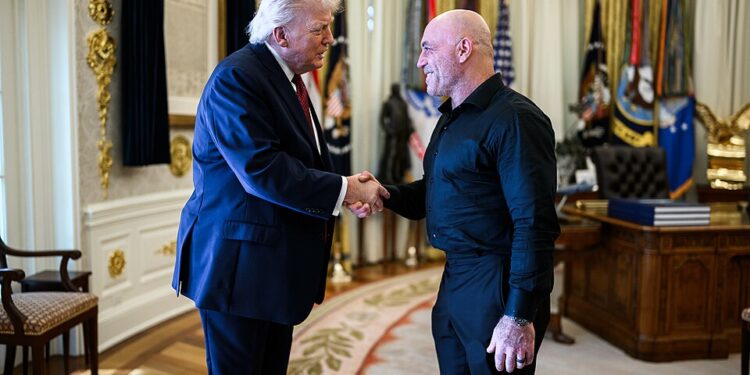
Podcasting giant Joe Rogan has delivered a surprising response to a proposal from a top Trump adviser, rejecting the idea that influential conservative podcasters should receive special access to White House press briefings.
The outspoken media personality, who played an important role in Donald Trump’s successful 2024 presidential campaign, made it clear that he has little interest in becoming part of Washington’s traditional political press corps.
Rogan’s remarks have attracted attention because the proposal was intended to strengthen relationships between the Trump administration and independent media figures who helped Republicans reach millions of Americans.
However, Rogan believes the White House briefing room should remain a place for professional journalists rather than entertainers and political commentators.
Trump Adviser Proposes Special Access for Podcasters
The controversy began when David Sacks, a prominent technology investor and Trump adviser, discussed the Republican Party’s relationship with independent media during an episode of the All-In podcast.
Sacks argued that conservative podcasters had played an important role in Trump’s 2024 election victory, helping the Republican candidate communicate directly with Americans who had grown frustrated with traditional news outlets.
He suggested that the administration should have done more to maintain those relationships, including giving influential podcast hosts front-row access to White House press briefings.
Sacks specifically referenced major independent media personalities, including Joe Rogan, Tucker Carlson, Theo Von, and Megyn Kelly.
His broader concern was that Republicans had lost support from influential voices who previously helped communicate the party’s message to millions of voters.
The discussion came as Republicans examined the political consequences of the 2026 midterm elections and debated how to reconnect with Americans who had become dissatisfied with the party’s direction.
For Sacks, keeping influential independent commentators engaged was an important part of rebuilding that political coalition.
But Rogan had a very different reaction.
Joe Rogan Rejects the White House Proposal
During the November 13 episode of The Joe Rogan Experience, Rogan discussed the proposal with comedians Shane Gillis and Ari Shaffir.
Instead of embracing the possibility of gaining greater access to the White House, Rogan immediately dismissed the suggestion.
“Hey, how about no? How about real journalists?” Rogan responded.
He argued that podcasters like himself are not professional political reporters and should not be treated as though they are.
Rogan also made it clear that he had no intention of regularly attending White House briefings to question administration officials.
His reaction reflected his belief that podcasting and political journalism serve different purposes.
While traditional reporters are expected to investigate government policies and question public officials, Rogan’s popular program centers on informal conversations about politics, culture, entertainment, and current events.
The distinction matters because the growing popularity of podcasts has blurred the lines between political commentary and professional news reporting.
Rogan apparently believes those lines should remain recognizable.
Rogan Raises Concerns About Political Commentary
Rogan went further, questioning why Americans place so much importance on the political opinions of entertainers and podcast personalities.
He suggested that society has become too willing to treat popular commentators as authoritative sources on complicated national issues.
Although Rogan frequently discusses politics with influential guests, he has consistently presented his program as a place for open conversations rather than conventional journalism.
His latest comments reinforced that distinction.
The remarks are particularly interesting because independent media has become an increasingly powerful force in American politics.
Millions of Americans now receive political information through podcasts, online interviews, and digital platforms rather than relying exclusively on television networks and newspapers.
For conservative voters who believe traditional media organizations frequently present Republican policies unfairly, these alternatives have become especially appealing.
Nevertheless, Rogan’s response suggests that independent media personalities do not necessarily want the responsibilities or formal recognition associated with traditional White House reporting.
Rogan Previously Helped Trump Reach Millions of Voters
Rogan’s comments carry additional significance because of his relationship with President Trump.
During the 2024 presidential campaign, Trump appeared on The Joe Rogan Experience for an extended interview that attracted enormous public attention.
The conversation allowed Trump to discuss his political positions, personal experiences, and plans for the country in a relaxed setting that differed dramatically from conventional television interviews.
Rogan also hosted Vice President JD Vance, providing another opportunity for Republican leaders to reach listeners who might not regularly follow political news.
Trump’s appearance on Rogan’s podcast became one of the campaign’s most widely discussed media moments.
Political analysts pointed to the interview as an example of how Republicans successfully reached younger male voters through alternative media platforms.
Rogan ultimately endorsed Trump shortly before the election.
However, his willingness to interview and support the Republican candidate did not mean he intended to become a permanent political ally or spokesperson for the administration.
His rejection of the White House access proposal reinforces that independence.
Conservative Media Faces an Important Question
The disagreement highlights an important challenge for the Republican Party as it evaluates its future political strategy.
For decades, conservatives have criticized what they consider unfavorable coverage from major national news organizations.
The rise of independent podcasts created an opportunity for Republican candidates to bypass traditional media outlets and speak directly with millions of Americans.
Trump recognized the importance of that approach during his 2024 campaign, appearing on popular programs that attracted substantial audiences outside conventional political circles.
Those interviews helped demonstrate that candidates could communicate with voters without depending entirely on established television networks.
Yet the relationship between political leaders and independent commentators can become complicated.
Podcast hosts often build loyal audiences by presenting themselves as independent thinkers willing to question politicians from both major parties.
If those personalities become too closely associated with a particular administration, they risk losing some of the independence that made them popular in the first place.
Rogan’s comments suggest he understands that concern.
Rather than seeking a prestigious position in the White House press room, he appears content to continue interviewing political figures on his own terms.
What Rogan’s Decision Means for Trump
For President Trump and the Republican Party, the episode offers a reminder that support from independent media personalities cannot necessarily be taken for granted.
Although Rogan helped introduce Trump to a massive audience during the 2024 election, he has also demonstrated a willingness to disagree publicly with the administration.
His latest comments do not mean he opposes allowing independent media to cover the White House.
Instead, he believes podcast hosts should not automatically be treated as professional journalists simply because they command large audiences.
That distinction could shape future discussions about the role of alternative media in American politics.
As Republicans work to strengthen their political coalition, maintaining productive relationships with influential independent voices will likely remain an important priority.
But those relationships may depend on respecting the independence that helped make podcasting successful in the first place.
For Rogan, the message is clear: He may be willing to sit down with President Trump for another lengthy conversation, but he has no interest in trading his podcast microphone for a seat in the White House press briefing room.