
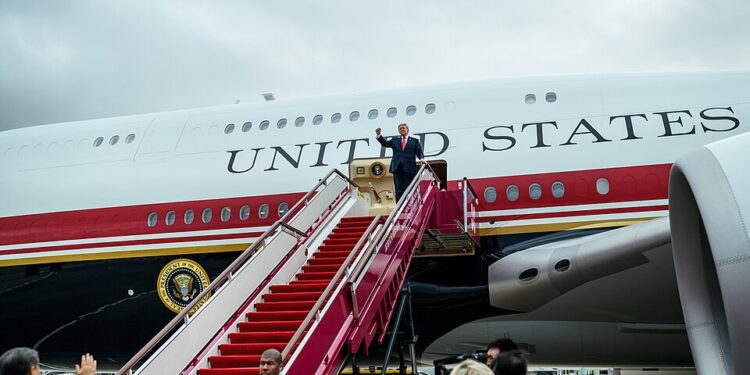
President Donald Trump is receiving a strong show of support from one of America’s highest-ranking intelligence officials as questions continue to surround his relationship with Russian President Vladimir Putin.
Director of National Intelligence Jay Clayton delivered a clear message Sunday, November 22, defending Trump’s foreign policy decisions and expressing complete confidence in the president’s handling of relations with Russia and China.
The comments followed a high-profile diplomatic summit involving Trump, Putin, and Chinese President Xi Jinping, where discussions focused on international security, nuclear tensions, and ongoing conflicts.
Clayton’s remarks offered a public defense of the administration’s diplomatic strategy at a time when Washington remains deeply divided over how the United States should deal with its most powerful international rivals.
Intelligence Chief Expresses Complete Confidence In Trump
During an appearance on CNN’s “State of the Union,” Clayton faced questions from host Dana Bash about Trump’s decision to describe Putin and Xi as his friends.
Bash pointed to social media posts in which Trump used friendly language toward the two leaders, raising questions about whether Putin should actually be considered a friend of the United States.
Clayton responded by emphasizing the importance of Trump’s recent diplomatic efforts.
He praised the president for bringing together the leaders of three major nuclear powers during a particularly difficult period in international relations.
According to Clayton, the discussions represented an important opportunity to improve communication and reduce the risk of dangerous confrontations.
He then delivered a direct statement about Trump’s leadership.
“In that context, whatever language the president wants to use, I trust him completely,” Clayton said.
The intelligence chief’s response made clear that he supports the president’s judgment when it comes to communicating with foreign leaders, even when those leaders represent countries with significant disagreements with Washington.
Trump Defends His Approach To Russia And China
The controversy began after Trump used friendly language while interacting with Putin during a diplomatic gathering in Shenzhen, China.
Before approaching the Russian leader, Trump jokingly asked who he was before referring to him as his friend.
The exchange attracted attention because Russia remains a major geopolitical rival of the United States, particularly following its invasion of Ukraine.
However, Trump has frequently argued that maintaining personal relationships with foreign leaders can help facilitate negotiations and prevent unnecessary confrontations.
His approach places considerable emphasis on direct communication, even with governments whose policies conflict with American interests.
Clayton defended that strategy, describing the recent gathering as a significant diplomatic development.
The intelligence director pointed to the importance of encouraging communication between the United States, Russia, and China, particularly given their substantial nuclear arsenals.
He characterized the summit as a remarkable accomplishment in an increasingly complicated international environment.
Clayton Makes Important Clarification About Putin
Although Clayton strongly defended Trump’s diplomatic language, he also acknowledged that Russia’s actions remain a serious concern.
During a separate appearance on ABC’s “This Week,” the intelligence director addressed the distinction between Trump’s personal relationship with Putin and Russia’s relationship with the United States.
Clayton made clear that the Russian president should not automatically be considered an American friend simply because Trump uses friendly language during diplomatic discussions.
He specifically pointed to the ongoing conflict in Ukraine.
“He is not America’s friend in Ukraine,” Clayton said.
That distinction is important because the United States continues to face difficult decisions involving Russia’s military activities, European security, and the future of diplomatic negotiations.
Clayton’s remarks suggested that Trump’s willingness to engage directly with Putin should not be interpreted as an endorsement of Russia’s actions.
Instead, the intelligence director emphasized the broader importance of maintaining communication between nations whose disagreements could have major international consequences.
Ukraine War Remains A Major Foreign Policy Challenge
The recent meeting involving Trump, Putin, and Xi also renewed attention on the ongoing war between Russia and Ukraine.
Ukrainian President Volodymyr Zelensky offered his own assessment of the summit, arguing that Putin had failed to achieve some of his desired diplomatic objectives.
Zelensky also raised concerns about international discussions involving Ukraine’s future without direct Ukrainian participation.
The disagreement highlights the difficult diplomatic environment facing the Trump administration.
Any meaningful progress toward ending the conflict would require addressing major disputes involving Ukrainian territory, European security, and relations between Russia and Western governments.
For the United States, the challenge involves pursuing diplomatic opportunities without overlooking national security concerns or the interests of American allies.
The administration’s ability to balance those priorities will remain a major factor in evaluating Trump’s foreign policy.
Nuclear Security Takes Center Stage
One of the most significant elements of Clayton’s defense involved the danger of nuclear escalation.
The United States, Russia, and China possess some of the world’s most powerful military capabilities, making communication among their leaders particularly important.
Diplomatic disagreements involving these countries can have consequences extending far beyond their own borders.
Clayton emphasized that Trump’s efforts to encourage communication among the three leaders should be viewed in that broader security context.
The recent summit included discussions about preventing nuclear conflict and reducing international tensions.
While diplomatic meetings do not guarantee lasting agreements, maintaining direct communication can help governments better understand one another’s intentions.
That principle remains an important consideration for American national security officials, regardless of political disagreements over the president’s diplomatic style.
Trump’s Foreign Policy Continues To Spark Debate
Trump’s approach to international relations has long generated disagreements among political leaders in Washington.
Supporters argue that the president’s willingness to communicate directly with adversarial governments creates opportunities for negotiations that might otherwise prove difficult.
They also maintain that diplomacy does not require personal hostility between world leaders, even when their governments disagree on important issues.
Critics, meanwhile, question whether friendly language toward Putin could provide the Russian president with political advantages or weaken the message Washington sends about Moscow’s actions.
Senate Democratic Leader Chuck Schumer criticized the recent summit, describing it as a diplomatic embarrassment for the United States.
The competing reactions illustrate the broader debate over Trump’s handling of international security.
For many Americans, the central question is whether the administration’s approach will produce measurable results, including reduced military tensions, stronger national security, and progress toward resolving ongoing conflicts.
What Clayton’s Comments Mean For The White House
Clayton’s public statements provide Trump with a significant expression of confidence from a senior official responsible for overseeing the nation’s intelligence community.
His remarks also highlight an important distinction in the administration’s foreign policy approach.
Maintaining diplomatic relationships with rival governments does not necessarily mean accepting their policies or abandoning American interests.
Instead, the administration is emphasizing the importance of direct negotiations when confronting complicated international challenges.
Whether that strategy ultimately succeeds will depend on the agreements reached, the actions taken by foreign governments, and the results for American national security.
For now, Clayton has made his position unmistakably clear.
Despite continuing concerns about Russia’s actions in Ukraine and its relationship with the United States, the intelligence chief expressed complete confidence in Trump’s judgment.
As the president continues navigating relations with Moscow and Beijing, the effectiveness of his diplomatic strategy will remain under close examination in Washington and around the world.