
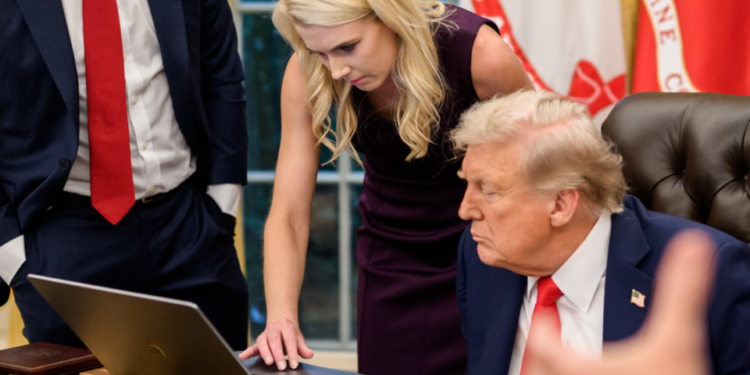
President Donald Trump is facing a new legal complication involving Truth Social after a federal judge authorized additional evidence gathering in a lawsuit that includes longtime Trump aide Natalie Harp.
The November 24 ruling places renewed attention on communications between the White House and Trump Media & Technology Group, the company behind the president’s social media platform.
While the decision represents another legal challenge involving the Trump administration, the court has not determined that Trump, Harp or any other White House official violated the law.
The case nevertheless raises important questions about presidential communications, government transparency and the role of private technology companies in distributing official information.
Federal Judge Issues New Truth Social Order
U.S. District Judge J. Paul Oetken authorized a limited discovery process in a lawsuit brought by The Intercept Media and the Freedom of the Press Foundation.
The organizations are challenging a subscription-based service connected to Truth Social that reportedly allows paying customers to obtain certain information faster than ordinary users.
The plaintiffs argue that providing preferential access to presidential announcements raises constitutional concerns.
President Trump, Natalie Harp, longtime Trump adviser Dan Scavino and two White House entities are named as defendants in the case.
Under the new ruling, attorneys for the plaintiffs will be permitted to obtain certain records from Trump Media as they attempt to support their allegations.
The discovery process will examine how the subscription service functions, what advantages subscribers receive and communications between the company and the defendants.
Natalie Harp Draws Renewed Attention
Harp has become a familiar figure within Trump’s inner circle, serving as an executive assistant to the president and maintaining a close working relationship with him.
Her responsibilities have placed her near the center of Trump’s daily activities and communications.
That proximity makes the latest court development particularly noteworthy as attorneys seek information about interactions between Trump Media and members of the administration.
However, the discovery order does not require Harp to personally testify at this stage.
Instead, the judge has authorized a restricted examination of information held by Trump Media.
The distinction is important because being named in a lawsuit does not establish that an individual engaged in wrongdoing.
Trump Administration Pushes Back
The Trump administration is seeking to dismiss the lawsuit, while Trump Media has opposed the plaintiffs’ request for preliminary relief.
Those legal challenges remain an important part of the proceedings.
The judge considered arguments from both sides before allowing the limited discovery process to begin.
Although the plaintiffs will have an opportunity to gather additional evidence, the court has not issued a final decision regarding their constitutional claims.
The administration retains the ability to defend its position and challenge the allegations through the judicial process.
Truth Social Dispute Raises Bigger Questions
Since entering national politics, Trump has frequently used social media to communicate directly with the American people.
Truth Social has become an important outlet for his policy announcements, political statements and responses to developing national events.
Direct presidential communication can help Americans receive information without relying entirely on traditional news organizations.
The current lawsuit, however, focuses on whether a commercial subscription arrangement creates an unequal opportunity to receive information connected to official government business.
Presidential announcements involving economic policy, international trade and financial regulations can carry significant consequences for businesses, investors and retirement accounts.
Even small differences in when information becomes available could matter in certain financial markets.
Whether the Truth Social arrangement creates a legally significant advantage remains a question for the court.
The eventual outcome could also influence how future presidents communicate through privately operated digital platforms.
What’s Next For Trump And Natalie Harp?
The federal judge established January 29, 2027, as the deadline for completing the initial evidence-gathering process.
Additional court filings could provide a clearer understanding of the relationship between Trump Media, its subscription service and White House communications.
For now, Harp remains among the defendants involved in an unresolved civil case, and the Trump administration continues to contest the lawsuit.
The latest ruling represents a procedural development rather than a determination of guilt or liability.
As the case moves forward, the central question will be whether the evidence supports the plaintiffs’ constitutional allegations or strengthens the administration’s legal defense.
The next phase of proceedings could have lasting implications for presidential communications, public access to government information and the use of social media by future administrations.