
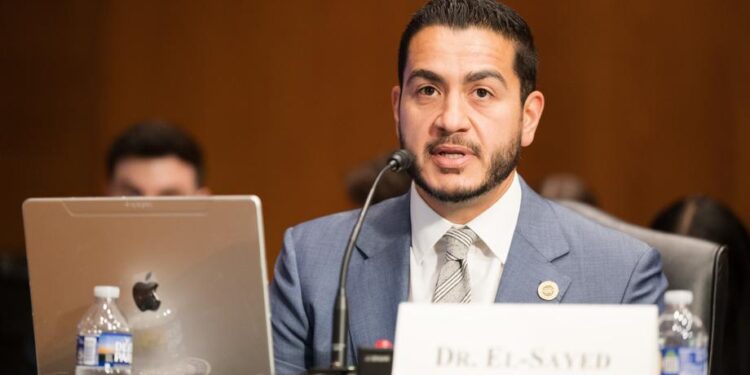
Michigan Democratic Senate candidate Abdul El-Sayed is facing unexpected criticism from a prominent Black civil rights leader who has accused him of promoting unrealistic political promises and questioned whether voters can trust him to deliver results.
The criticism comes from Rev. Charles E. Williams II, president of the Michigan chapter of the National Action Network, the civil rights organization founded by Al Sharpton.
In newly publicized undercover footage, Williams expressed serious concerns about El-Sayed’s credibility, his progressive political agenda, and his ability to connect with Black voters.
His criticism included a particularly harsh description of the Democratic candidate’s campaign promises: “snake oil.”
The remarks have introduced another controversy into Michigan’s closely watched U.S. Senate race, where El-Sayed is competing against Republican Mike Rogers ahead of the November 3 midterm elections.
Prominent Black Leader Questions El-Sayed’s Credibility
Williams made his comments during conversations connected to a voter outreach meeting at Detroit’s historic King Solomon Missionary Baptist Church.
The footage, originally obtained by The Midwesterner, captured the pastor expressing frustration with the Democratic candidate’s ambitious campaign proposals.
Williams specifically questioned whether El-Sayed could realistically accomplish promises involving Medicare for All and removing money from politics.
His central argument was that passing sweeping legislation requires political support that El-Sayed might not have in Washington.
With President Donald Trump in the White House, Williams questioned how the Democratic candidate expected to secure approval for proposals opposed by Republicans.
Williams described such promises as unrealistic and accused progressive politicians of offering voters solutions they might never be able to implement.
“So you just selling snake oil,” Williams declared.
The criticism represents a significant disagreement over whether ambitious campaign proposals offer meaningful solutions or create expectations that elected officials cannot fulfill.
Williams Reveals He Opposed El-Sayed In Democratic Primary
The controversy goes beyond disagreements over government policy.
Williams also acknowledged that he supported Democratic Rep. Haley Stevens rather than El-Sayed during Michigan’s Senate primary.
He expressed disappointment with the primary’s outcome and raised concerns about his previous dealings with El-Sayed.
According to Williams, the two had experienced personal disagreements involving what he characterized as promises that were not followed by corresponding actions.
Those accusations reflect Williams’ account and have not been independently verified.
Still, his willingness to discuss those concerns publicly illustrates the political divisions facing Michigan Democrats as Election Day approaches.
Williams also suggested that some Black voters remain skeptical of El-Sayed, describing attitudes toward the candidate as ranging from hesitation to “flat-out disdain.”
Those are striking words from a leader affiliated with an organization that has historically worked to increase political participation in Black communities.
Democrats Face Questions About Black Voter Support
Black voters have played an important role in Michigan’s recent statewide elections, particularly in Detroit and surrounding communities.
That makes El-Sayed’s relationship with these voters an important factor in the Senate contest.
Williams’ comments have raised questions about whether the Democratic nominee has done enough to address local concerns and establish trust with community leaders.
Additional attention followed El-Sayed’s appearance at Historic Second Baptist Church in Benton Harbor.
Although the surrounding neighborhood has a large Black population, observers reported that the audience attending his campaign appearance was overwhelmingly white.
The event prompted discussion about the candidate’s effectiveness in reaching voters who have traditionally supported Democrats.
A September Washington Post–Schar School poll also suggested a gap between overall Democratic support and El-Sayed’s standing among Black voters.
However, more recent polling has shown substantial support for El-Sayed among Black voters, indicating that the concerns expressed by Williams should not be interpreted as representing the entire community.
The conflicting signals underscore the importance of distinguishing criticism from individual political leaders from the broader preferences of Michigan voters.
Al Sharpton Enters Michigan Political Debate
The controversy has also attracted attention because of Williams’ connection to civil rights activist Al Sharpton.
Sharpton recently traveled to Detroit to encourage voter participation ahead of the midterm elections.
During that visit, he met with Williams and participated in efforts aimed at increasing turnout.
However, Sharpton stopped short of endorsing El-Sayed.
Instead, he emphasized that voters should consider which candidates best represent their interests, regardless of political affiliation.
“It’s not whether we’re Democrat or Republican,” Sharpton said, emphasizing the importance of choosing candidates based on the needs of the community.
Sharpton also described his organization’s voter outreach efforts as nonpartisan.
His comments highlight an important distinction between encouraging political participation and endorsing a particular candidate.
For El-Sayed, the situation creates another challenge as his campaign works to build support across Michigan’s diverse electorate.
Republican Mike Rogers Could Benefit From Democratic Divisions
The controversy arrives during a competitive Senate campaign in which Republican Mike Rogers is attempting to win a seat with national political implications.
Rogers, a former congressman, has campaigned against El-Sayed’s progressive policy agenda while seeking to expand Republican support among Michigan voters.
The election could play an important role in determining the balance of power in the U.S. Senate.
Meanwhile, Democrats have faced additional disagreements involving El-Sayed and his former primary opponent, Haley Stevens.
Those tensions have generated questions about party unity during the final days before Election Day.
Recent reporting indicates that the disagreement between the two Democrats has continued even as party leaders attempt to bring their supporters together.
El-Sayed has maintained that his campaign is focused on economic affordability and defeating Rogers.
Supporters argue that his progressive proposals are intended to address longstanding problems involving healthcare costs, household expenses, and economic opportunity.
Critics, however, question whether those proposals can realistically advance through Congress.
That debate has now become a central part of the controversy surrounding Williams’ remarks.
Michigan Senate Race Raises Bigger Questions About Political Promises
Beyond the immediate dispute, Williams’ comments raise a question that extends far beyond Michigan.
How much weight should voters place on ambitious campaign promises when the political circumstances make those promises difficult to accomplish?
Candidates from both major parties frequently campaign on proposals that require cooperation from Congress, the president, or state governments.
Winning an election does not automatically guarantee the political support necessary to enact those proposals.
Williams argues that voters deserve a realistic explanation of what elected officials can accomplish.
His criticism suggests that political credibility depends not only on identifying problems but also on explaining how proposed solutions can become law.
For Michigan residents concerned about healthcare affordability, rising everyday expenses, and economic security, those questions may influence their decisions at the ballot box.
Election Day Will Put El-Sayed’s Support To The Test
As November 3 approaches, El-Sayed must balance competing demands within the Democratic Party while continuing to make his case to Michigan voters.
Rogers, meanwhile, is seeking to capitalize on disagreements among Democrats and persuade voters that Republican leadership offers a better alternative.
Williams has made clear that his personal dissatisfaction with El-Sayed does not mean he is encouraging voters to support Republicans.
Instead, he has urged community members to participate in the election and make their own decisions.
That distinction is important because criticism of a Democratic candidate does not necessarily translate into support for the Republican opponent.
Nevertheless, the controversy has placed renewed attention on El-Sayed’s leadership style, campaign promises, and relationship with influential community figures.
The Bottom Line
Rev. Charles E. Williams II’s criticism has created an uncomfortable political moment for Abdul El-Sayed just days before Michigan’s Senate election.
By describing the candidate’s progressive promises as “snake oil,” Williams has challenged whether El-Sayed can realistically deliver the changes he is promising voters.
Whether those concerns influence the election remains uncertain.
What is clear is that Michigan’s Senate contest now involves more than traditional disagreements between Republicans and Democrats. It also includes important questions about political trust, campaign credibility, and the ability of elected officials to deliver meaningful results.
Michigan voters will make their decision on November 3.