
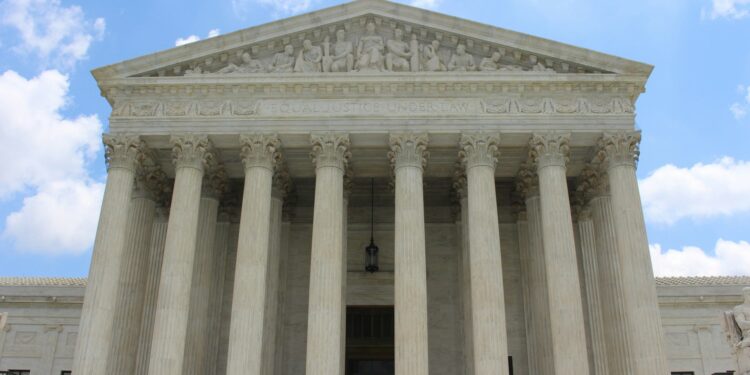
A revealing moment at the U.S. Supreme Court on Tuesday is sparking new concerns among conservatives as the justices consider a major campaign finance case that could significantly reshape American elections.
During oral arguments in NRSC v. FEC, Supreme Court Justice Amy Coney Barrett openly questioned a lawyer representing the Democratic National Committee (DNC) about whether eliminating long-standing limits on political party spending would actually benefit Republicans more than Democrats.
Justice Barrett noted that current campaign finance restrictions apply equally to both major parties and pressed Democrats on why they are now fighting to preserve those limits.
“If there isn’t an imbalance in who this benefits, why would the DNC be here?” Barrett asked, signaling skepticism toward the Democrats’ position and raising eyebrows among court watchers.
Democrats Push Back on Spending Freedom
Democratic election lawyer Marc Elias, speaking on behalf of the DNC and other Democratic campaign organizations, argued that Democrats have never supported removing coordinated spending limits. According to Elias, lifting those restrictions would damage the party’s ability to invest in long-term priorities like voter registration and grassroots outreach.
Elias claimed that current spending caps serve as a financial “buffer,” preventing massive sums from being poured directly into individual congressional or presidential campaigns and instead forcing parties to spread resources more evenly.
Republicans Say the Rules Are Outdated
Republicans see the issue very differently.
The case centers on decades-old limits that cap how much political parties can spend in direct coordination with their own candidates. These rules were originally designed to prevent wealthy donors from bypassing individual contribution limits by routing money through party committees.
However, Republican leaders argue the system is broken. They say the restrictions weaken political parties while empowering outside special-interest groups and super PACs that face far fewer limits.
Noel Francisco, attorney for the National Republican Senatorial Committee, told the Court that the coordinated spending rules are increasingly at odds with recent Supreme Court rulings on free speech and political expression.
He also dismissed corruption concerns, noting that parties have little incentive to “buy influence” from candidates who are either unopposed or already in safe seats.
Kavanaugh Raises Bigger Constitutional Concerns
Supreme Court Justice Brett Kavanaugh appeared to echo Republican concerns, warning that years of campaign finance laws—combined with court decisions—have steadily stripped political parties of their traditional role.
Kavanaugh suggested that weakening parties while empowering outside groups has had unintended and potentially harmful consequences for the country’s constitutional system.
“I’m concerned that the combination of campaign finance laws and this Court’s decisions have reduced the power of political parties compared to outside groups,” Kavanaugh said during the hearing.
Trump Administration Sides With Republicans
The Federal Election Commission, which revised its position after President Donald Trump returned to office, is also backing the effort to strike down the coordinated spending limits.
If the Supreme Court rules in favor of Republicans, political parties would gain far greater freedom to support their candidates through advertising, organizing, and voter outreach—potentially reshaping future elections at every level.
What Happens Next?
The Supreme Court has not yet issued a decision in the case. But the sharp questioning from Justice Barrett and comments from Justice Kavanaugh have fueled speculation about whether the Court’s conservative majority is unified on this issue.
The ruling could have far-reaching consequences for campaign finance law, political power, and the future of American elections—making it one of the most closely watched Supreme Court cases of the year.