
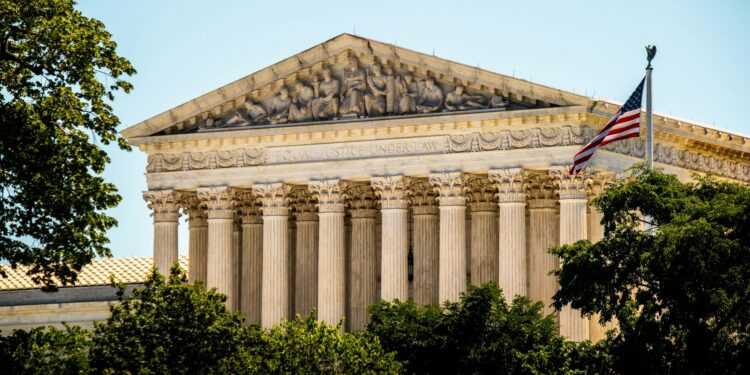
Supreme Court Justice Elena Kagan has launched unusually sharp criticism of her conservative colleagues, accusing the nation’s highest court of making decisions that have weakened America’s political system and intensified divisions across the country.
Kagan, one of three liberal justices serving on the nine-member Supreme Court, delivered her remarks during an October 20 appearance at Catholic University’s law school in Washington, D.C.
Her criticism focused on several major rulings involving voting rights, congressional redistricting, and campaign finance regulations.
The comments come less than two weeks before the November 3 midterm elections, when voters will determine which party controls Congress.
Although Kagan has frequently disagreed with the conservative majority in written opinions, her public criticism drew attention because Supreme Court justices generally avoid directly challenging their colleagues in public appearances.
Supreme Court Justice Slams Conservative Majority
Kagan argued that recent Supreme Court decisions have produced consequences extending far beyond the courtroom.
According to the justice, the conservative majority has failed to sufficiently consider how its rulings affect elections, political representation, and public confidence in government.
She expressed particular frustration with decisions that have reduced federal judicial oversight of partisan congressional redistricting.
Kagan believes these rulings have allowed political leaders to manipulate electoral boundaries in ways that protect their parties and reduce competition.
Her argument centers on whether the Supreme Court should consider the practical consequences of election-related decisions when determining constitutional questions.
Conservative justices have generally maintained that courts must follow the Constitution and federal law, even when their interpretations produce politically controversial results.
That disagreement reflects a longstanding debate over judicial power and the proper role of the nation’s highest court.
Kagan Raises Alarm Over Voting Rights Decision
One of Kagan’s strongest objections concerns the Supreme Court’s interpretation of the Voting Rights Act of 1965.
The landmark law was designed to protect Americans from racial discrimination in voting and has played an important role in federal election oversight for decades.
In April 2026, the Supreme Court issued a significant ruling involving Louisiana’s congressional districts, concluding that the challenged map violated constitutional protections against racial discrimination.
The decision prompted renewed debate over the relationship between the Voting Rights Act and the Constitution’s Equal Protection Clause.
Kagan disagreed with the majority’s reasoning and warned that the ruling could undermine protections intended to ensure fair political representation.
Supporters of the conservative majority’s approach argue that government officials must respect constitutional restrictions on the use of race when drawing electoral boundaries.
Critics counter that the decision could make it harder to protect minority voters from discriminatory districting practices.
The controversy demonstrates how disputes over constitutional interpretation can have significant consequences for elections across the country.
Congressional Redistricting Becomes Major Flashpoint
Kagan also criticized a 2019 Supreme Court decision that limited federal courts’ authority to intervene in partisan gerrymandering disputes.
Gerrymandering occurs when political boundaries are drawn to favor a particular party or group.
In its 2019 ruling, the Supreme Court determined that claims involving purely partisan gerrymandering generally present political questions beyond the reach of federal courts.
The majority reasoned that federal judges lack a clear constitutional standard for deciding how much partisan advantage is too much.
The ruling left those disputes largely to state courts, state constitutions, and the political process.
Kagan strongly disagreed with that approach.
She warned that both Republicans and Democrats have increasingly sought partisan advantages when drawing congressional districts.
Her concern is that heavily partisan districts can discourage political competition and leave voters with fewer meaningful choices.
The issue has become particularly significant as both parties compete for control of the House of Representatives in the upcoming elections.
Campaign Finance Ruling Sparks Another Disagreement
The Supreme Court’s decisions involving political campaign spending have also drawn criticism from Kagan.
In June 2026, the conservative majority struck down federal restrictions on certain coordinated expenditures between political parties and their candidates.
The ruling strengthened constitutional protections for political speech under the First Amendment.
Supporters argue that political parties have a constitutional right to communicate their messages and spend money supporting candidates.
They maintain that federal restrictions on political expenditures can interfere with freedom of expression.
Kagan and her liberal colleagues disagree with the majority’s approach.
They argue that removing campaign finance restrictions increases the risk of corruption and gives wealthy political donors greater influence over elected officials.
The disagreement raises an important question: How should the government balance the constitutional protection of political speech against concerns about the influence of money in elections?
With campaign spending continuing to rise, the issue remains important for both major political parties.
Kagan Admits Conservative Court Has Ruled Against Trump
Despite her criticism, Kagan acknowledged that the Supreme Court’s conservative majority has not consistently supported President Donald Trump.
She pointed to rulings involving presidential authority, tariffs, citizenship, and election policies as examples of the court taking positions contrary to Trump’s administration.
Her acknowledgment challenges the argument that conservative justices automatically rule in favor of Republican presidents.
Trump appointed three members of the Supreme Court during his first term: Neil Gorsuch, Brett Kavanaugh, and Amy Coney Barrett.
Those appointments helped establish the current 6-3 conservative majority.
However, Supreme Court justices hold lifetime appointments and are expected to reach decisions independently, regardless of which president nominated them.
That independence has occasionally produced rulings opposed by Republican officials, including Trump himself.
Kagan’s acknowledgment reinforces an important distinction between a justice’s constitutional philosophy and loyalty to a political party.
Supreme Court Debate Intensifies Before Midterm Elections
The timing of Kagan’s remarks has added significance to the controversy.
Americans are preparing to vote in congressional elections that will determine the balance of power in Washington for the final two years of Trump’s current term.
Questions involving voting rights, election procedures, and congressional boundaries could have lasting consequences for future elections.
The Supreme Court’s conservative majority generally favors interpretations of the Constitution that place limits on federal judicial authority in certain political disputes.
Kagan and her liberal colleagues have argued that some of those interpretations leave important legal protections inadequately enforced.
These disagreements also reflect competing views about the responsibilities of the federal government, the authority of individual states, and the proper limits of judicial intervention.
Ultimately, the constitutional questions extend beyond any single election or political administration.
What Happens Next For The Supreme Court?
Kagan’s remarks do not change any existing Supreme Court decisions, and the conservative majority continues to hold substantial influence over the court’s direction.
Nevertheless, her criticism highlights the divisions among the justices over some of the country’s most consequential legal questions.
Future cases involving congressional redistricting, voting procedures, political spending, and presidential authority could bring those disagreements back into public view.
For Americans concerned about constitutional protections, fair elections, and the independence of the judiciary, those decisions will remain worth watching.
The larger question is whether the Supreme Court can maintain public confidence while its justices continue to disagree so sharply over the Constitution and the future of American elections.
As the 2026 midterms approach, that debate is unlikely to disappear.