
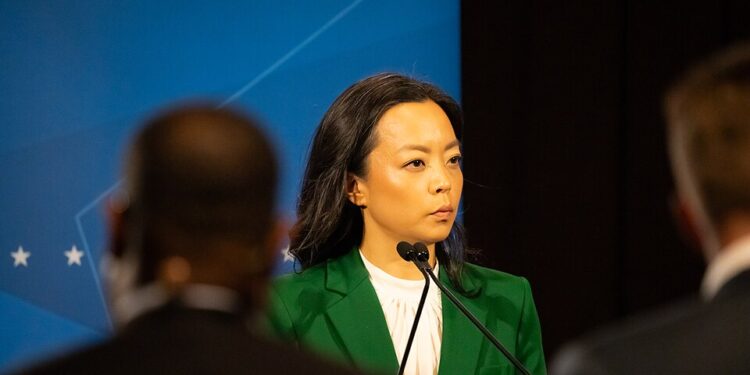
Wisconsin’s race for governor is putting Democratic socialist Francesca Hong under a national microscope as voters examine years of controversial statements on Thanksgiving, police, immigration enforcement and taxes.
Hong, a Democratic state representative, has received support from Democratic Socialists of America chapters and emerged as a major contender in Wisconsin’s Democratic gubernatorial primary.
But her rise has also revived statements that could prove difficult to explain to voters in one of America’s most closely divided political battlegrounds.
Among them: Hong once referred to Thanksgiving as a “colonizer holiday,” supported defunding and ultimately abolishing police, called for abolishing Immigration and Customs Enforcement, and backed legislation that would have imposed a 17.3% state income-tax rate on some of Wisconsin’s highest earners.
Hong has since distanced herself from some of those positions while standing by others.
That transformation is becoming a major issue in the governor’s race, with opponents questioning whether Hong’s views genuinely evolved or whether she is attempting to broaden her appeal as she seeks statewide office.
Francesca Hong’s Past Comes Back Into Focus
Hong’s political rise comes during a period of growing influence for the Democratic socialist movement.
Democratic socialist candidates and politicians have scored victories in several high-profile races, helping move issues such as higher taxes on wealthy Americans, expanded government programs and major changes to law enforcement into the Democratic Party’s broader debate.
Wisconsin could represent an even more significant test.
Unlike overwhelmingly Democratic districts where progressive candidates have traditionally performed well, Wisconsin is a genuine political battleground.
Republicans and Democrats have fought extraordinarily close races there for years, making independents and moderate voters especially important in statewide elections.
That means Hong’s earlier statements could receive considerably more attention if she becomes the Democratic nominee.
Even former Democratic presidential nominee Hillary Clinton has warned about the political danger Democrats could face when Republicans successfully portray candidates as socialists or communists.
Hong’s critics believe her record provides Republicans with plenty of ammunition.
Hong Previously Called for Defunding and Abolishing Police
Public safety could become one of Hong’s biggest political vulnerabilities.
During the nationwide protests and unrest of 2020, Hong explicitly supported defunding police departments as an initial step toward eventually abolishing them.
The comments came while Hong was campaigning for her first term in the Wisconsin State Assembly and followed the police shooting of Jacob Blake in Kenosha.
Hong subsequently made an even stronger statement about American law enforcement.
In another social media post, she claimed police existed to uphold white supremacy and again called for departments to be defunded and abolished rather than reformed.
Those comments are now receiving renewed scrutiny as Hong campaigns to become governor.
Her position today is markedly different.
During a recent appearance on “Pod Save America,” Hong rejected the idea that she would abolish police as governor.
Instead, she emphasized combating violent crime and said law enforcement agencies should receive appropriate resources and training.
Hong also said police officers must be held accountable when they violate the law.
She explained that conversations with people more directly connected to public-safety problems had influenced her thinking and convinced her that practical solutions were necessary.
That explanation establishes a clear current position.
Whether voters accept the evolution is another question.
Hong Still Supports Abolishing ICE
Hong’s position on federal immigration enforcement appears to have changed much less.
Earlier this year, she described abolishing U.S. Immigration and Customs Enforcement as a meaningful policy for keeping communities safe.
ICE plays a major role in enforcing federal immigration law, including immigration arrests, detention and removal operations.
Calls to abolish the agency became a rallying point among some progressive Democrats during President Donald Trump’s first administration.
The issue has again become politically significant as immigration enforcement remains at the center of the national debate.
Unlike her earlier support for abolishing police departments, Hong has not similarly disavowed her position on eliminating ICE.
That distinction could become particularly important if she advances to the general election.
Thanksgiving Remark Follows Hong Into Governor’s Race
Hong’s political history isn’t limited to government policy.
Thanksgiving has unexpectedly become part of the Wisconsin governor’s race because of a social media message Hong posted in 2020.
During the COVID-19 pandemic, Hong urged people not to gather for Thanksgiving and referred to the celebration as a “colonizer holiday.”
She encouraged residents instead to maintain physical distance, wear masks, order food from independent restaurants and provide meals for people in their communities.
The “colonizer holiday” description has resurfaced as Hong has gained national political attention.
Asked recently whether she actually wanted to cancel Thanksgiving, Hong rejected that interpretation and said she now loves the holiday.
“I don’t want to cancel it,” Hong told Politico.
For political opponents, however, the original comment provides an easily understood example of the kind of progressive rhetoric they argue is disconnected from many mainstream voters.
Valentine’s Day Didn’t Escape Hong’s Criticism
Hong has also criticized Valentine’s Day.
Before becoming a prominent statewide candidate, Hong worked as a chef and frequently discussed conditions facing restaurant and service-industry employees.
In a Valentine’s Day post in 2022, Hong complained about the treatment of service workers during the holiday and connected the celebration to capitalism.
She argued that commercial culture tells Americans how they are supposed to demonstrate love.
Her frustration with difficult working conditions in restaurants may resonate with people who have worked in the service industry.
But combined with Hong’s democratic socialist politics, the criticism of capitalism provides opponents with another example they can use to define her political philosophy.
Hong Backed a 17.3% Tax Rate on High Earners
The debate becomes substantially more consequential when taxes enter the picture.
Hong previously supported legislation that would have dramatically increased Wisconsin’s income-tax rate for the state’s wealthiest residents.
The proposal would have established an additional tax bracket with a 17.3% rate for individuals earning at least $750,000 and married couples earning $1 million or more.
That rate would have been more than twice Wisconsin’s existing top individual income-tax rate.
Supporters argued the additional revenue should be used to increase education funding.
The proposal failed to pass.
Hong later embraced a much smaller increase.
During a Democratic gubernatorial debate in July, she supported an 8.65% income-tax rate on millionaires.
Although still an increase, that figure is dramatically below the 17.3% rate contained in the earlier proposal.
The change gives Hong’s critics another opportunity to question how she would actually govern.
Republicans See an Opening
Hong’s political opponents are already attempting to make those changes part of the campaign.
Megan Novak, state director for Americans for Prosperity-Wisconsin, has argued that voters are watching Hong move away from positions associated with Madison’s progressive political culture as she seeks support across the entire state.
That argument will likely become increasingly important if Hong secures the Democratic nomination.
Wisconsin voters wouldn’t merely be choosing between two candidates.
They could be asked to decide between dramatically different philosophies concerning taxes, policing, immigration enforcement, government spending and the appropriate role of government itself.
Democratic Socialists Seek Another Major Victory
Hong’s campaign is also bigger than one Wisconsin election.
Democratic socialists have been attempting to demonstrate that their movement can succeed beyond a handful of deeply progressive congressional districts.
High-profile victories elsewhere have strengthened that argument and encouraged progressive activists to target additional state and federal offices.
Hong winning a statewide nomination in Wisconsin would provide another important milestone.
But winning a Democratic primary and winning a general election are two very different challenges.
Wisconsin’s closely divided electorate means a successful candidate generally needs to appeal beyond the most committed members of his or her political base.
That could explain why Hong’s evolving positions are attracting so much attention.
Has Hong Changed — Or Has Her Campaign Strategy Changed?
Candidates changing their opinions over time isn’t unusual.
Experience in government, changing circumstances and conversations with constituents can legitimately alter a politician’s perspective.
Hong argues that experience has affected her thinking, particularly when it comes to policing and public safety.
Her critics aren’t convinced.
They point to the timing of her changes and argue voters deserve to know whether Hong would govern according to the moderate positions she expresses today or the more progressive positions she promoted earlier in her political career.
That is ultimately a judgment Wisconsin voters will have to make.
The contrast is substantial.
Hong once advocated abolishing police. Today, she says police need resources and training.
She once described Thanksgiving as a “colonizer holiday.” Today, she says she loves Thanksgiving.
She supported legislation containing a 17.3% income-tax rate for certain high earners. She has since supported a much lower 8.65% rate on millionaires.
Yet on ICE, Hong continues to embrace a position firmly associated with the progressive wing of American politics.
Wisconsin Could Become a National Political Test
The stakes extend well beyond the Badger State.
A Hong victory would provide democratic socialists with evidence that their candidates can compete for major statewide offices in politically competitive territory.
A defeat could strengthen Democrats who believe the party needs more moderate candidates to win swing states.
Republicans, meanwhile, have every incentive to make Hong’s previous statements central to the campaign should she become the Democratic nominee.
For voters, the fundamental question is considerably simpler.
Which Francesca Hong would govern Wisconsin?
The activist who once talked about abolishing police, abolishing ICE and dramatically increasing taxes on high earners?
Or the statewide candidate now emphasizing public safety, practical solutions and more moderate positions on some of the issues that helped establish her political identity?
Wisconsin voters will make that decision at the ballot box — and the answer could provide an important clue about the future direction of the Democratic Party.