
A new Democratic proposal is taking aim at how President Donald Trump’s years in the White House could eventually be remembered inside one of America’s most prominent museums.
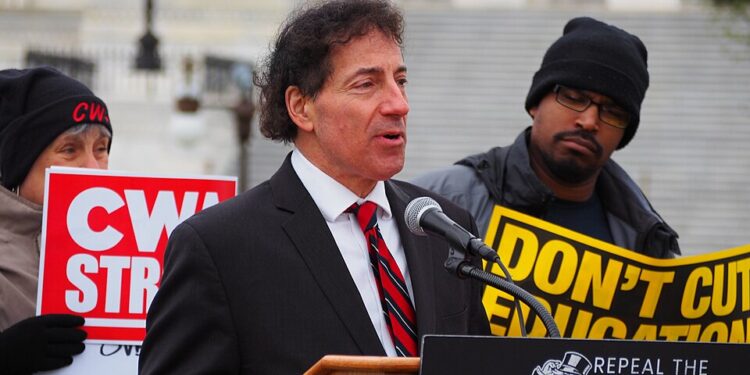
Rep. Jamie Raskin of Maryland has introduced legislation directing the Smithsonian Institution to preserve banners, signs, photographs, videos, and other materials connected to Trump’s two presidencies.
The proposal could ultimately lead to a permanent exhibit at the National Museum of American History focused on the Trump era and the intense political battles surrounding his administration.
Raskin, one of Trump’s most outspoken Democratic critics, says the materials should be preserved so future generations can examine what he describes as a period marked by government propaganda, corruption, and authoritarianism.
The legislation immediately raises a broader question: Should Congress play a direct role in deciding how a sitting president’s legacy is presented by America’s national museums?
Raskin Wants Trump-Era Materials Preserved
Raskin introduced what he calls the “Preserving and Remembering the History of Trump and other Tyrants Act.”
Under the proposal, the Smithsonian would be instructed to collect historically significant materials from both Trump administrations.
Among the items specifically mentioned are the oversized banners featuring Trump that have been displayed outside federal government buildings.
The legislation also calls for preserving signs connected to the Trump administration’s ongoing dispute with the Smithsonian over how museums present American history.
Rather than removing every trace of those political battles, Raskin wants many of the materials preserved as part of the historical record.
Raskin Launches Harsh Attack on Trump
While announcing the legislation, Raskin used unusually strong language against the president.
The Maryland Democrat accused Trump of attempting to reshape American history around his own political views and described elements of the administration as examples of “authoritarian narcissism.”
Raskin also alleged that Trump engaged in a broader effort to distort or sanitize parts of American history.
Those are Raskin’s characterizations, and Trump supporters are likely to strongly reject them.
For many Republicans, the administration’s efforts involving museums and federal institutions have instead been presented as an attempt to challenge what conservatives see as years of ideological bias in the way American history is discussed.
That disagreement sits at the center of the latest fight.
Smithsonian Becomes Political Battleground
The Smithsonian has increasingly found itself caught in Washington’s larger culture war.
The Trump administration has pushed for warning signs outside the National Museum of American History suggesting that certain exhibits can reflect the personal or political viewpoints of museum curators.
Supporters of that effort argue that federally supported museums should give visitors a balanced presentation of American history rather than promoting one ideological interpretation.
Critics argue that political leaders should not interfere with historians, curators, and museum professionals.
Raskin’s legislation would preserve some of those very signs as historical artifacts.
That means materials created by the Trump administration to criticize the Smithsonian could eventually become part of a Smithsonian exhibit examining Trump himself.
Trump Banners Could Become Museum Pieces
The legislation would also require the preservation of large Trump banners displayed at federal buildings.
Those banners have become recognizable symbols of the administration and would potentially be included alongside photographs, video recordings, government documents, and other materials from the Trump years.
The Smithsonian secretary would be given authority to identify additional objects considered historically important.
Personal accounts from Americans who opposed Trump administration policies could also be collected.
That provision may prove especially controversial among Republicans who could question whether the resulting exhibition would fairly represent supporters of the president as well.
National Park Service Also Targeted
Raskin’s proposal goes beyond the Smithsonian.
The legislation would direct the National Park Service to remove certain signs placed near the National Museum of American History if they were installed without congressional authorization.
That provision could create another dispute over the balance of power between Congress and the executive branch.
It also highlights how a disagreement that might appear to be about museum exhibits has developed into a much larger argument involving presidential authority, federal agencies, historical interpretation, and political messaging.
Battle Over Trump’s Legacy Is Growing
Trump’s legacy is already shaping political debates even while he remains in office.
His supporters credit him with reshaping immigration policy, challenging federal bureaucracy, changing the judiciary, confronting foreign adversaries, and pushing back against progressive cultural institutions.
His Democratic critics have taken a dramatically different view, frequently describing his presidency as a threat to democratic norms and established institutions.
Raskin’s bill brings that disagreement directly into the Smithsonian.
If the measure moves forward, lawmakers could eventually be asked to decide whether the federal government should mandate a permanent museum exhibit centered on the Trump era.
Republicans could argue that such an exhibit risks becoming taxpayer-supported partisan messaging if it adopts the language and assumptions contained in Raskin’s proposal.
Democrats supporting the legislation could argue that preserving controversial materials is precisely what historical institutions are supposed to do.
Who Gets To Write American History?
The controversy ultimately extends beyond Donald Trump or Jamie Raskin.
It raises a fundamental question about who gets to shape the historical record.
Should presidential administrations influence how national museums describe American history?
Should Congress decide which political controversies deserve permanent exhibitions?
Or should those decisions remain primarily in the hands of historians and museum professionals?
Those questions could become increasingly important as Washington’s political divisions extend into schools, museums, monuments, federal agencies, and other institutions responsible for preserving the nation’s history.
For Trump supporters, the proposal may look less like neutral preservation and more like an attempt by political opponents to define his presidency before history has had time to judge it.
For Raskin and his allies, the legislation is being presented as an effort to make sure the events and controversies of the Trump era are permanently documented.
Either way, the fight demonstrates that the political battle over Donald Trump is no longer limited to elections and legislation.
It now includes a growing struggle over how America will remember his presidency for decades to come.