
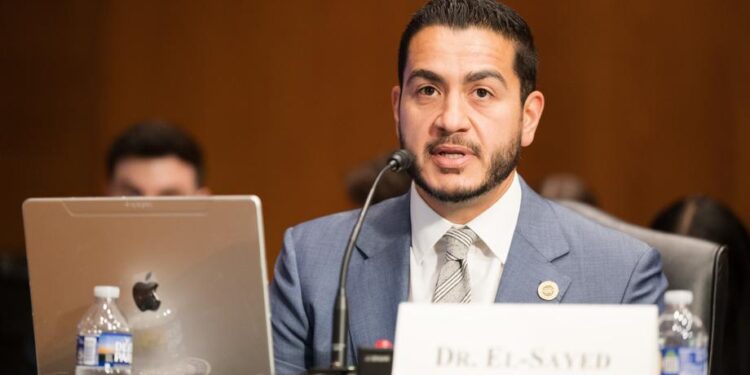
President Donald Trump repeatedly called Michigan Democratic Senate candidate Abdul El-Sayed “Mohamed” while attacking him on the campaign trail. But the Democrat had a response that turned the president’s own words against him.
“I will be Senator Mohamed to you, bro,” El-Sayed told supporters during a Sunday campaign rally in Grand Rapids, Michigan.
The comeback came just hours after Trump delivered a blistering attack on El-Sayed at a Republican rally in Port Huron, raising questions about the Democrat’s political views, religious background, and qualifications for the United States Senate.
Rather than ignore the criticism, El-Sayed decided to confront the president directly, turning Trump’s repeated references to his name into a prediction about the upcoming election.
The exchange highlights the increasingly personal battle for Michigan’s open Senate seat, where Republican Mike Rogers and El-Sayed are competing in one of the country’s most closely watched midterm contests.
Trump Takes Aim at El-Sayed During Michigan Rally
Speaking before Republican supporters on October 25, Trump urged Michigan voters to support Rogers and reject El-Sayed, a progressive Democrat and former public health official.
The president accused El-Sayed of having extremist sympathies and alleged connections to the Muslim Brotherhood, an international Islamist movement.
Trump also characterized the Democratic candidate as a national security concern, using unusually harsh language to describe his political opponent.
At one point, Trump suggested that El-Sayed should be required to pass through a metal detector before entering the Senate if elected.
The president’s comments included repeated references to El-Sayed as “Mohamed,” rather than Abdul, the name the candidate commonly uses.
Although Mohamed is part of El-Sayed’s name, the Democrat interpreted Trump’s repeated emphasis on it as an attack on his Muslim identity.
Trump’s accusations about El-Sayed’s supposed connections to extremist organizations have not been substantiated. El-Sayed has rejected allegations that he belongs to the Muslim Brotherhood.
The confrontation added another controversial chapter to a campaign already marked by sharp disagreements over national security, healthcare, and the direction of the country.
El-Sayed Fires Back: ‘Senator Mohamed to You, Bro’
Later that same day, El-Sayed addressed Trump’s remarks during a campaign appearance in Grand Rapids.
Rather than respond with an equally lengthy attack, the Democratic candidate turned the president’s choice of words into a joke about his own political ambitions.
El-Sayed said he was not concerned about how Trump pronounced his name or whether the president remembered it correctly.
He suggested that after November, Trump could simply call him senator.
“I will be Senator Mohamed to you, bro,” El-Sayed declared, drawing an enthusiastic response from supporters.
The remark quickly became one of the most memorable moments of the political confrontation.
El-Sayed also accused Trump of selectively taking issue with Muslim names while maintaining relationships with leaders and investors from Middle Eastern countries.
He referenced Saudi financial connections involving Trump’s son-in-law, Jared Kushner, and the controversy surrounding a luxury aircraft offered by Qatar.
Those remarks reflected El-Sayed’s broader argument that the president’s attacks were politically motivated.
However, the Democrat’s response did not resolve the larger disagreements between the candidates over their political beliefs and policy proposals.
Republicans Raise Concerns About El-Sayed’s Political Views
Beyond the dispute over his name, El-Sayed faces criticism from Republicans over his progressive agenda and political associations.
One controversy involves Hasan Piker, a left-wing political commentator who has faced widespread condemnation for past remarks about the September 11 terrorist attacks.
Piker previously made statements suggesting that the United States deserved the attacks, comments that have continued to generate controversy.
El-Sayed’s association with the commentator has drawn scrutiny from Republicans, including Rogers and Trump.
Critics argue that candidates for national office should be willing to distance themselves from inflammatory rhetoric, particularly statements concerning terrorism and national security.
El-Sayed, meanwhile, has accused his political opponents of focusing on personal attacks rather than substantive policy debates.
Republicans have also questioned his proposals involving government-funded healthcare and other progressive economic policies.
These disagreements could prove important among Michigan voters who are concerned about federal spending, taxes, healthcare costs, and national security.
Trump and Republicans See Michigan as a Critical Senate Race
Michigan’s Senate contest has become a major priority for both political parties.
Rogers, a former Republican congressman with experience in national security matters, is seeking the seat being vacated by retiring Democratic Sen. Gary Peters.
Rogers previously ran for the Senate in 2024 but narrowly lost to Democrat Elissa Slotkin.
Now he is hoping to win another opportunity to represent Michigan in Washington.
El-Sayed, a physician who previously served as Detroit’s health director, is campaigning on a progressive platform emphasizing healthcare access, economic reform, and government accountability.
If elected, El-Sayed would become the first Muslim to serve in the United States Senate.
The outcome could have significant implications for the balance of power in Congress.
Republicans are seeking to maintain and potentially strengthen their Senate majority, while Democrats are fighting to defend seats and improve their position heading into the next legislative session.
Trump’s aggressive campaigning in Michigan reflects how seriously Republicans are taking the contest.
Economic Concerns Remain Important to Michigan Voters
Despite the national attention surrounding the exchange between Trump and El-Sayed, many Michigan residents are focused on everyday financial concerns.
Household expenses, healthcare premiums, gasoline prices, taxes, and the future of American manufacturing remain important issues throughout the state.
Michigan’s automobile industry also makes energy policy, trade, and manufacturing employment particularly significant in statewide elections.
Rogers has emphasized Republican economic policies, national security, and opposition to progressive government programs.
El-Sayed has promoted expanded healthcare access and proposals intended to make essential services more affordable.
The candidates’ competing approaches offer voters substantially different visions of the federal government’s role in the economy.
El-Sayed has argued that Trump’s personal attacks distract from discussions about the financial pressures facing families.
Republicans, meanwhile, contend that the Democrat’s policy proposals and political associations deserve serious examination.
For undecided voters, those policy disagreements may ultimately matter more than the latest exchange of insults.
Trump’s Remarks Spark Broader Political Backlash
The president’s statements have also drawn criticism from some Arab American political figures, including individuals who previously supported Trump.
The reaction is particularly relevant in Michigan, home to one of the nation’s largest Arab American populations.
Arab American voters played a notable role in the state’s 2024 presidential election, particularly in communities surrounding Detroit.
Some voters who supported Trump have subsequently expressed concerns about his rhetoric toward El-Sayed.
However, it remains unclear whether the controversy will significantly influence voting preferences in the Senate race.
Trump retains strong support among many Republican voters, and his appearances are intended to energize the party’s base ahead of Election Day.
El-Sayed is attempting to use the president’s criticism to motivate Democrats and supporters who believe the attacks have crossed a line.
Both campaigns are likely to continue emphasizing the issues they believe will motivate voters to turn out.
Michigan Voters Will Have the Final Say
With the November 3 election approaching, the confrontation between Trump and El-Sayed has added another layer of controversy to an already competitive Senate race.
Trump has made clear that he wants Rogers to win, while El-Sayed is attempting to turn the president’s criticism into momentum for his own campaign.
The Democrat’s “Senator Mohamed” response may have produced a memorable political moment, but it is only one part of a much larger contest.
Voters will ultimately have to evaluate the candidates’ qualifications, political records, policy proposals, and approaches to the major challenges facing Michigan and the nation.
Whether Trump’s remarks help Rogers or motivate additional support for El-Sayed remains to be seen.
For now, El-Sayed has turned an attack on his name into a campaign message of his own. But only Michigan voters can decide whether he will actually earn the title of senator.