
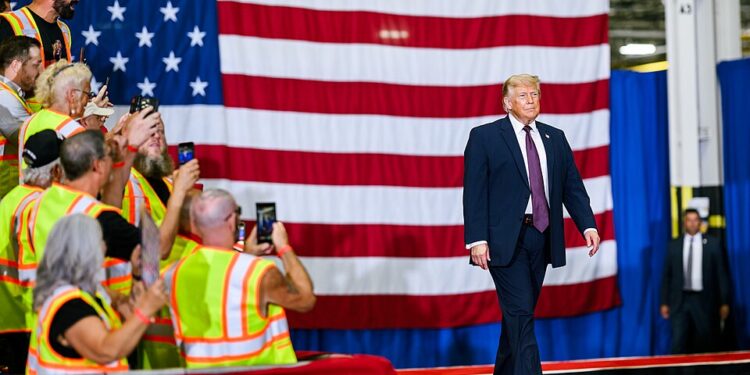
President Donald Trump is facing another round of criticism over his poll numbers as Republicans prepare for a crucial midterm election that could determine control of Congress.
CNN political analyst and New York Times reporter Maggie Haberman offered a particularly harsh assessment Monday, declaring that Trump is struggling across the polling landscape and remains vulnerable on an issue affecting millions of American households: affordability.
During an appearance on CNN’s “The Source” with Kaitlan Collins, Haberman argued that the numbers paint a difficult picture for the president.
“There is no polling where this president is popular. Let’s put it that way,” Haberman said.
She then turned to Americans’ concerns about everyday expenses.
“And there is no polling where he is not in trouble on the issue of affordability,” she added.
The comments represent the latest criticism from a journalist who has repeatedly clashed with Trump over her coverage of his presidency.
But beyond their long-running feud, the polling discussion raises a larger question for Republicans: Can Trump energize conservative voters enough to overcome concerns about prices, the economy and the ongoing conflict with Iran?
Trump Faces Difficult Poll Numbers
Collins cited CNN polling showing Trump with a net approval rating of negative 32 percentage points.
The Republican Party as a whole performed better in the same polling, registering a net rating of negative 21 points.
Other recent surveys have also indicated that Trump’s approval rating has fallen as the country approaches the midterm elections.
That does not mean the outcome in November has been decided.
Polls represent a snapshot of public opinion at a particular moment, and voter attitudes can shift considerably as an election approaches. Different surveys can also produce different results depending on methodology, timing and the voters being measured.
Haberman herself acknowledged that public polling does not always match private polling she has reviewed.
Still, she argued that one issue continues to present a serious challenge for the White House.
Affordability Becomes a Midterm Battleground
The cost of living could emerge as one of the defining issues of the midterm elections.
American families continue paying close attention to grocery bills, housing expenses, healthcare costs, energy prices and other everyday necessities.
That makes the political debate over “affordability” especially important for Republicans representing competitive congressional districts.
Haberman pointed to a White House healthcare event earlier Monday where administration officials repeatedly emphasized affordability.
She suggested that the focus reflected the political pressure Republicans are facing.
“That is the kind of thing that Republicans who are in these districts that are embattled do not want to be dealing with,” Haberman said.
Trump has previously pushed back against Democratic attacks on affordability, accusing his political opponents of using the issue to damage his administration.
Republicans now face the challenge of convincing voters that the president’s policies will ultimately strengthen household finances while Democrats attempt to make rising costs a central campaign issue.
For older Americans living on fixed incomes or watching retirement savings closely, those economic arguments could carry particular weight.
Iran War Adds Another Political Challenge
The economy is not the only major issue hanging over the midterm elections.
The conflict with Iran has stretched into its sixth month, creating another potential political vulnerability for the administration.
Foreign policy can quickly influence domestic politics when military operations affect energy markets, federal spending or Americans’ confidence about the direction of the country.
Trump and his supporters can argue that a strong national defense and an assertive American foreign policy are necessary to protect U.S. interests.
Critics of the administration, meanwhile, are likely to question the costs and duration of the conflict.
How voters ultimately judge the administration’s handling of Iran could become another factor in competitive House and Senate races.
Trump Wants Republicans to Vote Like He Is on the Ballot
Despite concerns about his approval rating, Republican leaders are not abandoning Trump.
Quite the opposite.
The president remains the dominant figure in the Republican Party and has enormous influence with the conservative voters Republicans need to turn out in November.
Trump has urged supporters to treat the midterms almost as though he were personally running.
He told voters to pretend he is “on the ballot” when they enter the voting booth.
The message underscores a familiar problem for Republicans: Trump has demonstrated an extraordinary ability to generate enthusiasm when he is a candidate, but translating that enthusiasm to other Republican candidates can be more complicated.
That could make turnout among Trump supporters one of the biggest variables of the election.
If conservative voters stay home because Trump is not personally on the ballot, vulnerable Republicans could pay the price.
If those voters turn out in large numbers, however, the political landscape could look very different from what current approval polls suggest.
Haberman and Trump Have Battled for Years
Haberman’s latest remarks are unlikely to improve her relationship with the president.
Trump and the New York Times journalist have engaged in a bitter public feud stretching back years.
The president has repeatedly accused Haberman of unfair and inaccurate reporting about him. He has also attacked her personally and used an insulting nickname when discussing her work.
Their dispute recently erupted again following a New York Times report concerning Trump’s plans surrounding the 25th anniversary of the Sept. 11 terrorist attacks.
The Times reported that Trump planned to skip the New York City anniversary ceremony and attend the Irish Open after organizers rejected a request for him to speak at the commemoration.
Political speeches at the Ground Zero anniversary ceremony have been prohibited by the National September 11 Memorial & Museum since 2012.
Trump responded by fiercely attacking Haberman’s credibility.
“She’s been falsely writing about me for years,” Trump wrote, while accusing her of producing “fake reporting” about him.
Trump is nevertheless expected to participate in a Sept. 11 memorial service at the Pentagon, according to the Times, while Vice President JD Vance is expected to represent the White House at the New York ceremony.
Polls Versus Voters
Haberman’s comments will undoubtedly generate attention, especially given her history with Trump.
But Republicans have a larger concern than what one journalist says on CNN.
They need votes.
Polls can reveal weaknesses, identify issues that concern Americans and provide campaigns with valuable information. They cannot determine an election months in advance.
Trump has repeatedly defied political predictions throughout his career, and his supporters have often argued that traditional polling fails to capture the intensity of his political base.
The real test will arrive when Americans cast their ballots.
Republicans will be counting on concerns about border security, crime, taxes, government spending, national defense and other conservative priorities to motivate voters.
Democrats are likely to counter by emphasizing prices, healthcare, the Iran conflict and dissatisfaction with Trump.
That sets up a consequential midterm battle in which control of Congress — and the direction of Trump’s agenda for the remainder of his term — could be at stake.
Haberman may believe the polling is clear.
American voters will have the final say.