
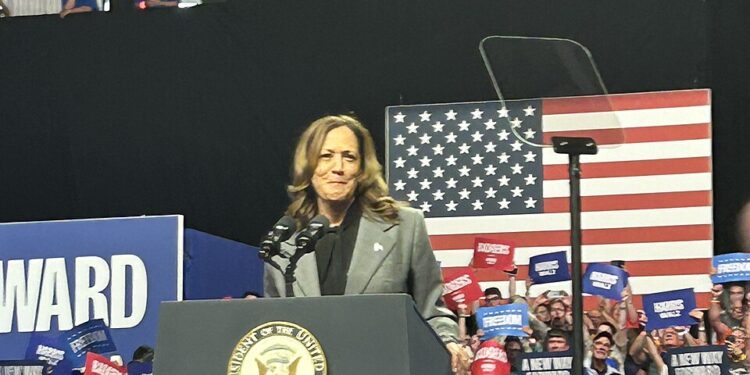
Kamala Harris is returning to the campaign trail in a major battleground state as questions continue to build over whether the former vice president is preparing for another White House run in 2028.
Harris appeared in Detroit on Tuesday alongside Democratic U.S. Senate nominee Dr. Abdul El-Sayed, putting herself back in the political spotlight just two years after losing the presidential election to Donald Trump.
The Michigan visit is part of a broader round of midterm campaigning by Harris, who is also expected to appear in other politically important states as Democrats fight for congressional control.
At the center of her Detroit appearance was a roundtable discussion on Black maternal health.
During the event, Harris strongly defended diversity, equity and inclusion initiatives, commonly known as DEI.
“The attack on DEI is an attack on maternal care,” Harris said.
She argued that the debate over DEI could affect healthcare protections for Black women during pregnancy, childbirth and postpartum care.
Harris also connected the issue directly to the 2026 midterm elections and control of the U.S. Senate.
Her appearance comes as she remains under intense scrutiny over her political future.
Harris has not announced a 2028 presidential campaign, but she has acknowledged that she is considering another run, and her increased activity in major political states is drawing attention from Democrats and Republicans alike.
Harris Returns To A Critical Battleground
Michigan carries particular political significance for Harris.
Trump defeated her in the state during the 2024 presidential election, and Democrats are now fighting to hold an open Senate seat there following Sen. Gary Peters’ decision to retire.
El-Sayed is facing Republican Mike Rogers in the general election.
The contest has become one of the closely watched Senate races of the 2026 campaign, with both parties viewing Michigan as important to the battle for control of the chamber.
Harris’ appearance was also aimed at helping Democrats move beyond divisions that emerged during the party’s contentious Senate primary.
El-Sayed defeated Rep. Haley Stevens to capture the Democratic nomination.
Now Democratic leaders are attempting to unite the party around him ahead of November.
An Awkward History Between Harris And El-Sayed
The political partnership between Harris and El-Sayed comes with some baggage from the 2024 presidential campaign.
El-Sayed supported Michigan’s “uncommitted” movement during the 2024 Democratic presidential primary.
The movement was organized in opposition to the Biden administration’s handling of the Israel-Hamas war and encouraged Democrats to vote “uncommitted” rather than support President Joe Biden.
Harris was Biden’s vice president at the time.
After Biden later withdrew from the presidential race and Harris became the Democratic nominee, El-Sayed ultimately endorsed her.
Their public appearance Tuesday appeared designed, in part, to demonstrate that those past disagreements would not prevent them from working together during the 2026 campaign.
Harris even joked about their relationship as the roundtable concluded.
“I think we are at the point of our new relationship where I can call you Abdul,” Harris said.
El-Sayed responded that he would continue calling her “Madame Vice President.”
Democrats Try To Unite In Michigan
El-Sayed’s campaign has faced the challenge of bringing together different factions of Michigan’s Democratic coalition following a difficult primary.
Harris’ visit placed one of the Democratic Party’s most recognizable national figures alongside the Senate nominee as the party attempts to consolidate support ahead of Election Day.
El-Sayed said Harris’ appearance was about Democratic unity.
The two participated in an hourlong discussion at Birth Detroit focused on maternal health and other policy issues.
Michigan also presents Harris with an opportunity to reconnect with voters in a state that proved difficult for her during the 2024 presidential election.
Disagreements over U.S. policy toward Israel created significant tensions among Democratic voters in Michigan, particularly within the state’s large Arab American community.
El-Sayed has taken positions on Israel that differ substantially from those Harris supported while serving in the Biden administration.
Despite those differences, the two are now campaigning together.
Harris Steps Back Into The National Spotlight
The timing of Harris’ renewed political activity is likely to keep speculation about 2028 alive.
She is campaigning for Democratic candidates in several politically important states, including Michigan, Nevada and Georgia.
Her allies say her immediate focus is helping Democrats in the midterms.
At the same time, Harris has not ruled out seeking the presidency again.
The Associated Press reported that Harris is weighing another presidential campaign while stepping up her involvement in the 2026 elections.
That means virtually every major campaign appearance could be examined for clues about her longer-term plans.
Michigan is especially noteworthy because the state could once again play an important role in the Democratic presidential nominating process.
For Harris, campaigning there provides an opportunity to remain visible with Democratic activists, elected officials and voters well before the next presidential election.
Harris Takes Aim At Trump
After the Detroit roundtable, Harris also sharply criticized President Trump over restrictions involving several news organizations and White House access.
She called the situation “abhorrent” and accused Trump of attempting to interfere with journalists’ ability to report on the federal government.
The dispute adds another national political issue to Harris’ return to the campaign trail.
Her comments also demonstrate that she is increasingly willing to directly confront Trump as she resumes a more visible role in Democratic politics.
The 2028 Question Isn’t Going Away
Harris’ political future remains unsettled.
She has not formally entered the 2028 presidential race, and the next presidential election is still more than two years away.
But her return to battleground-state campaigning ensures that questions surrounding another Harris presidential campaign are unlikely to disappear anytime soon.
Her Michigan trip allows her to accomplish several political objectives at once: support a Democratic Senate candidate, reconnect with important voting groups, raise her national profile and maintain relationships in a state that could matter again in a future presidential primary.
Whether Harris ultimately decides to pursue the White House again remains unknown.
For now, however, one thing is clear: Kamala Harris is moving back into the center of Democratic politics — and her actions are already attracting attention ahead of 2028.